Table of Contents
- What Does Global Research Reveal About HR Technology Value Realization?
- Why Does HR Technology Investment Not Always Deliver Expected Value?
- How Should Enterprises Measure HR Technology ROI?
- How Can Organisations Evaluate HR Transformation Outcomes?
- What Do the Stages in the Evolution of HR Technology Mean for Value?
- Why Is Integration Important to HR Technology Value Realization?
- How Can Leaders Improve HR Technology Value Realization?
- How Can Rolling Arrays Help Organisations Assess HR Technology Value?
- Frequently Asked Questions
Resources > Blog > The State of HR Technology Value Realization: Global Research and Enterprise Insights
The State of HR Technology Value Realization: Global Research and Enterprise Insights
November 23, 2026
What Does Global Research Reveal About HR Technology Value Realization?
Gartner reported in June 2024 that only 24% of HR employees surveyed believed their organisation’s HR function was maximising business value from HR technology. Its survey of 85 HR leaders also found that only 35% were confident their current approach to HR technology supported business objectives.
Source: Gartner research on HR technology business value.
Deloitte’s 2025 Global Human Capital Trends research, which surveyed nearly 10,000 business and HR leaders across 93 countries, highlights another important consideration. Technology investments increasingly aim to help people perform better and create new forms of value, rather than simply automate existing tasks.
Source: Deloitte research on the changing value case for HR technology.
ISG’s 2025 HR technology survey reported that 52% of respondents measured HR technology ROI, compared with 46% in its previous survey. The findings also highlight integration as an important factor in value creation.
Source: ISG State of HR Technology and Service Delivery.
These studies use different samples and methodologies, so their percentages should not be treated as directly comparable. Together, however, they reinforce a common business question: how effectively are organisations translating HR technology investments into measurable outcomes?
Why Does HR Technology Investment Not Always Deliver Expected Value?
Several factors can explain this gap.
Technology adoption without process improvement: Digitising an inefficient process may make transactions faster without addressing unnecessary approvals, duplicated activities or unclear accountability.
Limited integration: HR systems often depend on connected applications for payroll, finance, identity management and workforce reporting. Fragmented data flows can limit the value of individual platforms.
Unclear business objectives: When organisations define success primarily through delivery milestones, they may fail to establish measurable expectations for efficiency, service quality or workforce outcomes.
Underused capabilities: Employees and managers may continue using manual workarounds even when the technology offers more effective ways to complete tasks.
Weak outcome measurement: Without reliable baseline data and clear ownership, organisations struggle to determine whether improvements resulted from the technology, process changes or other business factors.
These challenges show why value realization requires coordinated decisions across business processes, technology, people and governance.
How Should Enterprises Measure HR Technology ROI?
A useful assessment starts with a defined baseline and distinguishes measurable financial benefits from broader improvements in workforce and business performance.
Financial outcomes
Financial measures may include reduced administrative costs, lower expenditure on overlapping systems, decreased external support costs and savings from retiring redundant applications.
Organisations should distinguish realised savings from projected benefits. A reduction in processing time, for example, does not automatically translate into a cash saving unless it changes staffing requirements, spending or the capacity to deliver additional work.
Operational outcomes
Operational measures help leaders assess whether the technology improves the way HR and business teams work.
Examples include transaction processing time, error rates, data correction effort, service request volumes, payroll related exceptions and time spent on manual activities.
Workforce and business outcomes
Some technology investments aim to improve manager effectiveness, employee experience, workforce planning or access to better talent insights.
These outcomes may require different measures, such as employee service satisfaction, manager self service adoption, workforce data quality or improvements in decision making.
Deloitte’s research reinforces the importance of assessing technology value beyond straightforward efficiency gains, particularly when investments aim to augment human capabilities.
The right measures depend on the business case. Organisations should avoid assigning a financial value to every improvement when the evidence does not support it.
How Can Organisations Evaluate HR Transformation Outcomes?
Leaders should examine whether the transformation has changed the way HR services operate and whether those changes support business priorities.
Start with the original objectives. If the transformation aimed to standardise processes across countries, assess process consistency, local exceptions and service performance. If it aimed to improve workforce decisions, assess data availability, reporting quality and how decision makers use the information.
Next, compare results with the baseline. Review whether the expected improvements occurred, how much progress the organisation achieved and which factors influenced the results.
Finally, establish accountability. Business owners should understand which outcomes they own, what evidence demonstrates progress and what action is required when results fall short.
This approach helps organisations distinguish between successful technology delivery and successful business transformation.
What Do the Stages in the Evolution of HR Technology Mean for Value?
This evolution changes how organisations should evaluate value.
Administrative digitisation: Early systems helped organisations record employee information, manage transactions and reduce dependence on paper based processes. Value centred on accuracy, accessibility and administrative efficiency.
Integrated HR platforms: Enterprise HR systems brought processes and data together across areas such as employee administration, recruitment and talent management. Value increasingly depended on integration, process consistency and a reliable source of workforce information.
Cloud based and employee centred technology: Cloud platforms and self service capabilities expanded access and made ongoing platform development easier to consume. Value increasingly depended on user adoption, employee experience and effective process design.
Analytics and AI enabled HR: Modern capabilities can support workforce insights, decision making and the augmentation of human work. Value now also depends on data quality, responsible use, redesigned workflows and the ability to measure improvements in human and business performance.
These stages are a broad conceptual progression, not a universal sequence followed by every organisation. Many enterprises operate a mixture of legacy applications, integrated platforms and newer capabilities.
The important implication is that technology maturity alone does not determine business value. Each stage creates different opportunities, dependencies and measurement requirements.
Why Is Integration Important to HR Technology Value Realization?
Employee data may move between HR, payroll, finance, learning and workforce planning systems. If these applications operate with inconsistent data, disconnected workflows or duplicated records, employees and managers may continue to rely on manual work.
Integration can improve the consistency of information, reduce reconciliation effort and support decisions across business functions.
However, integration should address a defined business need. Connecting every application without reviewing process ownership, data standards and system responsibilities can introduce additional complexity.
Organisations should prioritise integrations according to business impact, data criticality and the outcomes they expect to achieve.
They should also measure whether integration improves operational performance rather than assuming that a more connected technology landscape automatically creates value.
How Can Leaders Improve HR Technology Value Realization?
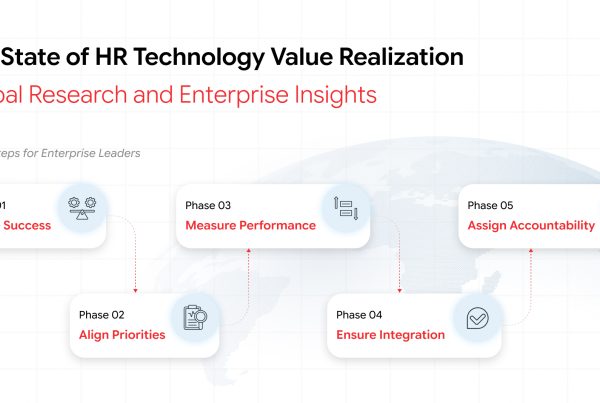
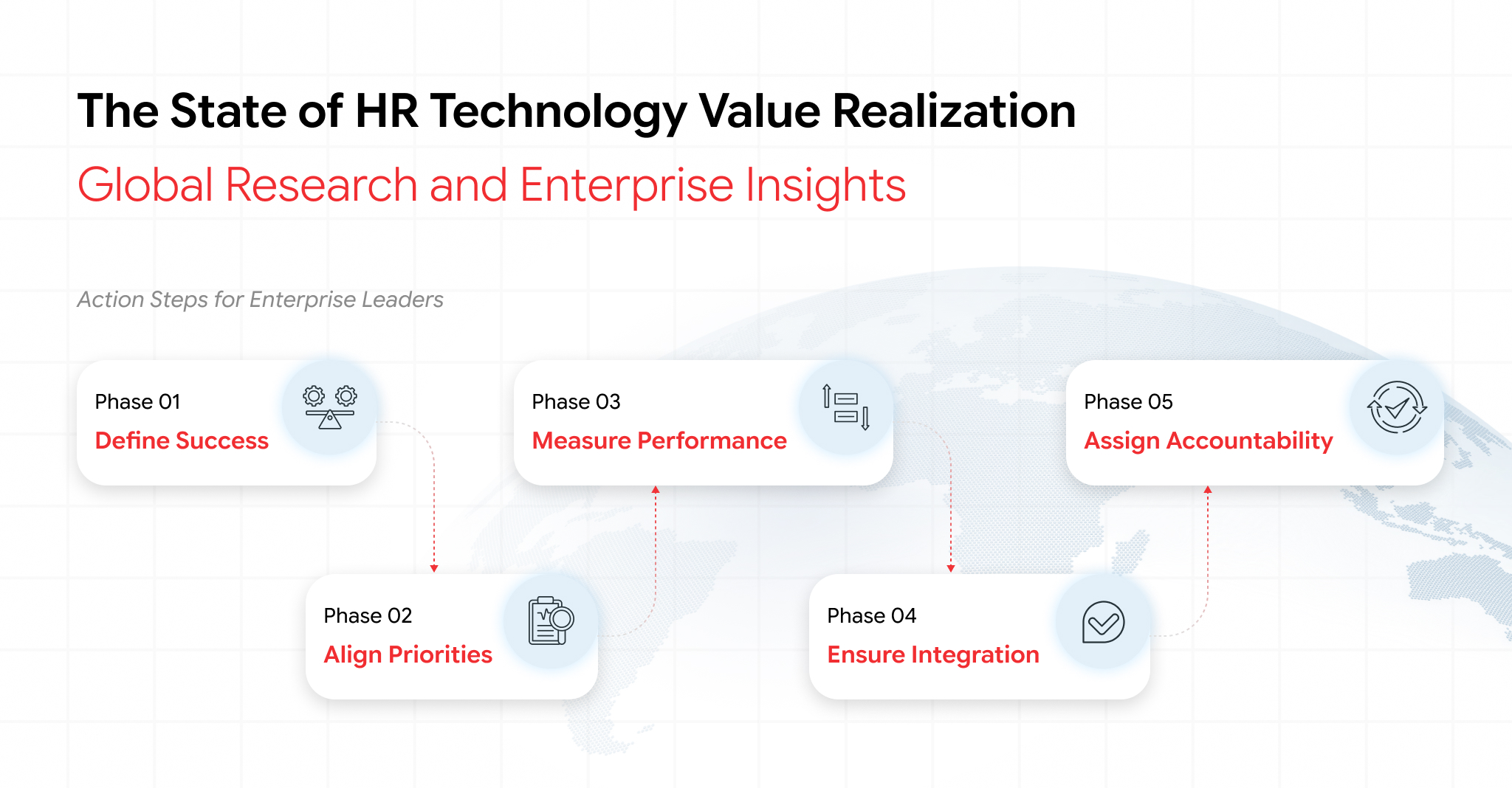
Define success before investing. Establish business objectives, baseline measures and clear expectations before selecting or implementing technology.
Connect technology decisions with business priorities. Evaluate capabilities according to the problems they solve and the outcomes they enable, not simply the number of features available.
Measure adoption and performance together. Adoption helps explain whether employees use the technology, while operational and business measures show whether that use delivers meaningful results.
Review integration and process design. Address process inefficiencies, data quality issues and unnecessary complexity that limit the value of the technology.
Reassess value over time. Business requirements, platform capabilities and workforce needs change. Review performance regularly and update priorities as new opportunities emerge.
Assign accountability. HR, IT, Finance and business leaders should agree on who owns each outcome and how they will evaluate progress.
These practices help organisations treat HR technology as an ongoing business investment rather than a project that ends at go live.
How Can Rolling Arrays Help Organisations Assess HR Technology Value?
Rolling Arrays helps enterprises assess HR technology choices, evaluate business cases and identify opportunities to improve the value delivered by their HR technology landscape.
A structured assessment can help leaders identify gaps between expected and actual outcomes, prioritise improvement opportunities and connect future technology decisions with business requirements.
The goal is not simply to implement more technology. It is to ensure that technology investments support measurable business priorities and create sustainable value.
FAQ
What is HR technology value realization?
HR technology value realization is the process of achieving and demonstrating the business benefits expected from HR technology investments. It includes financial, operational, workforce and service outcomes.
How is HR technology ROI different from technology adoption?
Adoption measures whether people use a system or capability. ROI evaluates the financial return relative to the investment. Adoption can influence ROI, but usage alone does not prove financial or business value.
How can organisations measure HR technology success?
Organisations should establish baseline measures, define expected outcomes and track relevant indicators such as operating costs, processing time, data accuracy, user adoption and business performance. Measures should reflect the original investment objectives.
Why do HR transformation outcomes differ from implementation success?
Implementation success focuses on delivering the planned technology and scope. HR transformation outcomes focus on whether the organisation improves processes, services, decisions and business performance through the change.
How does integration affect HR technology ROI?
Effective integration can reduce manual work, improve data consistency and support cross functional processes. The financial impact depends on the business problem addressed and the extent to which the improvement reduces costs or creates additional value.
How should organisations evaluate newer HR technology and AI investments?
They should assess the intended business outcome, implementation requirements, data readiness, workflow changes, adoption needs and measurable benefits. Evaluations should account for both efficiency improvements and the potential to enhance human capabilities.
Share with your network