Table of Contents
- Why Do Recruitment Processes Fail Even When Organisations Have Recruitment Teams?
- What Are the Seven Common Hiring Process Failures?
- How Can Organisations Improve Recruitment Process Efficiency?
- How Can Organisations Improve the Effectiveness of Their Recruiters?
- How Does Recruitment Process Improvement Support HR Transformation?
- Conclusion
- Frequently Asked Questions
Resources > Blog > Seven Common Hiring Process Failures and How to Improve Recruitment Decisions
Seven Common Hiring Process Failures and How to Improve Recruitment Decisions
November 06, 2026
Why Do Recruitment Processes Fail Even When Organisations Have Recruitment Teams?
The problem often lies in how the recruitment process operates across teams.
Hiring managers may provide incomplete requirements. Recruiters may receive unrealistic expectations. Interview scheduling may take too long, and decision makers may disagree about what makes a suitable candidate. Even when a strong candidate emerges, delayed approvals or unclear compensation expectations can jeopardise the offer.
These challenges in recruiting employees are not always caused by a lack of recruiter capability. They can reflect broader issues in process design, decision making, accountability and coordination.
Recruitment process improvement therefore requires organisations to examine the entire hiring journey rather than attempting to solve every problem through additional sourcing or recruiter training.
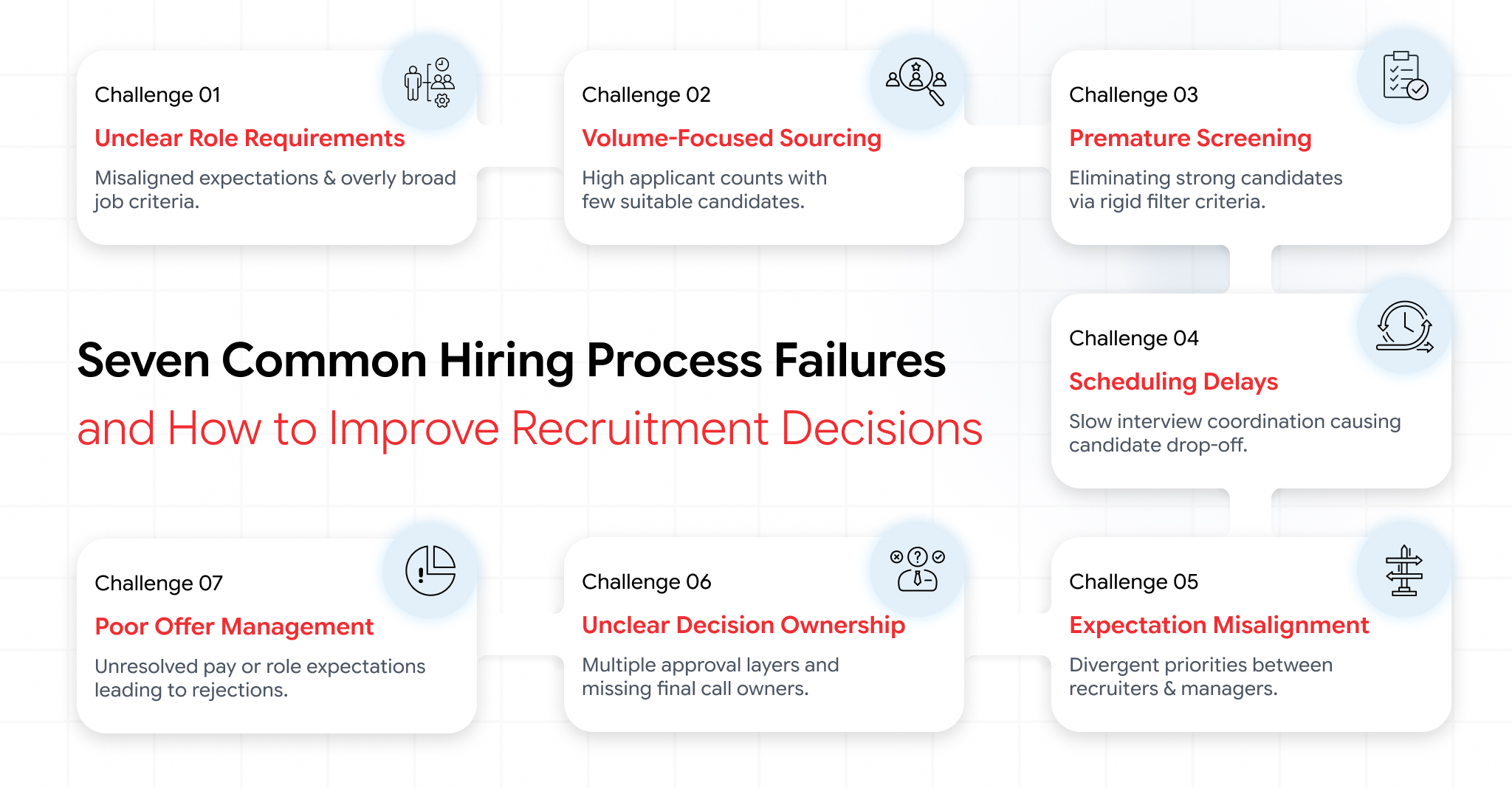
What Are the Seven Common Hiring Process Failures?
1. Unclear Role Requirements Create Misaligned Hiring
Recruitment becomes difficult when hiring managers cannot clearly explain what success in a role looks like.
Job descriptions may contain long lists of qualifications, responsibilities and preferred skills without distinguishing essential requirements from desirable ones. Recruiters then struggle to identify suitable candidates, while applicants receive inconsistent messages about the opportunity.
This creates avoidable screening effort and increases the risk of rejecting candidates who could perform the role effectively.
How to improve it:
Before opening a vacancy, recruiters and hiring managers should agree on the business need, expected outcomes, essential capabilities, experience requirements and realistic compensation range.
They should also identify which requirements are genuinely necessary at entry and which can be developed after hiring.
A clear role brief creates a common reference point for sourcing, screening and selection. It also reduces repeated changes to requirements once recruitment is underway.
2. Recruitment Sourcing Generates Volume Instead of Suitable Candidates
A high number of applications does not necessarily indicate an effective recruitment strategy.
Organisations may rely on the same job boards, agencies or sourcing methods for every vacancy, even when different roles require different approaches. This can produce large applicant pools without generating enough candidates who meet the actual requirements.
Recruiters then spend more time screening unsuitable applications instead of engaging with promising candidates.
How to improve it:
Match sourcing channels to the role, target talent pool, required capabilities and recruitment urgency.
Review which sources generate relevant applicants and which consistently produce candidates who progress through assessment. Where suitable, combine direct sourcing, referrals, professional networks and external recruitment partners.
The objective is to improve the relevance of the candidate pool, not simply increase its size.
3. Screening Decisions Remove Suitable Candidates Too Early
Initial screening helps recruiters manage application volumes, but poorly defined screening criteria can eliminate suitable candidates before their capabilities receive proper consideration.
For example, an overly restrictive experience requirement may exclude candidates with relevant transferable skills. Inconsistent screening practices can also produce different outcomes for candidates with similar qualifications.
This weakens the candidate pipeline before hiring managers have an opportunity to assess relevant evidence.
How to improve it:
Establish clear screening criteria based on essential role requirements. Distinguish mandatory qualifications from preferences, and ensure recruiters understand how to assess relevant experience and transferable capabilities.
Review rejection patterns to identify whether screening criteria are unnecessarily restrictive.
Recruiters should document the reasons for screening decisions so that hiring managers can understand how candidates progress through the process.
4. Recruitment Scheduling Delays Cause Candidate Drop Off
A suitable candidate may lose interest when interviews take too long to arrange or when the organisation repeatedly changes dates.
Delays often occur because interviewers have limited availability, responsibilities are unclear or recruitment teams coordinate schedules through lengthy email exchanges.
Candidates may accept competing offers while waiting for a decision. Recruiters then have to restart sourcing, increasing workload and extending vacancy duration.
How to improve it:
Agree on interviewer availability and decision timelines before interviews begin.
Organisations can establish service expectations for interview feedback, use shared scheduling tools and assign clear responsibility for coordinating each recruitment stage.
Recruitment teams should also communicate proactively with candidates when delays occur.
Faster scheduling does not mean rushing decisions. It means removing administrative delays that do not improve the quality of assessment.
5. Hiring Managers and Recruiters Work Towards Different Expectations
Recruitment often slows when recruiters and hiring managers interpret the same vacancy differently.
A recruiter may prioritise the requirements agreed at the start of the process, while a hiring manager introduces additional expectations after reviewing candidates. Interviewers may also disagree about which capabilities matter most.
These differences lead to repeated searches, conflicting feedback and delayed decisions.
How to improve it:
Create a shared understanding of the role before sourcing begins.
Recruiters and hiring managers should agree on essential criteria, interview responsibilities, decision authority and the process for reviewing candidates who do not meet every preferred requirement.
If the business need changes, the team should document the change and assess its impact on the recruitment plan.
Regular, focused communication helps resolve disagreements before they create further delays.
6. Recruitment Decisions Lack Clear Ownership and Timelines
Even when candidates perform well during assessment, hiring decisions can remain pending because nobody has clear responsibility for making the final call.
Multiple approval layers, unclear decision rights and repeated requests for additional interviews can extend the process without producing meaningful new evidence.
This creates frustration for candidates and recruiters while leaving business teams waiting for the required talent.
How to improve it:
Define who recommends, evaluates, approves and communicates the final hiring decision.
Set reasonable decision timelines for each stage and establish an escalation process when deadlines are missed.
Additional interviews should address a specific evidence gap rather than repeat assessments that have already been completed.
Organisations should also review approval requirements to determine whether every step contributes sufficient value to justify the time involved.
7. Offer Management Fails to Convert Selection into a Successful Hire
Recruitment does not end when the organisation selects a candidate.
Offers can fail when compensation expectations remain unresolved, approvals take too long or the role differs from what the candidate understood during interviews.
In some cases, recruiters discover these concerns only after the formal offer has been issued.
The result is lost candidates, repeated recruitment activity and delayed workforce capacity.
How to improve it:
Discuss compensation expectations, notice periods, role responsibilities and important employment conditions early enough to identify potential mismatches.
Before issuing an offer, confirm internal approvals and ensure that the proposed terms reflect the agreed requirements.
Recruiters should maintain clear communication throughout the offer stage and record reasons for rejection when candidates decline.
Reviewing these patterns helps organisations identify whether problems originate in compensation, decision speed, candidate expectations or another part of the process.
How Can Organisations Improve Recruitment Process Efficiency?
Organisations can map the recruitment journey from vacancy approval through candidate sourcing, screening, assessment, offer and joining. For each stage, they should identify the responsible owner, required inputs, expected completion time and conditions for progression.
This analysis helps distinguish necessary assessment activities from avoidable administrative work.
Recruitment teams can then prioritise improvements based on their impact on business critical vacancies, recruiter capacity and candidate experience.
For example, standardising role approval requirements may reduce repeated clarification. Better scheduling coordination may shorten delays between interviews. Clear decision ownership may prevent completed assessments from remaining unresolved.
Technology can support these improvements through workflow automation, applicant tracking systems, scheduling tools and recruitment analytics. However, automation should follow a clear process rather than reproduce existing inefficiencies in a digital system.
How Can Organisations Improve the Effectiveness of Their Recruiters?
Recruiters need clear requirements, timely hiring manager decisions, appropriate sourcing resources and reliable recruitment systems. When these conditions are absent, even capable recruiters can spend significant time resolving problems outside their control.
Organisations can improve recruiter effectiveness by:
- Providing clear role briefs before recruitment begins.
- Establishing realistic service expectations with hiring managers.
- Giving recruiters access to relevant sourcing channels and tools.
- Clarifying decision authority and escalation procedures.
- Reviewing workload distribution and vacancy complexity.
- Using recruitment analytics to identify recurring process constraints.
- Providing regular feedback and targeted development.
Recruiter performance should be assessed using a balanced view of efficiency, candidate experience, hiring manager feedback and recruitment outcomes. Comparing recruiters only by vacancy volume or time to fill can encourage behaviour that prioritises speed over suitability.
The objective is to create an environment where recruiters can focus on finding and securing suitable talent rather than repeatedly compensating for process failures.
How Does Recruitment Process Improvement Support HR Transformation?
For example, unclear hiring requirements may reflect gaps in workforce planning. Repeated approval delays may reveal governance problems. Fragmented recruitment data may prevent leaders from understanding hiring demand and capacity.
HR leaders should evaluate these issues in the context of their wider transformation priorities.
For a broader perspective on sequencing transformation priorities, read our guide to the HR Transformation Roadmap. It explores what organisations should expect as they progress through HR transformation over the first 36 months.
Connecting recruitment improvement with the wider HR transformation roadmap helps organisations prioritise changes that support business requirements, improve operational effectiveness and strengthen the overall employee journey.
What Happens When Value Realization Becomes Continuous?
HR leaders can use performance data to decide where to optimize processes, activate existing capabilities, improve adoption, or introduce new technology.
This creates a shift from “Did we implement the system?” to “Are we getting the value we expected from it?”
FAQ
What Are the Most Common Recruitment Process Problems?
Common problems include unclear role requirements, ineffective sourcing, restrictive screening criteria, interview scheduling delays, misalignment between recruiters and hiring managers, slow decisions and unsuccessful offer management.
How Can Organisations Improve Their Recruitment Process?
Organisations can improve recruitment by clarifying role requirements, selecting appropriate sourcing channels, standardising screening criteria, reducing administrative delays, assigning decision ownership and reviewing recruitment outcomes.
What Is Hiring Process Optimization?
Hiring process optimization involves identifying and removing unnecessary delays, repeated work and inconsistent practices while preserving the assessments and controls needed to make sound hiring decisions.
How Can Recruiters Improve Recruitment Efficiency?
Recruiters can improve efficiency through better role planning, relevant sourcing strategies, clear communication, consistent workflows, effective scheduling and recruitment analytics that identify recurring bottlenecks.
How Can Organisations Improve the Effectiveness of Their Recruiters?
Organisations can improve recruiter effectiveness by providing clear requirements, appropriate resources, timely decisions, defined responsibilities and balanced performance measures that reflect both recruitment efficiency and hiring outcomes.
What Role Does Technology Play in Recruitment Process Improvement?
Recruitment technology can automate administrative tasks, support candidate tracking, improve scheduling and provide visibility into recruitment performance. Its effectiveness depends on process clarity, reliable data, appropriate configuration and consistent adoption.
Share with your network