Table of Contents
- What Is Global Payroll Compliance?
- Which International Payroll Requirements Should Employers Review?
- How Do Payroll Compliance Requirements Differ Across Countries?
- Why Is APAC Payroll Compliance Challenging for Multinational Organisations?
- How Can HR Systems Support International Payroll Compliance?
- What Should a Global Payroll Compliance Framework Include?
- How Can Organisations Reduce Global Payroll Compliance Risks?
- How Can Rolling Arrays Help Organisations Strengthen Payroll Governance?
- Frequently Asked Questions
Resources > Blog > Global Payroll Compliance: A Guide to Country Requirements, HR Systems and Statutory Reporting
Global Payroll Compliance: A Guide to Country Requirements, HR Systems and Statutory Reporting
November 25, 2026
What Is Global Payroll Compliance?
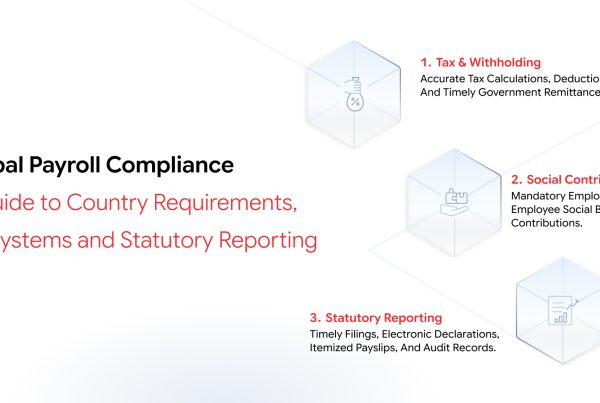
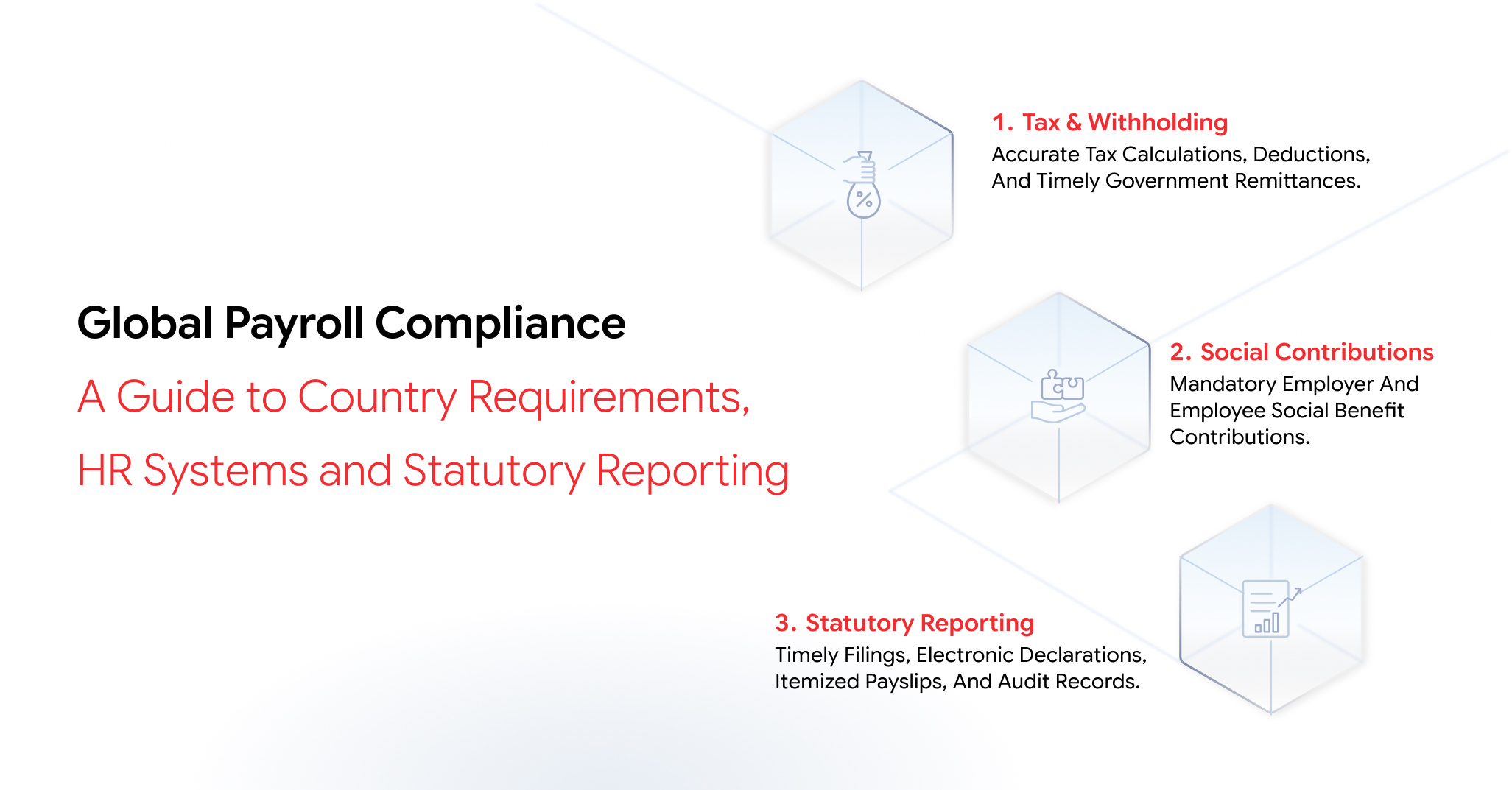
These obligations can cover salary calculations, income tax withholding, employer and employee social security contributions, payslips, payroll records, statutory reporting and employment related payments.
The exact requirements depend on local legislation, employee circumstances and the organisation’s operating structure.
For multinational employers, compliance involves more than calculating salaries correctly. Organisations must also maintain reliable records, submit required information to the relevant authorities and demonstrate that their payroll processes follow applicable rules.
A central payroll policy can establish common controls, but local requirements still need appropriate attention.
Which International Payroll Requirements Should Employers Review?
Tax withholding and reporting
Employers may need to calculate and withhold income tax, remit payments to tax authorities and report employee earnings within prescribed deadlines.
Rules can differ according to employee residency, compensation type, employment location and other circumstances. International assignments can introduce additional considerations when employees work across borders.
Social security and statutory contributions
Many jurisdictions require employer contributions, employee deductions or both. These may fund retirement, social insurance, healthcare or other statutory schemes.
Payroll teams must understand contribution eligibility, calculation rules, applicable thresholds and payment deadlines in each country.
Employment law and wage requirements
Local rules may govern minimum wages, overtime, leave payments, salary frequency, deductions, final settlements and itemised payslips.
Employers must ensure their payroll calculations reflect the applicable employment requirements rather than relying exclusively on global payroll templates.
Statutory reporting and record keeping
Authorities may require periodic payroll declarations, annual employment income statements, contribution reports and supporting employee records.
Organisations should establish who prepares each submission, who validates the information, who approves it and who retains evidence of completion.
Employee classification and cross border employment
Employment arrangements involving contractors, expatriates, remote workers or employees assigned to another country can introduce additional tax and employment obligations.
Organisations should assess these arrangements before payroll begins, rather than assuming that the employee’s contractual location alone determines the applicable requirements.
How Do Payroll Compliance Requirements Differ Across Countries?
Organisations should maintain a country compliance register that identifies applicable obligations and the official sources used to verify them.
Singapore
Singapore employers may need to manage Central Provident Fund contributions for eligible employees, employment income reporting and employment record requirements.
For example, the CPF Board requires employers to declare wage information accurately when calculating contributions. The Inland Revenue Authority of Singapore requires employers covered by the Auto Inclusion Scheme to submit employment income information electronically by the applicable deadline.
Official guidance:
CPF Board employer obligations
IRAS employment income reporting
India
Employers operating in India need to assess the payroll and employment requirements applicable to their workforce, establishment and location.
Relevant areas can include income tax withholding, provident fund contributions, employee insurance where applicable, professional tax in relevant states, and other statutory payments or reporting obligations.
Because some requirements depend on employee eligibility, establishment characteristics and state level rules, organisations should validate the specific obligations applicable to each employee group and location.
Malaysia
Employers operating in Malaysia need to consider applicable income tax deductions and reporting, Employees Provident Fund contributions, Social Security Organisation obligations and employment related requirements.
Eligibility, contribution calculations and reporting obligations may vary by employee circumstances and the applicable legislation. Payroll teams should verify current requirements through the relevant Malaysian authorities.
Other APAC markets
Countries such as Australia, Indonesia, Japan, the Philippines, South Korea, Thailand and Vietnam have their own tax, social security, employment and reporting frameworks.
Organisations should avoid assuming that a process validated in one APAC market can be replicated unchanged across the region.
For current country specific guidance, use official government sources and qualified local payroll or tax advisers. Requirements can change, so compliance registers should include the date of the latest review and the owner responsible for updates.
Why Is APAC Payroll Compliance Challenging for Multinational Organisations?
Countries differ in their statutory contribution systems, reporting calendars, employment requirements, data formats and administrative procedures. Some organisations also operate several payroll providers and HR platforms across the region.
This can create several challenges.
Fragmented employee data: Different systems may store inconsistent information about compensation, employee status, work location or statutory eligibility.
Different reporting calendars: Each country may have its own filing dates, payment deadlines and reporting cycles.
Limited regional visibility: Regional HR and Finance leaders may struggle to identify overdue submissions, recurring errors or emerging compliance risks across multiple entities.
Provider coordination: Local payroll providers may use different processes, reporting formats and escalation procedures.
Regulatory change: Changes to contribution rules, tax requirements or employment legislation may require updates to payroll calculations, workflows and reporting.
Organisations can address these challenges by standardising governance and reporting where practical while preserving the country specific controls needed for compliance.
For a broader discussion of regional payroll models and provider evaluation, read HR’s Guide to Evaluating Asia Pacific Payroll Solutions.
How Can HR Systems Support International Payroll Compliance?
However, the system must be configured correctly and supported by processes that reflect local requirements. Technology alone cannot guarantee compliance.
Maintain accurate employee data
Payroll calculations depend on reliable employee records, including employment status, compensation, work location and relevant statutory information.
Organisations should define data ownership, validation rules and approval procedures for changes that affect payroll.
Support country specific calculations
Payroll technology should accommodate applicable local rules for earnings, deductions, contributions and reporting.
Where the organisation uses a central HR platform with separate local payroll solutions, teams must validate the data exchanged between systems and confirm that each provider receives the information it needs.
Improve statutory reporting
Appropriate system capabilities can help teams prepare reports, validate payroll data and support submissions to relevant authorities.
Organisations should confirm which reporting activities the software supports, which require additional configuration and which remain the responsibility of a local provider or internal team.
Maintain audit trails
Access controls, approval records, payroll change logs and submission evidence help organisations investigate discrepancies and demonstrate that important controls operated as intended.
These records also help teams identify recurring issues and improve processes.
Monitor regulatory changes
Organisations should establish a process to identify changes in local requirements, assess their impact and update payroll configurations or procedures.
Responsibilities should be clear across HR, Finance, IT, payroll providers and external advisers.
What Should a Global Payroll Compliance Framework Include?
Country compliance register: Document applicable requirements, responsible authorities, reporting frequency, deadlines and evidence requirements for each jurisdiction.
Clear ownership: Assign responsibility for payroll calculations, validation, approvals, statutory submissions, payments and record retention.
Payroll validation controls: Review important payroll changes, statutory calculations, exceptions and reconciliation results before final approval.
Deadline management: Maintain a calendar of required payments, filings and employee communications, with reminders and escalation procedures.
Provider oversight: Define contractual responsibilities, reporting expectations, service standards and escalation routes for outsourced payroll activities.
Change management: Review new legislation and regulatory guidance, assess their impact and document the resulting system or process changes.
Periodic compliance reviews: Evaluate whether controls remain effective, identify unresolved issues and track corrective actions to completion.
These practices help organisations move from reactive issue resolution towards a more consistent and auditable approach to international payroll compliance.
How Can Organisations Reduce Global Payroll Compliance Risks?
First, organisations should identify their highest risk areas. These may include missed statutory deadlines, inaccurate contributions, incomplete employee records, incorrect deductions or insufficient evidence of submissions.
Next, establish preventive controls such as automated validations, approval workflows, exception reports and deadline alerts where the systems support them.
Payroll teams should also reconcile relevant payroll outputs with payment records and statutory submissions. Discrepancies should have an assigned owner, a resolution deadline and documented evidence.
When an error occurs, organisations should assess its impact, determine whether a correction or notification is required and follow the relevant local procedure. The appropriate response depends on the jurisdiction and the nature of the error.
Finally, review recurring issues across countries. Repeated discrepancies may indicate a wider problem with data ownership, system integration, provider responsibilities or compliance governance.
How Can Rolling Arrays Help Organisations Strengthen Payroll Governance?
Rolling Arrays helps organisations evaluate HR technology requirements, assess technology investments and identify opportunities to improve processes and governance.
For multinational organisations, this broader perspective can help clarify how HR systems, payroll solutions, integrations and operational controls should work together to support reliable payroll delivery.
The objective is to build a technology and governance approach that supports local compliance requirements while giving regional leaders better visibility into payroll operations.
FAQ
What is global payroll compliance?
Global payroll compliance means meeting the applicable tax, employment, social security, payment, record keeping and statutory reporting requirements in every country where an organisation employs people.
What are the main international payroll requirements?
Common requirements include accurate salary calculations, income tax withholding, statutory contributions, compliant payslips, timely payments, employee income reporting and retention of required records. Exact obligations depend on local legislation and employee circumstances.
Why is international payroll compliance difficult?
Different countries have different regulations, reporting deadlines, contribution systems and employment rules. Managing multiple providers and disconnected HR systems can make it harder to maintain consistent data and oversight.
How can organisations improve APAC payroll compliance?
Organisations can maintain country specific compliance registers, assign clear ownership, validate payroll data, monitor deadlines, oversee local providers and review regulatory changes. Regional governance should support local compliance rather than replace it.
Can HR systems automate payroll compliance?
HR and payroll systems can support calculations, validations, reporting, reminders and audit trails. However, organisations must verify that the system supports the relevant local requirements and maintain appropriate review and approval controls.
How often should payroll compliance requirements be reviewed?
Organisations should monitor regulatory updates continuously through reliable sources and review country compliance registers regularly. They should also reassess requirements when entering a new country, changing employment arrangements or modifying payroll systems.
What is the difference between global payroll management and global payroll compliance?
Global payroll management covers the broader operation of payroll across countries, including processing, provider coordination and service delivery. Global payroll compliance focuses on meeting the legal and regulatory obligations that apply in each jurisdiction.
Share with your network