
Table of Contents
- What Is the Difference Between HR Standardisation and HR Localisation?
- What Should a Global HR Template Standardise?
- Which HR Processes Should Be Standardised Globally?
- Which HR Processes Should Be Localised?
- How Should Organisations Decide Between Standardisation and Localisation?
- How Much Localisation Is Too Much?
- How Can HR Technology Support Global Standardisation?
- How Should Organisations Govern Local Exceptions?
- A Practical Framework for Global HR Template Design
- Key Takeaways
- Frequently Asked Questions
Resources > Blog > Global HR Template vs Localisation: How Much Should You Standardise?
Global HR Template vs Localisation: How Much Should You Standardise?
October 02, 2026
A single global HR model can create consistency, simplify technology, improve reporting, and support governance. But applying exactly the same processes everywhere can create problems when countries operate under different employment regulations, labour markets, cultural expectations, and business requirements.
The answer is not choosing between global standardisation and local adaptation. It is designing an HR model where global standards provide the foundation while local requirements shape the appropriate implementation.
Deloitte’s research similarly describes the challenge as balancing global integration with local optimisation, highlighting the need for common standards and platforms alongside flexibility for local markets.
What Is the Difference Between HR Standardisation and HR Localisation?
HR localisation means adapting those elements where local regulations, market conditions, culture, or business requirements require a different approach.
The distinction is important because neither extreme works well for every organisation.
Too much standardisation can create processes that do not fit local requirements.
Too much localisation can result in duplicated processes, fragmented data, inconsistent employee experiences, and unnecessary technology complexity.
The objective is to determine what should be common and what genuinely needs to be different.
What Should a Global HR Template Standardise?
Real-world scenario
Consider a global organisation operating across 20 countries.
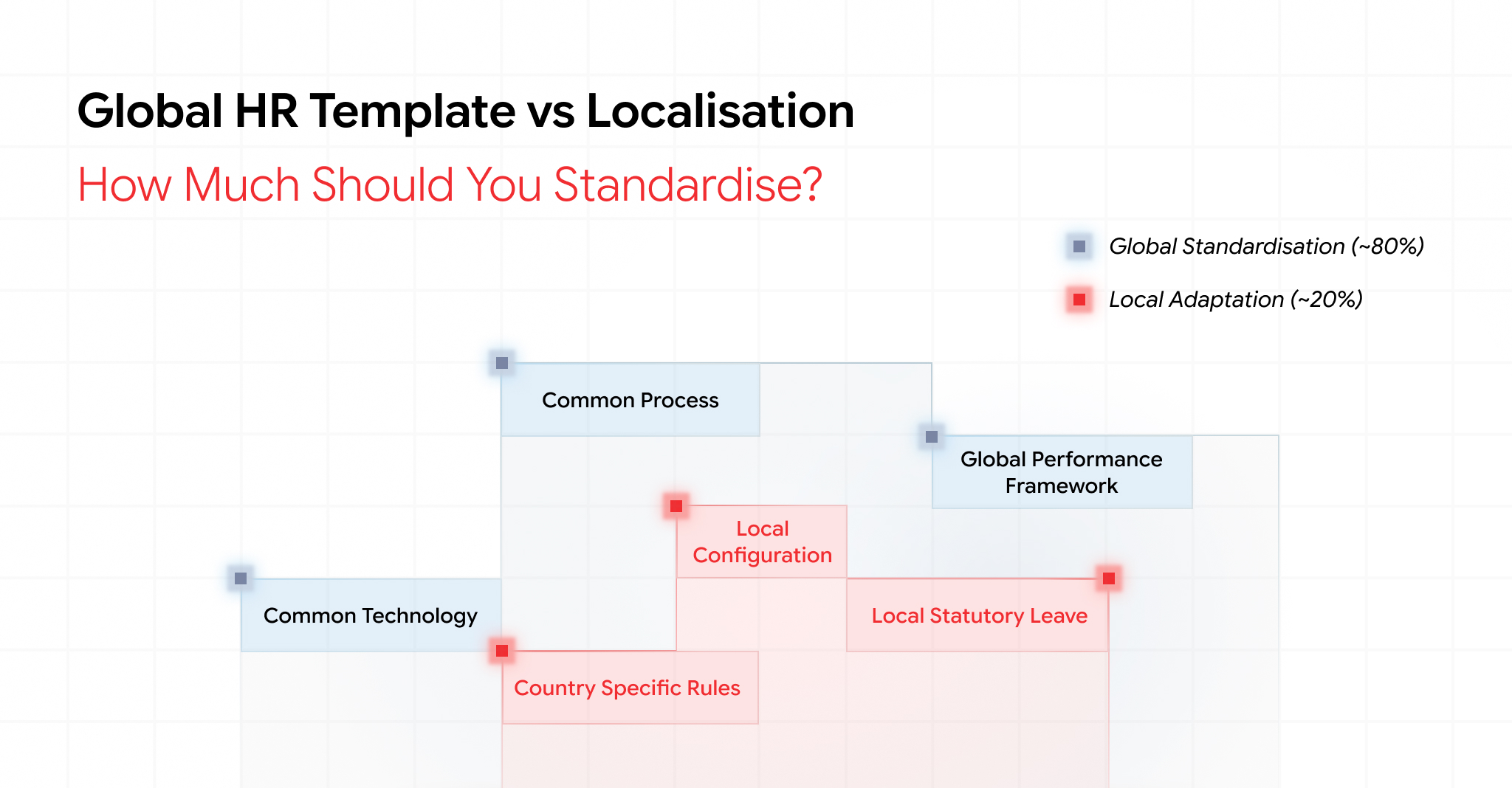
It can standardise its core performance management process by using one global performance cycle, common goal-setting principles, standard performance categories, and a shared technology workflow.
However, the organisation may need to localise statutory leave policies because entitlement, eligibility, carry-forward rules, and approval requirements can differ by country.
The global model therefore remains consistent:
Global Performance Framework → Common Process → Common Technology
while allowing:
Local Statutory Leave → Country Specific Rules → Local Configuration
This approach gives the organisation consistency where it matters while avoiding unnecessary standardisation where local requirements genuinely differ.
Which HR Processes Should Be Standardised Globally?
These may include:
- Core performance management
- Employee data structures
- Organisation and job structures
- HR reporting definitions
- Core talent processes
- HR technology workflows
- Access and security principles
- Governance frameworks
For example, a multinational organisation can use one global performance management framework while allowing country specific statutory requirements to be configured separately.
The principle is simple:
Standardise the process where consistency creates value. Localise only where a genuine requirement exists.
Which HR Processes Should Be Localised?
These may include:
- Statutory leave
- Payroll
- Tax requirements
- Employment regulations
- Benefits
- Labour requirements
- Data protection obligations
- Local language requirements
For example, a global organisation may use one common employee data model across all countries but configure different statutory leave entitlements for each market.
The technology and governance remain global, while the legally required rules remain local.
How Should Organisations Decide Between Standardisation and Localisation?
For each variation, organisations should ask:
- Is the difference legally required?
- Does it address a genuine business requirement?
- Can the global process accommodate the requirement through configuration?
- Would standardisation create a material employee or operational problem?
- What additional technology or maintenance complexity would localisation create?
This creates a more disciplined approach to global HR design.
A local team requesting a different workflow because “we have always done it this way” should not automatically receive a separate process.
A country requiring a different statutory leave calculation because of local legislation is a fundamentally different case.
How Much Localisation Is Too Much?
For example, imagine a global organisation with 30 countries. If each country maintains a different performance process, employee data structure, approval workflow, and reporting definition, the organisation may end up operating 30 HR models rather than one global model with controlled variations.
This can create:
- Higher technology complexity
- Fragmented reporting
- Increased maintenance
- Inconsistent employee experiences
- Greater governance effort
- Difficult global system upgrades
The objective should therefore be controlled localisation, not complete uniformity or unrestricted local freedom.
How Can HR Technology Support Global Standardisation?
For example:
- Global: Performance management process, employee data structure, workflow and reporting
- Local: Statutory leave rules, payroll requirements and country specific benefits
This allows organisations to maintain a common technology architecture while configuring legitimate local requirements.
The key is to avoid using technology configuration to preserve every historical local process.
How Should Organisations Govern Local Exceptions?
Organisations can establish an exception framework that records:
- The local requirement
- Why the global standard cannot meet it
- Whether the requirement is legally or commercially necessary
- The technology impact
- The operational impact
- The owner of the exception
- When the exception should be reviewed
For example, if a country requires a different leave calculation because of legislation, the variation can be formally documented and configured.
If another country requests a different approval workflow simply because managers are accustomed to it, the organisation can assess whether that variation is actually necessary.
This turns localisation from an informal negotiation into a governed business decision.
A Practical Framework for Global HR Template Design
1. Define the global principles
Establish the processes, data, technology, and governance elements that should be consistent.
2. Map country requirements
Identify legal, regulatory, operational, and market specific requirements.
3. Separate requirements from preferences
Distinguish genuine local needs from historical ways of working.
4. Design controlled variations
Determine where local configuration or process variation is appropriate.
5. Establish governance
Create a clear approval process for local exceptions.
6. Measure the model
Monitor adoption, compliance, process efficiency, technology complexity, and employee experience.
7. Review periodically
Local requirements and business priorities change. The global model should evolve accordingly.
Key Takeaways
- Global HR standardisation and local HR localisation should work together.
- A global HR template should standardise areas where consistency creates business value.
- Localisation should address genuine legal, regulatory, cultural, and market requirements.
- The 80/20 concept can provide a useful starting point but should not become a rigid rule.
- Global technology platforms can provide common foundations while supporting controlled local configuration.
- Governance is essential to prevent unnecessary local variations.
- The objective is a global HR model that provides both scale and local relevance.
FAQ
What is a global HR template?
A global HR template is a common framework of HR processes, policies, data structures, technology, governance, and service principles designed to provide consistency across countries.
What is HR localisation?
HR localisation is the adaptation of global HR processes or technology to address country specific legal, regulatory, cultural, workforce, or business requirements.
What is the difference between standardisation and localisation of HRM practices?
Standardisation creates common HR practices across markets, while localisation adapts those practices to meet legitimate local requirements. Effective global HR models combine both approaches.
How much should HR processes be standardised globally?
There is no universal percentage. Organisations should standardise processes where consistency creates value and allow local variation where legal, regulatory, cultural, or business requirements justify it.
How does HR technology support global standardisation?
A global HR platform can provide common data structures, workflows, reporting, security, and governance while allowing controlled local configuration for country specific requirements.
Why is global HR compliance important?
Global HR compliance requires organisations to maintain consistent governance while meeting the employment, payroll, tax, data, and other regulatory requirements applicable in individual countries.
How can organisations prevent excessive localisation?
Organisations can establish global standards, document local requirements, create an exception governance process, and periodically review whether local variations remain necessary.