
Table of Contents
- What Does Hiring for Potential Really Mean?
- Which Skills Can Be Taught?
- What Is a Character Gap?
- Why Hiring for Potential Does Not Mean Hiring Without Standards
- How Should Organisations Assess Potential?
- Why Candidate Personality Assessment Needs Care
- When Should Experience Still Matter More?
- How Can Organisations Identify a Teachable Skill Gap?
- How Does Hiring for Potential Change Recruitment?
- How Does This Connect to Talent Lifecycle Management?
- How Can Organisations Build a Potential Based Hiring Framework?
- From Hiring Experience to Hiring Potential
- Key Takeaways
- Frequently Asked Questions
Resources > Blog > How to Hire for Potential: Teachable Skills vs Character Gaps
How to Hire for Potential: Teachable Skills vs Character Gaps
September 30, 2026
This distinction is becoming increasingly important as organisations hire for roles that continue to change after the job description is written. Technical knowledge, systems experience, and process familiarity can often be developed. The more difficult question is whether a candidate has the behaviours and capacity required to learn, adapt, take ownership, and perform in an unfamiliar environment.
Hiring for potential does not mean ignoring experience or lowering hiring standards. It means understanding which gaps the organisation can develop and which gaps could fundamentally limit success in the role.
What Does Hiring for Potential Really Mean?
A conventional hiring process often starts with experience:
Have they performed this exact role before?
A potential focused approach adds different questions:
- Can they learn the required skills?
- Can they solve unfamiliar problems?
- Do they respond constructively to feedback?
- Can they adapt when circumstances change?
- Do they demonstrate ownership?
- Can they transfer existing capabilities into a new environment?
This does not make experience irrelevant.
Instead, it changes how experience is weighted against future capability.
Which Skills Can Be Taught?
Organisations should separate must have capabilities from teachable skills.
Teachable skills may include:
- Specific software knowledge
- Internal systems
- Company processes
- Product knowledge
- Industry terminology
- Organisation specific workflows
- Certain technical tools
- Reporting methods
If these capabilities can be developed through structured onboarding, training, coaching, or practical experience, requiring them before hiring may unnecessarily narrow the talent pool.
The key question is:
Can the organisation realistically close this gap after hiring?
What Is a Character Gap?
It relates to behavioural patterns that may be difficult to change through conventional training.
Examples can include:
- Lack of ownership
- Persistent unwillingness to learn
- Poor response to feedback
- Lack of accountability
- Consistent inability to collaborate
- Resistance to change
- Poor judgement in situations requiring responsibility
This does not mean these qualities should be treated as fixed or diagnosed through subjective impressions.
The important point is that organisations should assess observable behaviours and evidence, rather than making assumptions about personality.
Why Hiring for Potential Does Not Mean Hiring Without Standards
That is not the objective.
A strong potential based hiring model still establishes non negotiable requirements.
For example:
Must Have
Relevant qualifications, essential technical capability, regulatory credentials, or experience required to perform the role safely and effectively.
Teachable
Specific systems, processes, tools, product knowledge, or domain experience that can realistically be developed.
Potential Indicators
Learning agility, problem solving, adaptability, ownership, curiosity, and response to feedback.
This creates a more disciplined approach than simply removing experience requirements.
How Should Organisations Assess Potential?
Recruitment assessment can include structured methods such as:
- Behavioural interview questions
- Situational scenarios
- Problem solving exercises
- Work samples
- Case studies
- Learning agility exercises
- Structured reference checks
- Role specific assessments
For example, instead of asking whether a candidate considers themselves adaptable, ask them to describe a situation where they had to learn something unfamiliar and apply it to achieve an outcome.
The focus should be on observable evidence.
Why Candidate Personality Assessment Needs Care
A stronger approach is to assess behaviours that are genuinely relevant to the role.
For example, if adaptability is important, assess how candidates responded to changing priorities.
If collaboration matters, explore how they handled disagreement or worked through competing objectives.
If ownership matters, examine examples where they identified a problem and acted without waiting for instructions.
This produces evidence that is more directly connected to the requirements of the role.
When Should Experience Still Matter More?
Some roles require significant prior experience because the cost of the learning curve may be too high.
This can include positions involving:
- Safety critical responsibilities
- Highly regulated activities
- Specialist technical expertise
- Complex legal requirements
- Senior leadership decisions
- Immediate operational responsibility
In these situations, organisations may still assess potential, but proven capability and experience can remain important selection requirements.
The right question is not potential or experience.
It is:
What combination of proven capability and future potential does this role require?
How Can Organisations Identify a Teachable Skill Gap?
Is the skill essential on day one?
If the employee cannot perform the role safely or effectively without it, the requirement may be non negotiable.
Can the skill realistically be learned?
Consider the complexity of the skill, available training, manager capacity, and expected learning curve.
How long can the organisation wait?
A teachable skill still has an acquisition cost. The business needs to determine whether the required learning period fits the role.
Is the candidate demonstrating the ability to learn?
A candidate’s previous learning behaviour can provide evidence about how they may approach a new capability.
How Does Hiring for Potential Change Recruitment?
Instead of searching only for people who have already performed an identical role, organisations can consider candidates with transferable capabilities.
This can expand the talent pipeline while allowing organisations to hire for capabilities that are likely to remain valuable as roles evolve.
However, the approach requires stronger job design and recruitment assessment.
If the organisation does not know which capabilities are essential and which can be developed, recruiters and hiring managers cannot make consistent decisions.
How Does This Connect to Talent Lifecycle Management?
If an organisation hires for potential, it needs the development infrastructure to convert that potential into performance.
The model becomes:
Potential → Hiring → Onboarding → Development → Performance → Career Growth
This means hiring strategy needs to connect with learning, performance management, workforce planning, and career development.
Hiring for potential without investing in development simply transfers the skill gap from recruitment to the post hire environment.
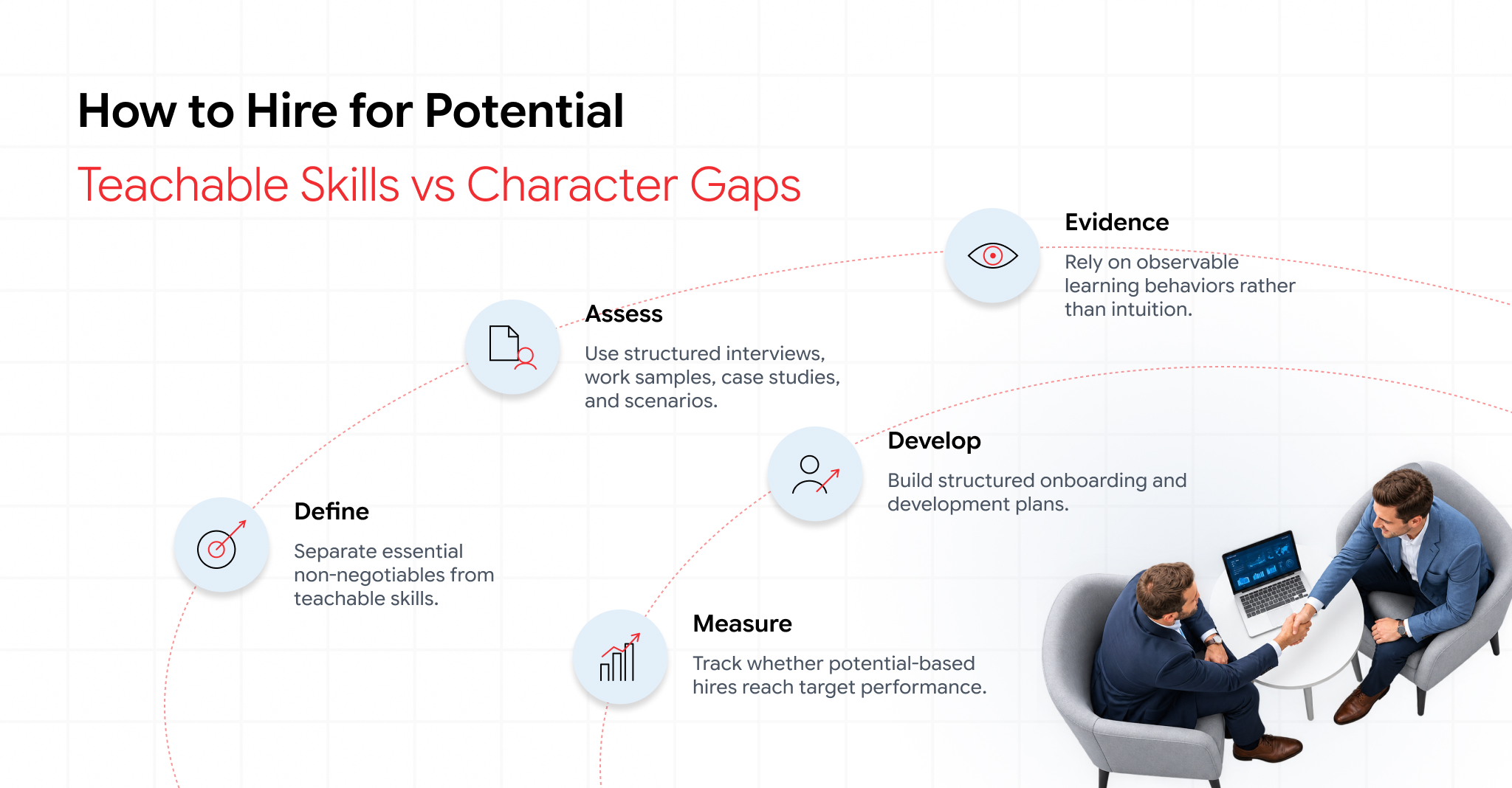
How Can Organisations Build a Potential Based Hiring Framework?
- Define
Separate essential capabilities from teachable skills for each role.
- Assess
Use structured recruitment assessment to evaluate capability, learning behaviour, and relevant experience.
- Evidence
Require candidates to demonstrate behaviours through scenarios, work samples, and structured interviews.
- Develop
Create an onboarding and development plan for the skills that can be built after hiring.
- Measure
Track whether candidates hired for potential actually reach expected performance and productivity.
This final step is particularly important.
The organisation should validate whether its definition of potential is actually producing better hiring outcomes.
From Hiring Experience to Hiring Potential
Potential provides evidence about what the candidate may be capable of learning and delivering next.
Neither should automatically replace the other.
A stronger hiring model determines:
What must the candidate already know?
What can the organisation teach?
What behaviours are essential for success?
What evidence demonstrates those behaviours?
What development investment will be required after hiring?
This moves recruitment away from simply matching resumes to job descriptions and toward making deliberate capability decisions.
Key Takeaways
- Hiring for potential does not mean ignoring experience.
- Organisations should distinguish essential capabilities from teachable skills.
- Character and behavioural gaps should be assessed through observable evidence rather than subjective assumptions.
- Structured recruitment assessment can provide stronger evidence of learning ability and adaptability.
- Some roles still require significant prior experience because the cost or risk of the learning curve is high.
- Hiring for potential must connect with onboarding, learning, performance, and career development.
- Organisations should measure post hire outcomes to determine whether their potential based hiring approach actually works.
FAQ
What does hiring for potential mean?
Hiring for potential means evaluating candidates based on both their existing capabilities and their demonstrated ability to learn, adapt, and develop the capabilities required for future performance.
What is the difference between hiring for potential and hiring for experience?
Hiring for experience places greater emphasis on capabilities candidates have already demonstrated in similar roles. Hiring for potential also considers transferable capabilities, learning ability, adaptability, and future capacity.
What are examples of teachable skills?
Examples can include company systems, internal processes, product knowledge, specific software, reporting methods, and certain technical or industry skills that can realistically be developed after hiring.
How can recruiters assess potential?
Recruiters can use structured interviews, work samples, situational assessments, case studies, problem solving exercises, and evidence from previous learning experiences.
Should organisations stop hiring for experience?
No. Experience remains important for many roles. The appropriate balance depends on the role’s complexity, risk, required day one capabilities, learning curve, and development capacity.
What is a character gap in hiring?
A character gap refers to a persistent behavioural or accountability issue that may be difficult to address through conventional skills training. Organisations should assess observable behaviours rather than make subjective judgements about a candidate’s personality.
Can hiring for potential improve the talent pipeline?
It can broaden the candidate pool by allowing organisations to consider people with transferable capabilities rather than requiring identical previous experience. The approach works best when organisations clearly define essential and teachable capabilities.