
Table of Contents
- Overview
- What Is Quality of Hire?
- Why Traditional Recruitment Metrics Are Not Enough
- How Should Organisations Measure Quality of Hire?
- What Should Be Measured During the First 12 Months?
- Can Quality of Hire Be Measured With One Number?
- How Does Quality of Hire Connect With Business Value?
- How Should Quality of Hire Influence Recruitment Decisions?
- What Is the Relationship Between Quality of Hire and Cost Per Hire?
- How Can Technology Improve Quality of Hire Measurement?
- What Should CXOs Ask About Hiring Quality?
- Building an Enterprise Quality of Hire Framework
- Key Takeaways
- Frequently Asked Questions
Resources > Blog > How to Measure Quality of Hire: From Hiring Decisions to 12 Month Performance
How to Measure Quality of Hire: From Hiring Decisions to 12 Month Performance
September 28, 2026
For enterprise organisations, this distinction matters. A hiring decision creates a workforce commitment that can affect productivity, capability, retention, manager capacity, and future talent costs.
Yet many organisations still measure recruitment primarily through time to hire, cost per hire, offer acceptance, and candidate volume. The measurement gap is significant. SHRM’s 2025 benchmarking data found that only 20% of organisations track quality of hire, despite the growing need to connect recruiting activity with business outcomes. This means many organisations have stronger visibility into the hiring process than into the value created after the hire.
A stronger quality of hire measurement framework follows employees beyond joining and evaluates whether hiring assumptions translate into measurable workforce outcomes over the first 12 months.
What Is Quality of Hire?
Unlike recruitment metrics that measure activity during hiring, quality of hire evaluates the outcome of the hiring decision.
A useful enterprise framework can examine:
- Performance against role expectations
- Time to productivity
- Retention
- Capability development
- Manager assessment
- Achievement of role objectives
- Internal progression
- Business or operational contribution
The exact measures should vary by role, function, and business model.
The objective is not to create one universal score for every employee. It is to establish a consistent framework that connects hiring decisions with workforce outcomes.
Why Traditional Recruitment Metrics Are Not Enough
However, they largely measure what happens before the employee begins contributing.
For example, a recruitment function may reduce time to hire while simultaneously seeing weaker performance or higher early attrition among new hires.
This creates an important distinction:
Recruitment efficiency is not the same as hiring effectiveness.
Enterprise leaders need both.
Recruitment metrics help optimise the hiring process. Quality of hire measurement helps determine whether the resulting workforce is delivering the expected value.
The scale of the investment makes this distinction important. SHRM’s 2025 U.S. benchmark puts average cost per hire at $5,475 for nonexecutive roles and $35,879 for executive roles. Executive hiring is therefore not simply a recruitment transaction; the quality of the resulting appointment can have significant financial implications.
How Should Organisations Measure Quality of Hire?
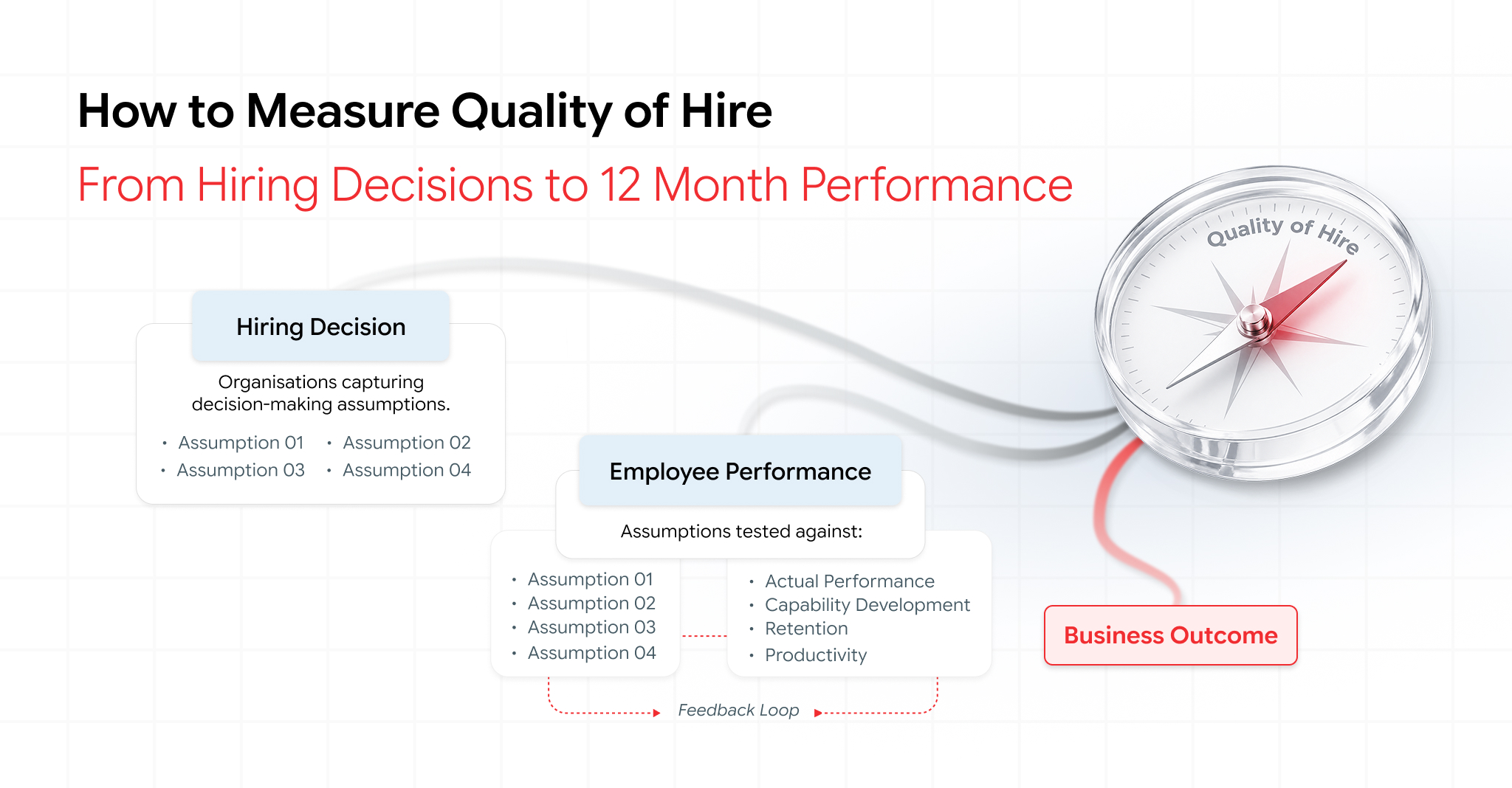
Hiring Decision → Employee Performance → Business Outcome
At the hiring stage, organisations can capture the assumptions behind the decision.
During employment, those assumptions can be tested against actual performance, productivity, retention, and capability development.
This creates a feedback loop that allows organisations to understand which hiring decisions consistently produce stronger outcomes.
What Should Be Measured During the First 12 Months?
First 90 Days: Integration
Measure whether the employee has successfully entered the organisation and established the foundations for productive contribution.
Possible indicators include:
- Role readiness
- Completion of onboarding
- Manager assessment
- Early performance indicators
- Training and capability requirements
Six Months: Contribution
At six months, organisations can begin assessing whether the employee is performing against defined role expectations.
Relevant measures can include:
- Performance against objectives
- Productivity
- Quality of work
- Capability development
- Manager assessment
- Role specific outcomes
Twelve Months: Sustained Performance
At the 12 month point, organisations can evaluate whether the original hiring decision translated into sustained contribution.
Measures may include:
- Performance rating or objective achievement
- Retention
- Productivity
- Capability progression
- Business outcomes
- Promotion or expanded responsibility
- Manager assessment
The specific measures should be adapted to the role rather than applied identically across every function.
There is also a strong case for measuring time to productivity explicitly. SHRM’s onboarding guidance recommends establishing role-specific time-to-productivity KPIs and tracking how long new hires take to reach the required contribution level. This is important because there is no single enterprise-wide benchmark for productivity ramp-up: a software engineer, sales executive, plant operator, and HR administrator will have fundamentally different productivity curves.
Can Quality of Hire Be Measured With One Number?
Quality of hire is increasingly treated as a composite measure rather than a single standalone metric. SHRM’s recent research describes quality of hire as a first-year outcome that should combine multiple signals rather than relying on one measure alone.
For example, an organisation could establish a composite measure using selected indicators such as:
Performance + Retention + Productivity + Capability
However, the weighting should reflect organisational priorities and role characteristics.
A sales role, software engineering role, frontline operations role, and senior executive role may require different definitions of successful hiring.
For executive reporting, the aggregate measure should therefore be supported by the underlying indicators.
How Does Quality of Hire Connect With Business Value?
Consider a critical role where an employee is expected to become productive within six months.
If the employee reaches expected performance quickly, remains in the role, and develops the required capabilities, the hiring decision has produced a different outcome from a hire who takes significantly longer to become productive or exits early.
This affects:
- Workforce capacity
- Manager productivity
- Recruitment demand
- Training investment
- Customer outcomes
- Operational continuity
- Future talent requirements
Quality of hire therefore provides a bridge between recruitment activity and workforce value.
How Should Quality of Hire Influence Recruitment Decisions?
Organisations can analyse quality of hire by:
- Recruitment source
- Role
- Business unit
- Location
- Hiring manager
- Experience level
- Assessment method
- Candidate profile
- Time to productivity
This can reveal patterns that traditional recruitment reporting may not identify.
For example, a source that generates a high volume of candidates may not necessarily produce the strongest long term performers.
Similarly, reducing hiring time may have different effects depending on role complexity and talent availability.
The objective is to use evidence from completed hiring cycles to improve future workforce decisions.
What Is the Relationship Between Quality of Hire and Cost Per Hire?
A lower cost per hire does not automatically indicate a better hiring outcome.
Organisations should consider the relationship between acquisition cost and subsequent workforce outcomes.
SHRM’s 2025 U.S. benchmark reports an average cost per hire of $5,475 for nonexecutive positions and $35,879 for executive positions. The difference illustrates why organisations should avoid treating every hiring decision as economically identical. For critical or senior roles, measuring only acquisition cost provides little visibility into whether the investment produced the expected workforce value.
A more useful perspective is:
Hiring Investment → Quality of Hire → Productivity → Retention → Workforce Value
This allows leaders to understand the cost of hiring alongside what that hiring decision produces over time.
Industry benchmarks for average cost per hire can provide context, but internal comparisons are often more useful when evaluating the effectiveness of an organisation’s own hiring model.
How Can Technology Improve Quality of Hire Measurement?
Recruitment data alone is insufficient.
Organisations may need to connect:
- Applicant data
- Recruitment source
- Assessment results
- Hiring information
- Onboarding data
- Performance data
- Learning data
- Workforce data
- Retention data
An integrated HR technology environment can help connect these datasets and create a more complete view of hiring outcomes.
AI and analytics can also help identify patterns across hiring cohorts, skills, performance, and retention while supporting more informed workforce decisions.
The technology should support the measurement framework rather than define it.
What Should CXOs Ask About Hiring Quality?
- Are we hiring for the capabilities the business actually needs?
- Which hiring channels consistently produce stronger outcomes?
- How quickly do new employees reach expected productivity?
- Which roles experience the greatest variation in hiring outcomes?
- Where are we seeing early attrition among new hires?
- Are our assessment methods predicting subsequent performance?
- What does our hiring data tell us about future workforce planning?
These questions turn quality of hire into a strategic workforce discussion rather than a recruitment reporting exercise.
Building an Enterprise Quality of Hire Framework
A practical model is:
Define → Measure → Connect → Analyse → Improve
- Define: Establish what successful hiring means for each critical role.
- Measure: Track performance, productivity, retention, and capability at defined checkpoints.
- Connect: Link recruitment data with post hire workforce data.
- Analyse: Identify patterns across roles, sources, managers, and business units.
- Improve: Use findings to refine hiring criteria, assessment methods, sourcing, onboarding, and workforce planning.
This creates a continuous feedback loop between hiring decisions and workforce outcomes.
Key Takeaways
- Quality of hire measures the outcome of hiring decisions, not simply recruitment activity.
- Time to hire and cost per hire remain useful but do not measure long term hiring effectiveness.
- A 12 month framework can connect hiring decisions with performance, productivity, retention, and capability.
- Quality of hire should be adapted to different roles and business requirements.
- Connecting recruitment and post hire data creates stronger workforce insights.
- The real value of quality of hire measurement comes from using the findings to improve future hiring decisions.
- For enterprise organisations, quality of hire can become a link between talent acquisition strategy and workforce value.
FAQ
What is the quality of hire?
Quality of hire measures the effectiveness and value of employees recruited by an organisation based on post hire outcomes such as performance, productivity, retention, capability, and role contribution.
How do you measure the quality of hire?
Organisations can measure quality of hire using a combination of performance, productivity, retention, capability development, time to productivity, and manager assessment. The framework should be adapted to the role and business context.
What are the most important quality of hire metrics?
Common quality of hire metrics include performance against objectives, time to productivity, first year retention, productivity, capability development, and manager assessment.
How long should organisations measure quality of hire?
A 12 month measurement period provides a useful view of sustained performance for many roles. Earlier checkpoints, such as 90 days and six months, can provide additional insight into onboarding and productivity.
Is quality of hire the same as cost per hire?
No. Cost per hire measures the investment required to recruit an employee. Quality of hire evaluates the outcome of that hiring decision after the employee joins.
How does quality of hire support workforce planning?
Quality of hire data can show which hiring approaches produce stronger workforce outcomes. This can help organisations make more informed decisions about future talent requirements, sourcing strategies, capability needs, and workforce investments.
Can AI help measure the quality of hire?
AI and analytics can help identify patterns across recruitment, performance, skills, productivity, and retention data. Organisations should establish clear measurement definitions, data governance, and appropriate human oversight before applying AI to hiring analysis.