Table of Contents
- Start With Business Requirements
- Assess the Current HR Technology Environment
- Define the Right HR Technology Capabilities
- Evaluate Integration and Data Requirements
- Consider Scalability and Future Readiness
- Evaluate the User Experience
- Plan for HR Technology Implementation
- Build a Structured Selection Framework
- Avoid Choosing Technology Before Defining the Future
- From Selection to Business Value
- Key Takeaways
- Frequently Asked Questions
Resources > Blog > How to Choose the Right HR Technology Stack: An Implementer’s Guide
How to Choose the Right HR Technology Stack: An Implementer’s Guide
September 25, 2026
For HR and business leaders, the challenge is balancing immediate requirements with future needs. For implementation teams, the focus also needs to include data migration, integrations, configuration, adoption, security, and long term maintainability.
A structured HR technology strategy helps organisations move from business requirements to technology selection and implementation with greater clarity.
Start With Business Requirements
Start by identifying:
- Business growth and workforce priorities
- Current HR process challenges
- Employee and manager experience requirements
- Reporting and analytics needs
- Compliance and governance requirements
- Automation opportunities
- Future workforce requirements
This creates a foundation for HR software selection and prevents the organisation from choosing technology based only on demonstrations or feature lists.
Assess the Current HR Technology Environment
Review current HR applications, data sources, integrations, workflows, reporting systems, and manual processes.
Consider where systems overlap, where information is duplicated, and where integrations create dependencies.
The objective is not necessarily to replace every existing system. Some specialised solutions may continue to provide value when they integrate effectively with the core HR platform.
Define the Right HR Technology Capabilities
Depending on the organisation, these may include:
- Core HR and employee data
- Talent management
- Payroll integration
- Workforce planning
- Learning and development
- Employee experience
- HR analytics
- Workflow automation
- AI enabled capabilities
- Document and information management
Separate essential capabilities from desirable capabilities. This helps create a focused evaluation framework and makes vendor comparison more consistent.
Evaluate Integration and Data Requirements
The selected platform may need to connect with payroll, finance, identity management, benefits, time management, learning, recruitment, and other enterprise applications.
During evaluation, assess:
- Integration architecture
- APIs and connectivity
- Data ownership
- Data quality
- Security requirements
- Migration complexity
- Reporting requirements
- Ongoing integration maintenance
A platform that meets functional requirements but creates significant integration complexity may increase implementation effort and ongoing operational demands.
Consider Scalability and Future Readiness
Consider future changes in:
- Workforce size
- Geographic expansion
- Organisational structure
- HR service delivery
- Regulatory requirements
- Automation
- Artificial intelligence
- Reporting and analytics
Future readiness does not mean purchasing every available capability today. It means understanding whether the technology can support the organisation as its requirements evolve.
Evaluate the User Experience
During evaluation, test realistic scenarios rather than relying only on presentations.
Examples include:
- Employee onboarding
- Manager approvals
- Employee data updates
- Leave requests
- Performance activities
- Reporting
- HR case management
- Workforce changes
Scenario based evaluation provides a clearer understanding of how the platform supports everyday work.
Plan for HR Technology Implementation
Implementation planning should address:
- Project governance
- Configuration
- Data migration
- Integrations
- Testing
- Security
- Change management
- Training
- User adoption
- Go live support
The implementation approach should also define responsibilities across business teams, HR, technology teams, implementation partners, and vendors.
A clear implementation plan reduces uncertainty and creates accountability across the transformation.
Build a Structured Selection Framework
The framework can include:
- Business fit: Does the platform support strategic priorities?
- Functional fit: Does it meet essential HR requirements?
- Technical fit: Can it integrate with the existing technology environment?
- User fit: Can employees, managers, and HR teams use it effectively?
- Implementation fit: Can the organisation implement and support it successfully?
- Commercial fit: Does the investment align with the expected value?
- Future fit: Can the platform support future requirements?
This creates a more defensible decision than relying on vendor presentations alone.
Avoid Choosing Technology Before Defining the Future
Technology should support the way the organisation intends to work.
Before finalising an HR technology stack, organisations should understand which processes need to change, which activities can be automated, what data is required, how employees and managers will interact with HR, and where AI can support future workflows.
This allows technology selection to become an enabler of transformation rather than the starting point for it.
From Selection to Business Value
Organisations should define success measures before implementation begins. These may include process efficiency, employee experience, adoption, data quality, reporting improvements, automation, and operational cost reduction.
The journey should connect:
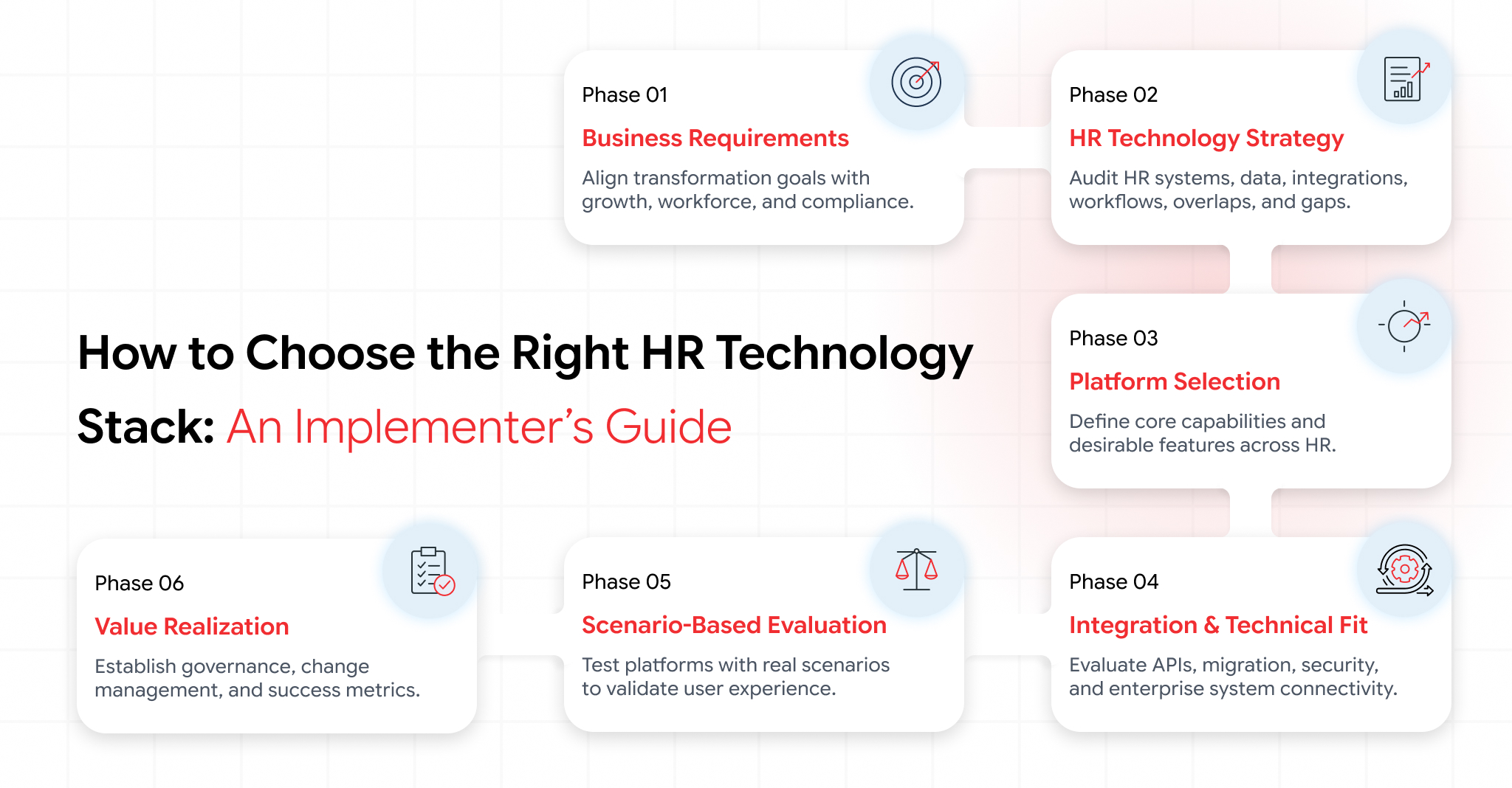
Business Needs → HR Technology Strategy → Platform Selection → Implementation → Adoption → Measurable Value
The goal is not simply to implement HR technology. It is to create a technology environment that continues supporting business and workforce priorities as the organisation grows.
Key Takeaways
- Start HR technology selection with business and workforce requirements.
- Assess the existing technology, data, processes, and integrations.
- Separate essential capabilities from desirable features.
- Evaluate platforms using realistic business scenarios.
- Consider integration, scalability, security, data, and user experience.
- Plan implementation and adoption before selecting the platform.
- Define measurable business outcomes from the beginning.
- Build an HR technology stack that supports both current and future requirements.
FAQ
What is an HR technology stack?
An HR technology stack is the collection of technology platforms and applications used to manage HR processes, employee data, talent, payroll, analytics, employee experience, automation, and related workforce activities.
How do you choose an HR technology stack?
Start by defining business and HR requirements, assessing the current technology environment, identifying required capabilities, evaluating integrations, comparing suitable HR tech platforms, and assessing implementation and future readiness.
What should I consider when selecting an HRIS system?
Key considerations include functional requirements, integration, data migration, security, user experience, scalability, implementation complexity, reporting, automation, AI capabilities, and total investment.
Why is HR technology strategy important?
An HR technology strategy connects technology decisions with business priorities. It helps organisations determine what capabilities they need, how systems should work together, and how technology can support future HR operations.
What is the difference between HR technology selection and implementation?
HR technology selection focuses on identifying the platform or combination of solutions that best meets organisational requirements. Implementation focuses on configuring, integrating, migrating, testing, deploying, and adopting the selected technology.
How can organisations evaluate HR technology vendors?
Organisations can establish clear requirements, use scenario based demonstrations, apply structured scoring criteria, assess technical and functional capabilities, review implementation requirements, and evaluate commercial considerations.
How does AI affect the HR technology stack?
AI can introduce new capabilities across HR, including automation, employee support, analytics, recommendations, content generation, and decision support. Organisations should consider AI as part of their future requirements while also assessing governance, security, data, and human oversight.