
Table of Contents
- Overview
- What Makes HR Technology Costs Difficult to Estimate?
- What Is Integration Debt?
- Why Parallel Run Costs Matter
- How Does Annual Price Escalation Affect HR System Pricing?
- What Is the True Cost of HRIS Systems?
- How Can Organisations Control Hidden HR Technology Costs?
- Why Should Integration Be Part of HR Technology Selection?
- Building a More Transparent HR Technology Business Case
- Key Takeaways
- Frequently Asked Questions
Resources > Blog > The Hidden Cost of HR Technology: Integration Debt, Parallel Run Costs and Escalation
The Hidden Cost of HR Technology: Integration Debt, Parallel Run Costs and Escalation
September 23, 2026
When organisations evaluate HR systems, the initial focus often falls on licence fees, user pricing, and implementation estimates. However, the actual investment can extend across integrations, data migration, testing, customisation, support, parallel operations, change management, and annual price increases.
Understanding these costs before selecting a platform helps organisations build a more realistic business case and avoid surprises during implementation.
The question is not simply How much does the HR software cost?
It is What will the complete technology investment cost over its lifecycle?
What Makes HR Technology Costs Difficult to Estimate?
These may include:
- Integration development and maintenance
- Data migration and cleansing
- Customisation and configuration
- Testing and quality assurance
- Additional environments
- Change management and training
- Reporting and analytics requirements
- Security and compliance activities
- Support and administration
- Temporary operating costs during transition
This means comparing software prices alone may not provide a complete view of the investment.
What Is Integration Debt?
A new HR platform may need to exchange information with payroll, finance, identity management, recruitment, learning, benefits, time management, and other enterprise applications.
Each connection can create ongoing dependencies.
Organisations should therefore evaluate:
- Number of integrations required
- Complexity of each integration
- Frequency of data exchange
- Data ownership
- API availability
- Security requirements
- Monitoring requirements
- Future maintenance needs
A platform with a lower licence cost can still require significant investment if its integration landscape is complex.
Why Parallel Run Costs Matter
This parallel run period can support validation and reduce operational risk, but it also creates additional costs.
Organisations may need to pay for:
- Existing system licences
- New platform subscriptions
- Additional implementation resources
- Data reconciliation
- Duplicate administration
- Testing and validation
- Temporary support
The longer the transition takes, the greater these costs can become.
Therefore, implementation timelines should be considered as part of the overall HR software cost rather than treated as a separate project consideration.
How Does Annual Price Escalation Affect HR System Pricing?
A small percentage increase may appear manageable in a single year. However, when applied repeatedly across several years and a growing user base, the cumulative effect can materially change the total cost.
When assessing HR system pricing, organisations should understand:
- Contract duration
- Annual escalation clauses
- User growth assumptions
- Additional module pricing
- Expansion costs
- Renewal conditions
- Support charges
- Integration related charges
The initial contract value should therefore not be treated as the complete long term cost.
What Is the True Cost of HRIS Systems?
A useful model is:
Software + Implementation + Integration + Data + Transition + Support + Expansion = Total HR Technology Investment
This approach helps organisations understand the difference between the initial purchase price and the actual cost of operating the technology over time.
It also creates a stronger foundation for comparing different HR technology solutions.
How Can Organisations Control Hidden HR Technology Costs?
Organisations can:
- Define requirements clearly
- Identify existing integrations
- Assess data quality early
- Separate essential and optional capabilities
- Identify potential customisation
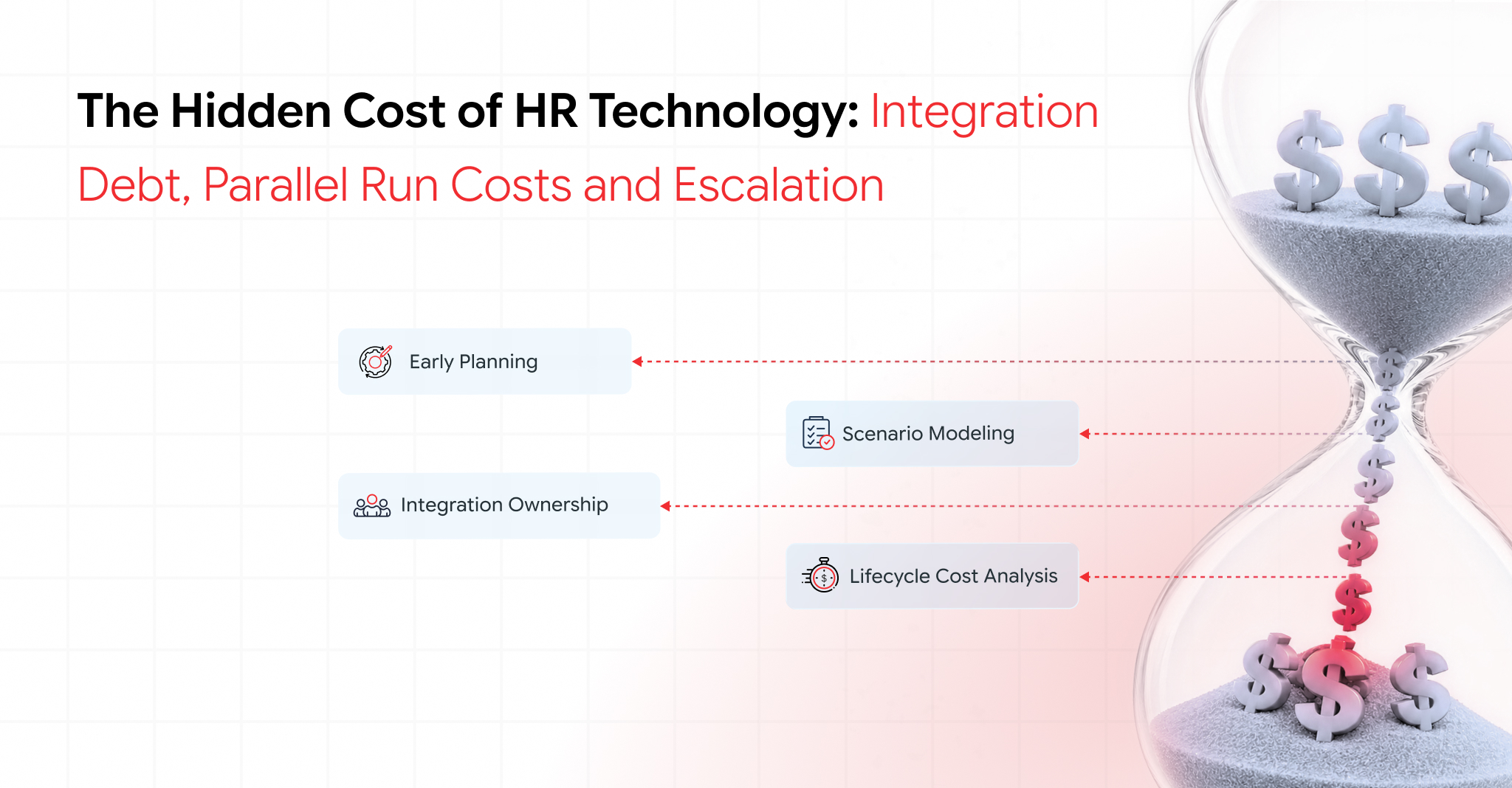
- Model different implementation scenarios
- Estimate parallel run periods
- Review contract escalation clauses
- Calculate long term operating costs
- Establish clear ownership for integrations and data
Early planning makes it easier to identify cost drivers before they become implementation issues.
Why Should Integration Be Part of HR Technology Selection?
During vendor evaluation, organisations should understand how the proposed platform will connect with the existing technology environment.
Scenario based evaluation can help answer practical questions:
- How will employee data move between systems?
- How will changes be synchronised?
- Who owns the data?
- What happens when an integration fails?
- How easy is troubleshooting?
- What will future system changes require?
These questions help reveal potential integration debt before the technology decision is finalised.
Building a More Transparent HR Technology Business Case
It should connect investment with expected business outcomes while accounting for the full cost of transformation.
The assessment can include:
Current Cost → Technology Investment → Integration Cost → Transition Cost → Operating Cost → Expected Business Value
This gives leadership a clearer view of what the transformation requires and what it is expected to deliver.
Key Takeaways
- HR technology costs extend beyond software licences.
- Integration debt can create significant long term technology costs.
- Parallel system operation can increase transition expenses.
- Annual escalation can materially affect long term HR system pricing.
- Data migration, testing, customisation, support, and training should be included in cost planning.
- Total lifecycle cost provides a more useful comparison than initial software pricing alone.
- Early cost modelling can help organisations make more informed HR technology decisions.
FAQ
What are the main HR technology costs?
Major costs can include software subscriptions, implementation, integrations, data migration, configuration, testing, training, support, security, and ongoing administration.
How is HR software cost calculated?
HR software cost may depend on employee numbers, modules, contract duration, implementation requirements, integrations, service levels, and additional capabilities.
What is integration debt?
Integration debt refers to the complexity and ongoing maintenance burden created by multiple or difficult system integrations. It can increase both implementation and long term operating costs.
Why are parallel run costs important?
Parallel run costs occur when existing and new HR systems operate simultaneously during transition. Organisations may incur overlapping licence, administration, support, testing, and reconciliation costs.
What should organisations consider when comparing HRIS pricing?
Organisations should consider the complete lifecycle investment, including software, implementation, integration, data migration, transition, support, expansion, and contractual price escalation.
How can organisations reduce hidden HR technology costs?
Early requirements definition, integration assessment, data cleansing, realistic implementation planning, lifecycle cost modelling, and careful contract review can help organisations identify and manage hidden costs before implementation.