
Table of Contents
- The Talent Supply Chain: Seven Stages Where Player Concentration Rises or Falls
- What Is the Talent Supply Chain?
- What Are the Seven Stages of the Talent Supply Chain?
- Where Does Talent Value Get Created or Lost?
- How Does Attracting Talent Influence the Supply Chain?
- How Does Talent Acquisition Affect Future Talent Value?
- Why Is Assimilation Important After Hiring?
- How Does Development Accelerate Talent Value?
- How Does Alignment Connect Talent With Business Priorities?
- How Does Internal Mobility Advance Talent?
- What Makes Talent Retention the Final Supply Chain Stage?
- How Can Organisations Measure the Talent Supply Chain?
- How Can Technology Improve the Talent Supply Chain?
- What Happens When One Stage of the Talent Supply Chain Breaks?
- How Should Organisations Improve Their Talent Supply Chain?
- Key Takeaways
- Frequently Asked Questions
Resources > Blog > The Talent Supply Chain: Seven Stages Where Player Concentration Rises or Falls
The Talent Supply Chain: Seven Stages Where Player Concentration Rises or Falls
September 21, 2026
The talent supply chain provides a way to examine these stages as connected points where organisations can strengthen, maintain, or lose talent value.
This article explores the seven stages in detail, focusing on what happens at each stage, where talent value can be created or lost, and what organisations can do to improve the flow of talent.
Editorial distinction: Unlike our existing article, which uses the Talent Supply Chain to connect A player concentration with business value and board level metrics, this article focuses on the seven stages themselves and how organisations can improve each stage.
What Is the Talent Supply Chain?
Traditional talent management often treats recruitment, development, performance, mobility, and retention as separate HR activities.
The supply chain perspective connects them.
A decision made at one stage can influence what happens at the next.
For example, weak workforce planning can affect hiring. Hiring decisions influence onboarding. Onboarding influences productivity. Development affects internal mobility. Career opportunities influence retention.
This creates a connected talent lifecycle rather than a collection of independent HR processes.
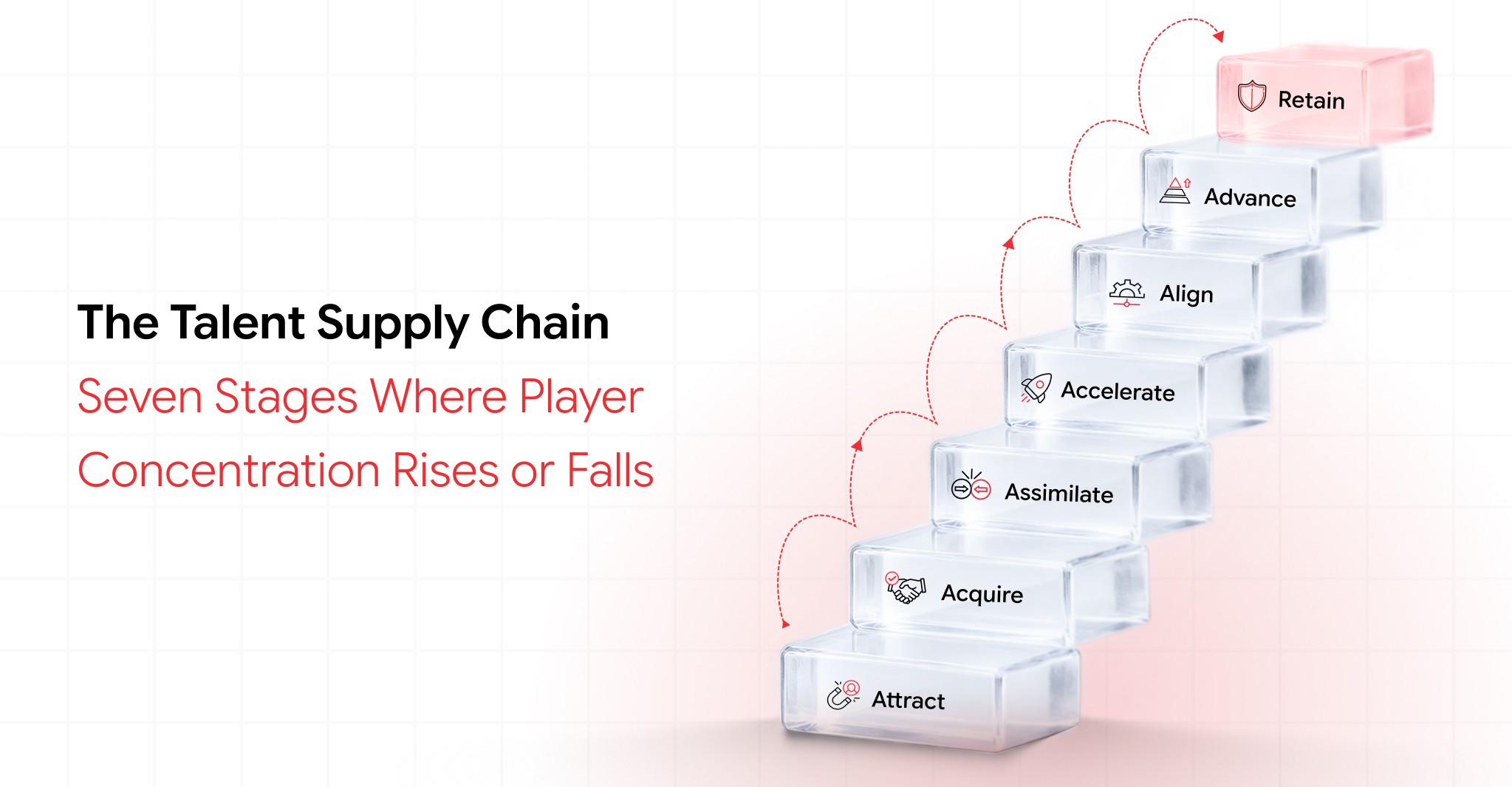
What Are the Seven Stages of the Talent Supply Chain?
1. Attract
Bring the right talent into the organisation.
2. Acquire
Identify and select people who match the requirements of the organisation and its critical roles.
3. Assimilate
Help new employees become productive and connected to the organisation.
4. Accelerate
Develop capabilities and enable employees to increase their contribution.
5. Align
Connect employee capabilities, roles, performance, and business priorities.
6. Advance
Create opportunities for career progression, internal mobility, and greater responsibility.
7. Retain
Keep valuable talent engaged and positioned to contribute over time.
Where Does Talent Value Get Created or Lost?
An organisation may attract strong candidates but lose value through poor selection.
It may hire strong people but lose momentum through ineffective onboarding.
It may have capable employees but fail to develop or move them into roles where their capabilities create greater value.
It may invest heavily in development but lose the employee before the organisation benefits from that investment.
This means talent management should not focus only on individual HR programmes.
It should examine the connections between stages.
How Does Attracting Talent Influence the Supply Chain?
A strong talent pipeline requires more than generating applications.
Organisations need to understand:
- Which capabilities will the business need?
- Which roles are strategically important?
- Where are talent shortages emerging?
- Which talent markets should the organisation access?
- How should the organisation position itself to attract the right people?
Workforce planning provides the foundation by connecting future business requirements with talent demand.
When attraction focuses only on volume, organisations can create a large pipeline without creating the right pipeline.
How Does Talent Acquisition Affect Future Talent Value?
The focus should move beyond filling vacancies.
Organisations should assess:
- Role requirements
- Capability requirements
- Candidate quality
- Role fit
- Future potential
- Critical role requirements
- Selection consistency
A strong acquisition process creates better conditions for the next stages of the talent supply chain.
Poor selection can create downstream costs across performance, development, mobility, and retention.
Why Is Assimilation Important After Hiring?
New employees need clarity around their role, access to the right tools, connection with their teams, and an understanding of how their work contributes to organisational goals.
Effective assimilation can help employees reach productive contribution faster.
Organisations should examine:
- Time to productivity
- Manager support
- Role clarity
- Access to technology
- Learning requirements
- Team integration
- Early employee experience
The quality of the transition from acquisition to assimilation can influence the value created from the original hiring decision.
How Does Development Accelerate Talent Value?
Development should therefore connect individual growth with business requirements.
This includes:
- Capability development
- Learning
- Coaching
- Performance feedback
- Critical skill development
- Leadership development
- Future capability planning
The objective is not simply to increase training participation.
It is to increase the organisation’s ability to place capable people into roles where they can create greater value.
How Does Alignment Connect Talent With Business Priorities?
Alignment requires organisations to ask:
Are the right people working on the right priorities?
This can involve:
- Clear role expectations
- Performance objectives
- Capability alignment
- Workforce priorities
- Manager effectiveness
- Business and talent planning
Without alignment, organisations can have highly capable employees working on priorities that do not reflect where the business needs them most.
How Does Internal Mobility Advance Talent?
Internal mobility can help organisations move existing capabilities toward emerging business needs.
A strong mobility strategy can connect:
Skills → Opportunities → Roles → Career Growth
Organisations can assess:
- Internal movement
- Career progression
- Succession
- Skills availability
- Critical role pipelines
- Employee aspirations
- Future workforce requirements
This creates a stronger internal talent pipeline while helping employees see opportunities within the organisation.
What Makes Talent Retention the Final Supply Chain Stage?
Retention is not simply about reducing employee turnover.
Organisations should understand which talent they need to retain, why those employees stay, and where retention risks are emerging.
Useful areas to examine include:
- Critical role retention
- Career opportunities
- Manager effectiveness
- Employee experience
- Capability development
- Compensation
- Mobility
- Engagement
A broad retention strategy treats every employee equally. A talent supply chain approach asks where retention has the greatest strategic importance.
How Can Organisations Measure the Talent Supply Chain?
Examples include:
- Attract: quality and relevance of talent pipeline
- Acquire: quality of hire and time to fill
- Assimilate: time to productivity and early retention
- Accelerate: capability development and performance progression
- Align: role and capability alignment
- Advance: internal mobility and career progression
- Retain: retention of critical talent
The objective is not to create another collection of HR metrics.
It is to understand where talent value changes across the entire lifecycle.
How Can Technology Improve the Talent Supply Chain?
An integrated technology environment can help organisations connect:
- Workforce planning
- Recruiting
- Core HR
- Performance
- Learning
- Skills
- Succession
- Internal mobility
- Employee experience
- Analytics
This creates greater visibility across the talent lifecycle.
AI can further support this by identifying patterns, highlighting capability gaps, supporting workforce planning, and helping organisations understand emerging talent risks.
Technology does not replace the talent strategy. It provides the infrastructure needed to execute and measure it more effectively.
What Happens When One Stage of the Talent Supply Chain Breaks?
A weak talent pipeline can create hiring pressure.
Poor hiring can increase onboarding and performance challenges.
Weak development can reduce internal mobility.
Limited mobility can affect engagement and retention.
High turnover can then increase pressure on recruitment and workforce planning.
This is why organisations should avoid optimising individual HR processes in isolation.
Improving one stage is useful. Improving the connections between stages creates greater value.
How Should Organisations Improve Their Talent Supply Chain?
A practical approach is:
- Map: Understand the seven stages and how they connect.
- Measure: Establish meaningful indicators at each stage.
- Identify: Find points where talent value is lost.
- Prioritise: Focus on the stages that have the greatest business impact.
- Improve: Redesign processes, policies, roles, and technology where required.
- Connect: Ensure each stage supports the next rather than operating as an isolated HR process.
- Review: Continuously monitor talent movement and outcomes, including whether workforce investments are creating measurable talent value.
This turns talent lifecycle management from a collection of programmes into a connected talent system.
Key Takeaways
- The talent supply chain connects the major stages through which talent creates value in an organisation.
- Talent value can rise or fall at every stage, from attraction through retention.
- Workforce planning provides an important foundation for understanding future talent requirements.
- Talent management becomes more effective when organisations examine connections between processes rather than individual programmes.
- Internal mobility and development can help organisations make better use of existing talent.
- HR technology can connect talent data across the lifecycle and provide greater visibility into talent movement.
- The goal is not simply to manage the employee lifecycle. It is to improve how talent value flows through the organisation.
FAQ
What is a talent supply chain?
A talent supply chain is a connected view of how talent enters, develops, moves through, contributes to, and remains within an organisation. It helps organisations identify where talent value is created or lost across the employee lifecycle.
What are the stages of the talent supply chain?
The seven stages covered in this framework are Attract, Acquire, Assimilate, Accelerate, Align, Advance, and Retain.
How is a talent supply chain different from talent management?
Talent management typically covers activities such as recruitment, development, performance, succession, and retention. A talent supply chain connects these activities to show how decisions at one stage influence outcomes at another.
How does workforce planning support the talent supply chain?
Workforce planning helps organisations understand future workforce requirements, identify capability needs, anticipate talent gaps, and build the right talent pipeline.
Why is talent retention part of the talent supply chain?
Retention determines whether an organisation continues to benefit from the talent it has attracted, developed, and advanced. It also helps protect organisational knowledge, capability, and continuity.
How can HR technology support talent lifecycle management?
HR technology can connect workforce planning, recruiting, performance, learning, skills, succession, mobility, and retention data. This gives organisations greater visibility across the talent lifecycle.
How can organisations improve their talent supply chain?
Organisations can map the talent lifecycle, measure each stage, identify value leakage, prioritise high impact areas, improve processes, and use technology to connect talent data and decision making.