Table of Contents
- Why Should Organizations Measure the Maturity of the HR Function?
- What Does the HR Maturity Curve Measure?
- What Does Stage 1: Deliver Look Like?
- What Does Stage 2: Standardize Look Like?
- What Does Stage 3: Optimize Look Like?
- What Does Stage 4: Predict Look Like?
- What Does Stage 5: Yield Look Like?
- How Can Organizations Measure Talent Yield Without Oversimplifying Workforce Value?
- How Can Leaders Identify Their Current HR Maturity Stage?
- Can Different Parts of the Organization Have Different HR Maturity Levels?
- What Should Organizations Prioritize at Each HR Maturity Stage?
- What Questions Should Leaders Ask When Assessing HR Maturity?
Resources > Blog > How Does the HR Function Mature from Service Delivery to Talent Yield?
How Does the HR Function Mature from Service Delivery to Talent Yield?
August 17, 2026
Overview
The HR function does not become strategic simply by implementing new technology or automating more processes. Maturity develops as HR strengthens service delivery, standardizes processes, builds trusted workforce data, improves decision-making, and connects workforce investments with measurable business outcomes. At the highest level of maturity, leaders focus on how effectively the organization converts workforce capabilities and HR investments into sustained business value. This article explores the maturity curve from HR service delivery to talent yield and the capabilities organizations need to progress.
Why Should Organizations Measure the Maturity of the HR Function?
Organizations should measure HR maturity to understand whether their operating model, processes, technology, workforce data, governance, and capabilities can support current business priorities and future transformation.
HR functions can appear modern without being mature.
An organization may have implemented a Tier 1 HR platform, introduced employee self-service, automated workflows, created workforce dashboards, and started experimenting with AI.
These investments can create valuable capabilities.
However, technology adoption alone does not show whether the HR function operates effectively or creates measurable business value.
- Fragmented HR processes across countries and business units.
- High levels of administrative work.
- Manual workarounds outside core HR platforms.
- Low employee and manager adoption.
- Inconsistent workforce data.
- Limited confidence in workforce analytics.
- Unclear process ownership and governance.
- HR metrics disconnected from business priorities.
- AI initiatives without the data, processes, or governance required to scale.
A maturity assessment helps leaders understand the current state of the HR function and identify which capabilities they need to strengthen next.
The objective is not to reach the highest maturity level as quickly as possible.
Organizations should build the foundations required to sustain each stage before moving to more advanced capabilities.
For example, workforce analytics creates limited value when the organization cannot trust its workforce data.
AI agents become difficult to scale when HR processes remain fragmented and accountability is unclear.
Talent yield becomes difficult to measure when organizations have not defined the business outcomes their workforce investments should create.
The maturity curve therefore helps leaders answer a practical question:
What should the HR function strengthen next to create greater business value?
What Does the HR Maturity Curve Measure?
The five stages of maturity include:
- Deliver – Focus on reliable HR administration and service delivery. Key question: Can HR deliver essential services consistently?
- Standardize – Focus on common processes, governance, and trusted workforce data. Key question: Can the organization operate HR consistently at scale?
- Optimize – Focus on technology utilization, automation, adoption, and efficiency. Key question: Are we creating greater value from our HR operating environment?
- Predict – Focus on workforce intelligence and forward-looking decisions. Key question: Can workforce insights help leaders make better decisions?
- Yield – Focus on measurable workforce and business value. Key question: Are workforce investments creating the outcomes the business needs?
These stages build on one another. Organizations continue strengthening operational excellence while expanding their ability to create strategic business value.
What Does Stage 1: Deliver Look Like?
The primary objective is operational stability.
HR teams typically focus on:
- Payroll and workforce administration.
- Employee records.
- Recruitment administration.
- Benefits administration.
- Employee inquiries and HR service requests.
- Compliance activities.
- Transaction processing.
- Basic operational reporting.
Leaders commonly ask:
- Are employees receiving accurate and timely HR services?
- Can HR complete transactions consistently?
- Are workforce records maintained correctly?
- Can the organization meet statutory and compliance requirements?
- How quickly does HR respond to employee requests?
These questions remain important throughout the maturity curve.
However, organizations at this stage may rely heavily on HR teams to complete administrative work.
Common characteristics include:
- High levels of manual processing.
- Email-based requests and approvals.
- Spreadsheets and offline trackers.
- Different processes across business units.
- Limited employee and manager self-service.
- Reactive problem-solving.
- HR metrics focused primarily on activity and service volumes.
What Is the Difference Between Governance, Program Management, and Project Reporting?
Organizations struggle to progress when administrative work consumes HR capacity and inconsistent processes prevent the organization from operating efficiently at scale.
The next priority is not necessarily to introduce more technology.
Leaders should first understand where process variation, unclear ownership, fragmented data, and manual work prevent HR from operating consistently.
This creates the foundation for the next maturity stage.
What Does Stage 2: Standardize Look Like?
The primary objective is consistency.
Organizations begin reducing unnecessary variation across functions, business units, and countries.
HR leaders focus on:
- Defining enterprise process principles.
- Standardizing common HR processes.
- Clarifying global, regional, and local responsibilities.
- Establishing process ownership.
- Strengthening workforce data governance.
- Defining common workforce data standards.
- Reducing unnecessary local variations.
- Establishing clearer technology governance.
- Creating consistent employee and manager experiences.
Leaders commonly ask:
- Which processes should operate consistently across the enterprise?
- Where do genuine local requirements justify variation?
- Who owns each end-to-end HR process?
- Who owns workforce data quality?
- Can employees and managers follow consistent ways of working?
- Does governance prevent unnecessary complexity from returning?
Organizations may implement or optimize HR platforms to support standardized processes and create a common workforce data foundation.
However, standardization does not mean forcing every business unit or country into identical processes.
Multi-country organizations need governance mechanisms that distinguish between legitimate statutory requirements and unnecessary local preferences.
What Shows That an Organization Is Ready to Move Beyond Standardization?
An organization is ready to progress when common processes operate consistently, process and data ownership are clear, leaders can trust core workforce information, and governance can control unnecessary variation.
At this point, the organization can focus more effectively on improving how it uses technology, automation, and digital HR capabilities.
What Does Stage 3: Optimize Look Like?
The primary objective is performance improvement.
Organizations may already use SAP SuccessFactors, Workday, or another enterprise HR technology environment.
The maturity challenge is no longer simply implementing technology.
Leaders need to determine whether the organization uses its processes, platforms, integrations, workforce data, and digital capabilities effectively.
Organizations focus on:
- Simplifying HR processes.
- Removing unnecessary approvals and handoffs.
- Increasing employee and manager self-service.
- Improving platform configuration.\
- Strengthening integrations.
- Reducing manual workarounds.
- Improving workforce data quality.
- Increasing adoption of existing capabilities.
- Automating repetitive work where appropriate.
- Measuring whether optimization creates business value.
Leaders commonly ask:
- Are we fully using the capabilities available in our HR technology environment?
- Where do manual workarounds continue to create unnecessary effort?
- Which processes should we simplify before automating them?
- Are integrations supporting reliable and efficient data flows?
- Are employees and managers using intended processes consistently?
- Where are adoption gaps limiting value realization?
Organizations at this stage may discover that they do not need immediate system replacement.
A structured assessment of the existing HR technology environment can identify where process redesign, platform optimization, improved integrations, stronger governance, or better adoption can create additional value.
What Prevents Organizations from Progressing Beyond Optimization?
Organizations struggle to move beyond optimization when they improve efficiency without strengthening workforce intelligence and decision-making capabilities.
Automation can reduce administrative effort.
Platform optimization can improve the employee experience.
Better integrations can strengthen data flows.
However, the next maturity stage requires organizations to use trusted workforce data to understand what is happening, anticipate what may happen next, and help leaders make better workforce decisions.
What Does Stage 4: Predict Look Like?
The primary objective is decision intelligence.
Organizations at earlier maturity stages typically use workforce data to explain what has already happened.
Leaders review:
- Employee turnover.
- Recruitment performance.
- Workforce costs.
- Absence.
- Learning participation.
- Employee engagement.
- Workforce demographics.
- HR service performance.
- These measures remain valuable.
At the Predict stage, organizations begin using workforce intelligence to answer more forward-looking questions:
- Where could critical workforce shortages emerge?
- Which skills will the organization need as business priorities change?
- Where are retention risks increasing?
- Which workforce segments require leadership attention?
- How could organizational changes affect workforce capacity?
- Where are productivity constraints developing?
- Which workforce investments are most likely to improve future business outcomes?
The shift is from reporting workforce activity to supporting business decisions.
What Capabilities Does Predictive HR Require?
Organizations need more than analytics technology to build predictive HR capabilities.
They need:
- Trusted and connected workforce data.
- Consistent workforce definitions.
- Clear data ownership.
- Reliable integrations.
- Strong data governance.
- Analytical capabilities within HR.
- Business leaders who understand how to use workforce insights.
- Clear processes for translating insights into decisions and actions.
- Appropriate governance for predictive models and AI-enabled capabilities.
Without these foundations, organizations may create sophisticated dashboards and models that leaders do not trust or use.
How Does AI Change the Predict Stage?
AI can help organizations analyze workforce information, identify patterns, generate insights, support scenario planning, and improve access to workforce intelligence.
AI agents may also help employees, managers, and HR teams interact with workforce information and coordinate activities across enterprise systems.
However, AI does not remove the need for strong HR foundations.
Organizations still need reliable data, standardized processes, clear governance, appropriate technology architecture, and human accountability.
The maturity question is not:
How much AI has the organization implemented?
It is:
Does AI help the organization make better workforce decisions and create measurable business value?
Organizations that answer this question clearly are better positioned to progress toward the highest stage of the maturity curve.
What Does Stage 5: Yield Look Like?
The primary objective is value creation.
Talent yield represents a management perspective rather than a universally standardized HR metric.
It asks:
How effectively does the organization convert workforce capabilities and HR investments into the business outcomes it needs?
Organizations at this stage do not stop measuring HR operations, adoption, employee experience, or workforce performance.
They connect these measures to broader outcomes.
For example:
- Did workforce planning reduce critical capability gaps?
- Did stronger manager capabilities improve team performance?
- Did HR technology investments reduce administrative effort and improve decision-making?
- Did talent investments improve the organization’s ability to execute business strategy?
- Did automation create measurable productivity gains?
- Did improved workforce data help leaders make faster and more confident decisions?
- Did AI-enabled capabilities improve business outcomes, employee experiences, or operating efficiency?
- Are transformation benefits sustained over time?
This creates a stronger connection between HR strategy, workforce decisions, transformation investments, and enterprise value.
What Is the Difference Between HR Efficiency and Talent Yield?
Although closely related, HR efficiency and talent yield measure different outcomes.
HR Efficiency focuses on:
- Delivering HR services efficiently.
- Improving speed, productivity, and operational performance.
- Reducing administrative effort and costs.
- Optimizing HR processes and service delivery.
- Answering the question: Is HR operating efficiently?
Talent Yield focuses on:
- Creating measurable business value from workforce investments.
- Connecting HR initiatives with business outcomes.
- Improving workforce capability and organizational performance.
- Aligning HR strategy with enterprise priorities.
- Answering the question: Are workforce investments producing meaningful business outcomes?
Organizations need both. Efficient HR operations provide the foundation, while talent yield demonstrates the strategic value created from those investments.
How Can Organizations Measure Talent Yield Without Oversimplifying Workforce Value?
Organizations should avoid reducing talent yield to a single universal formula.
Workforce investments influence business performance through complex relationships.
Revenue, productivity, customer outcomes, innovation, quality, and growth depend on many factors beyond HR.
A credible talent yield approach should therefore connect investments with outcomes without claiming that HR created the entire result.
Organizations can follow five steps.
Define the Business Outcome
Leaders should begin with the outcome the organization needs to improve.
Examples include:
- Increase productivity.
- Reduce critical capability shortages.
- Improve operational capacity.
- Strengthen workforce retention in strategic roles.
- Improve workforce agility.
- Reduce the cost of administrative work.
- Accelerate the deployment of critical skills.
Identify the Workforce Drivers
Organizations should identify the workforce conditions that influence the outcome.
These may include:
- Skills availability.
- Workforce capacity.
- Leadership capability.
- Employee retention.
- Manager effectiveness.
- Internal mobility.
- Workforce deployment.
- Adoption of new ways of working.
Connect HR Investments with the Workforce Drivers
Organizations should determine which HR initiatives and investments can influence those workforce conditions.
These may include HR technology, workforce planning, talent programs, process redesign, analytics, automation, AI-enabled capabilities, and change initiatives.
Establish Baselines and Targets
Leaders need credible baselines to determine whether performance improved.
They should define measurable targets, accountable owners, timeframes, and review periods before making major transformation investments.
Measure Outcomes and Validate Attribution
Organizations should monitor whether workforce drivers improved and whether those improvements contributed to the intended business outcomes.
Finance and business leaders should help validate assumptions when organizations translate workforce outcomes into financial value.
This approach helps HR communicate value without overstating its contribution to enterprise performance.
How Can Organizations Measure Talent Yield Without Oversimplifying Workforce Value?
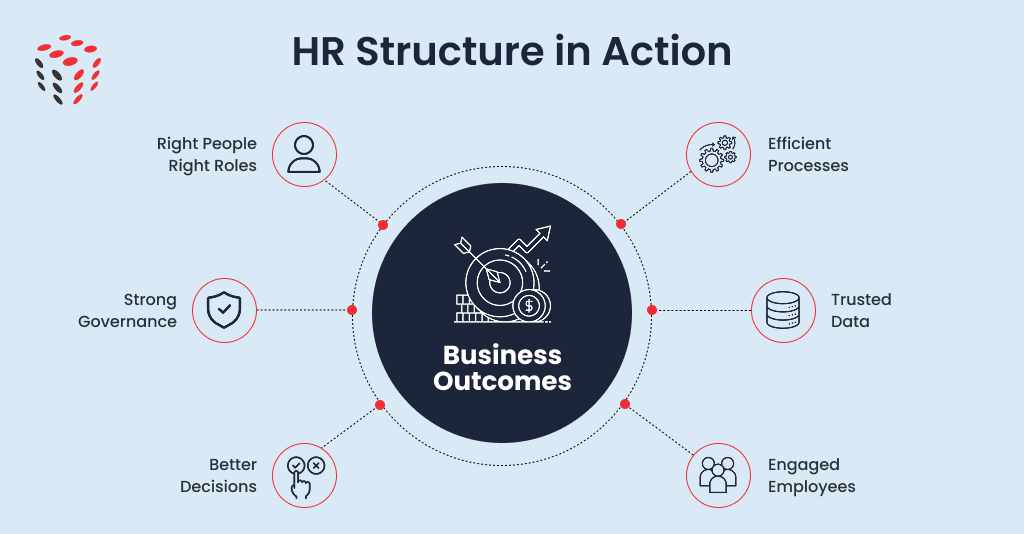
- HR Services: From transaction-focused delivery to business value creation.
- Processes: From manual and fragmented to continuously improved and outcome-driven.
- Technology: From supporting core administration to enabling workforce intelligence and measurable value.
- Workforce Data: From operational records to trusted data that supports strategic decision-making.
- Governance: From reactive oversight to governance that protects business value and future AI adoption.
- Measurement: From activity metrics to workforce insights and measurable business outcomes.
Organizations should identify both their strongest capabilities and the foundational gaps that prevent progress to the next maturity stage.
Can Different Parts of the Organization Have Different HR Maturity Levels?
A global organization may have standardized core HR processes while recruitment remains highly fragmented.
One country may use employee and manager self-service effectively while another relies heavily on manual administration.
Workforce data may support advanced analytics in one business unit while other teams still question data accuracy.
Organizations should therefore avoid assigning a maturity level based only on an enterprise-wide average.
Leaders should identify:
- Which capabilities operate consistently across the enterprise.
- Where maturity varies significantly across countries or business units.
- Which gaps create the greatest risk to business outcomes.
- Which foundational capabilities require enterprise-wide improvement.
- Where advanced capabilities can scale to other parts of the organization.
- Which local differences reflect genuine business requirements.
This approach helps organizations build a more practical transformation roadmap.
What Should Organizations Prioritize at Each HR Maturity Stage?
Organizations should prioritize the capabilities required to strengthen their current stage and remove the constraints that prevent progress toward greater business value.
At the Stabilize stage, the priority is to stabilize services, reduce critical manual risks, and understand process fragmentation, while avoiding the pursuit of advanced capabilities before reliable HR operations are in place. The Standardize stage focuses on establishing common processes, governance, ownership, and workforce data foundations, while avoiding the automation of unnecessary process variation. At the Optimize stage, organizations improve technology utilization, integrations, adoption, automation, and value realization, rather than assuming that a new platform will automatically solve operating problems. The Predict stage strengthens workforce intelligence and connects insights with business decisions, while avoiding analytics or AI capabilities that leaders cannot trust or use. Finally, the Yield stage focuses on connecting workforce investments with measurable business outcomes and continuously improving value creation, while avoiding claims of direct attribution for complex business outcomes without credible evidence.
Organizations do not need to transform every HR capability simultaneously.
The maturity curve helps leaders sequence investments according to business priorities and organizational readiness.
What Questions Should Leaders Ask When Assessing HR Maturity?
Leadership teams should ask:
- Can HR deliver essential services consistently across the organization?
- Which manual activities and workarounds continue to consume HR capacity?
- Are HR processes standardized where enterprise consistency creates value?
- Are process ownership and decision rights clearly defined?
- Can leaders trust workforce data?
- Are employees and managers using HR technology capabilities as intended?
- Is the organization realizing sufficient value from existing HR technology investments?
- Can workforce analytics help leaders anticipate challenges and make better decisions?
- Are AI initiatives supported by reliable data, processes, governance, and accountability?
- Can HR connect workforce investments with measurable business outcomes?
- Which capability gaps prevent the organization from progressing to the next maturity stage?
Clear answers help leaders create a transformation roadmap based on business needs and current maturity rather than technology trends.
Conclusion
HR maturity develops as organizations progressively strengthen service delivery, process consistency, governance, technology utilization, workforce data, decision-making, and value measurement.
The journey begins with reliable HR services.
Organizations then establish standardized processes and stronger governance, optimize existing HR technology investments, use workforce intelligence to support forward-looking decisions, and ultimately connect workforce capabilities and HR investments with measurable business outcomes.
The highest maturity stage is not defined by how much technology an organization owns or how many AI initiatives it launches.
It is defined by whether HR can demonstrate how effectively workforce capabilities and transformation investments contribute to the outcomes the business needs.
The maturity curve provides leaders with a practical way to understand their current position, identify the capabilities that require improvement, and sequence transformation priorities.
Organizations create stronger foundations for long-term transformation when they improve maturity deliberately rather than pursuing advanced capabilities before the operating environment is ready.
FAQ
What Is an HR Maturity Curve?
An HR maturity curve is a framework that evaluates how the HR function progresses from reliable service delivery and standardized processes to technology optimization, workforce intelligence, and measurable business value creation.
What Is Talent Yield in HR?
Talent yield is a management perspective that evaluates how effectively an organization converts workforce capabilities and HR investments into measurable and sustained business outcomes. It is not a universally standardized HR metric.
What Are the Five Stages of HR Maturity?
The five stages presented in this article are Deliver, Standardize, Optimize, Predict, and Yield. Each stage builds on the capabilities established at earlier stages.
Does Implementing AI Mean an HR Function Has Reached a High Level of Maturity?
No. AI adoption alone does not indicate HR maturity. Organizations need reliable processes, trusted workforce data, clear governance, connected technology, workforce adoption, and the ability to translate AI capabilities into better decisions and measurable business outcomes.
How Can Organizations Improve Their HR Maturity?
Organizations can improve HR maturity by assessing current capabilities, identifying foundational gaps, prioritizing improvements based on business needs, strengthening processes and governance, optimizing technology investments, improving workforce data, and connecting workforce initiatives with measurable outcomes.



Share with your network
Get updates in your inbox