
Table of Contents
- Why Does Legacy HR Data Become a Problem?
- What Data Should Organisations Migrate?
- What Are the Four Types of Data Migration?
- How Does HR Data Cleansing Improve Migration?
- How Does HR Data Retention Affect Migration Decisions?
- What Should an HRIS Data Migration Checklist Include?
- What Are the Best Practices for Data Migration?
- How Can Organisations Avoid Migrating Data They Do Not Need?
- How Does Data Migration Support HR Transformation?
- What Should Organisations Do With 20 Years of HR Data?
- Key Takeaways
- Frequently Asked Questions
Resources > Blog > HRIS Data Migration: What Legacy Data Should You Keep?
HRIS Data Migration: What 20 Years of Legacy Data Is Worth and What to Leave Behind
September 16, 2026
Years of employee records, organisational structures, payroll information, performance history, documents, and reporting data may exist across systems.
The question is not simply how to move everything. It is what the organisation actually needs to carry forward.
A structured approach to HR data cleansing, retention, validation, and migration can reduce complexity while creating a cleaner foundation for the new HR technology environment.
Why Does Legacy HR Data Become a Problem?
Legacy systems often accumulate data because organisations keep information available rather than continually reassessing its value.
This creates several challenges during HRIS data migration:
- Duplicate employee records
- Inconsistent employee identifiers
- Different organisational structures
- Outdated job and position information
- Incomplete historical records
- Inconsistent date and naming formats
- Documents with unclear retention requirements
- Data that no longer serves a business purpose
Moving all of this data into a new HRIS simply transfers the complexity.
What Data Should Organisations Migrate?
What data does the new HR environment actually need?
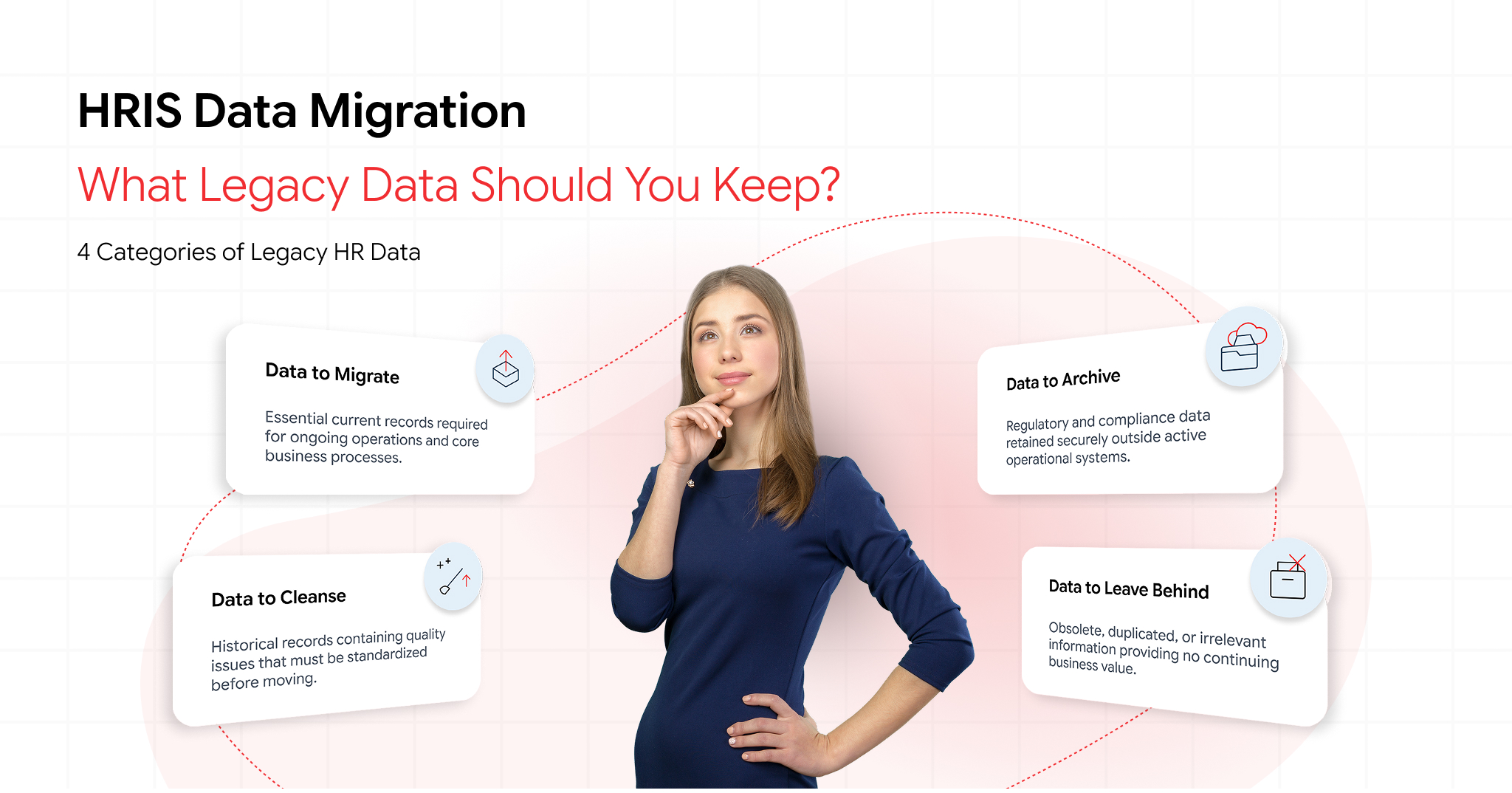
A useful classification can divide legacy HR data into four groups.
Data to Migrate
Data required for current operations, compliance, reporting, integrations, employee experience, or defined business processes should move into the new system.
Data to Cleanse and Migrate
Important historical information may contain quality issues. Organisations should cleanse, standardise, validate, and then migrate this data.
Data to Archive
Some historical information may need to remain accessible for legal, regulatory, audit, or business reasons without residing in the active HRIS.
Data to Leave Behind
Duplicate, obsolete, irrelevant, or unsupported information may have no continuing business value.
The objective is not maximum data migration.
The objective is purposeful data migration.
What Are the Four Types of Data Migration?
Storage Migration
Moving data from one storage environment to another.
Cloud Migration
Moving data or applications from an existing environment to a cloud environment.
Application Migration
Moving data from one application to another, such as moving from a legacy HRIS to a modern HR platform.
Business Process Migration
Moving business processes, data, and related capabilities to support a new operating model or business environment.
For HR transformation programmes, application migration is often central, but the migration strategy can involve multiple types depending on the organisation’s technology landscape.
How Does HR Data Cleansing Improve Migration?
A cleansing exercise can review:
- Duplicate records
- Missing information
- Invalid values
- Inconsistent formats
- Incorrect organisational assignments
- Outdated employee information
- Duplicate job or position records
- Inconsistent codes and identifiers
This creates an important principle:
Do not use the new HRIS to clean up problems that should have been addressed before migration.
Clean source data makes mapping, testing, validation, reporting, and downstream integrations easier.
How Does HR Data Retention Affect Migration Decisions?
HR data retention decisions should consider the organisation’s legal, regulatory, contractual, audit, operational, and business requirements.
For each data category, organisations should establish:
- Why the data needs to be retained
- How long it needs to be retained
- Where it should be stored
- Who should have access
- When it should be deleted
- What regulatory requirements apply
Retention decisions should involve the appropriate HR, legal, compliance, information security, and data governance stakeholders.
The result should be a clear distinction between active data, historical data, archived data, and data that no longer needs to be retained.
What Should an HRIS Data Migration Checklist Include?
1. Discover
Identify systems, data sources, integrations, files, historical records, and ownership.
2. Classify
Separate data according to business purpose, retention requirements, quality, and migration need.
3. Cleanse
Identify duplicates, incomplete records, inconsistent values, and obsolete information.
4. Map
Map legacy fields and values to the structure of the target HRIS.
5. Transform
Convert data formats, values, codes, and structures required by the new platform.
6. Validate
Check completeness, accuracy, relationships, security, and business rules.
7. Test
Run migration tests and reconcile results before production migration.
8. Migrate
Execute the approved migration using controlled processes.
9. Reconcile
Compare source and target data and resolve discrepancies.
10. Archive or Dispose
Securely retain or dispose of data according to approved retention requirements.
What Are the Best Practices for Data Migration?
Organisations should:
Start with business requirements
Determine what information the future HR environment actually needs.
Assign data ownership
Business owners should validate critical HR data rather than leaving all decisions to technical teams.
Clean before migrating
Address data quality issues before information enters the target system.
Define clear mapping rules
Document how legacy fields, values, codes, and structures translate into the new HRIS.
Test multiple times
Use test migrations to identify issues before production.
Validate with business users
HR and business stakeholders should confirm that migrated information works for real business scenarios.
Protect sensitive information
Apply appropriate security and access controls throughout the migration.
Document decisions
Record what was migrated, archived, transformed, or excluded and why.
How Can Organisations Avoid Migrating Data They Do Not Need?
If this data disappeared tomorrow, would the business actually need it?
The answer should guide the migration decision.
For every major data category, ask:
- Is it required for current HR processes?
- Is it needed for reporting?
- Is it required for compliance?
- Does the business need historical access?
- Does another system already retain it?
- Does it have a defined owner?
- Does it support future requirements?
This approach prevents the new HRIS from becoming an archive for decades of accumulated information.
How Does Data Migration Support HR Transformation?
When organisations examine their legacy data, they often uncover outdated structures, inconsistent processes, duplicate information, and reporting requirements that no longer reflect how the business operates.
This makes migration an important part of broader HR transformation.
The journey can connect:
Legacy Data → Data Cleansing → Future Requirements → HRIS Design → Migration → Validation → Better HR Data Foundation
The result is not simply a successful system migration.
It is a cleaner data foundation for future HR processes, analytics, integrations, automation, and AI capabilities.
What Should Organisations Do With 20 Years of HR Data?
The right approach is to evaluate historical data based on business value, regulatory requirements, accessibility needs, data quality, and future relevance.
Some information belongs in the new HRIS.
Some belongs in an archive.
Some needs cleansing before migration.
And some data has reached the end of its useful life.
The strongest HRIS data migration strategy makes these decisions deliberately before the migration begins.
Key Takeaways
- HRIS data migration is a business decision as well as a technical exercise.
- Organisations should not automatically migrate decades of legacy HR data.
- HR data cleansing should happen before migration to improve data quality and reduce complexity.
- HR data retention requirements should guide decisions around active data, archived data, and disposal.
- A structured HRIS data migration checklist should cover discovery, classification, cleansing, mapping, transformation, testing, validation, migration, and reconciliation.
- Data migration can create a cleaner foundation for HR technology, analytics, automation, and future AI capabilities.
FAQ
What is HRIS data migration?
HRIS data migration is the process of moving HR information from an existing HR system or other data sources into a new HR information system. It typically includes data discovery, cleansing, mapping, transformation, testing, migration, and validation.
What data should be migrated to a new HRIS?
Organisations should migrate data required for current business processes, reporting, compliance, integrations, employee services, and defined historical requirements. Data that does not provide continuing value may be archived or excluded.
What are the four types of data migration?
The four commonly recognised types are storage migration, cloud migration, application migration, and business process migration.
What is HR data cleansing?
HR data cleansing involves identifying and correcting inaccurate, incomplete, duplicated, inconsistent, or obsolete HR information before it enters the target system.
What are the best practices for data migration?
Best practices include defining business requirements, assigning data ownership, cleansing source data, establishing mapping rules, testing multiple times, validating results with business users, protecting sensitive information, and documenting migration decisions.
How long does HRIS data migration take?
The timeline depends on the number of systems, data volume, data quality, integrations, historical requirements, target HRIS, and migration complexity. Organisations should establish the timeline after completing data discovery and assessment.
Should all historical HR data be migrated?
No. Historical data should be assessed based on business value, regulatory requirements, retention obligations, accessibility needs, and future relevance. Some data can be migrated, some archived, and some excluded.
How does data migration support HR transformation?
Data migration provides an opportunity to improve data quality, simplify the HR technology environment, align information with future processes, and create a stronger foundation for analytics, automation, and AI.