
Table of Contents
- Why Can a Full RFP Become Too Much for a Mid Market Organisation?
- What Should a Right Sized Vendor Selection Process Include?
- When Does a Full RFP Still Make Sense?
- How Can Organisations Make Vendor Selection Faster Without Making It Weaker?
- What Should Leaders Ask Before Launching an RFP?
- What Is the Alternative to a Full RFP?
- How Can Organisations Maintain Objectivity Without a Full RFP?
- What Role Should Procurement Play?
- Does a Smaller Selection Process Mean a Smaller Decision?
- How Should Leaders Decide Whether They Need a Full RFP?
Resources > Blog > How Do You Actually Need a Full RFP for HR Technology Selection?
Do You Actually Need a Full RFP for HR Technology Selection?
August 30, 2026
Overview
For organisations with fewer than 10,000 employees, a full RFP can sometimes create more complexity than value. Large RFPs require significant time from HR, IT, procurement, and business teams, while extensive requirements and lengthy vendor responses can make it harder to identify the solution that genuinely fits the organisation. A right sized selection process can provide sufficient rigour while reducing effort, shortening timelines, and keeping the evaluation focused on business priorities.
Why Can a Full RFP Become Too Much for a Mid Market Organisation?
This approach can work well for large, complex enterprises with significant geographic scope and highly differentiated requirements.
For organisations below 10,000 employees, the situation may be different.
The organisation may have:
- Fewer countries and business units.
- A smaller HR technology landscape.
- More manageable integration requirements.
- A clearer decision making structure.
- A limited number of realistic Tier 1 vendors.
- Less need for highly customised functionality.
The question is therefore not whether an RFP is good or bad.
The question is whether the selection process is proportionate to the complexity of the decision.
What Should a Right Sized Vendor Selection Process Include?
It should typically include:
- Clear business and HR requirements.
- Defined functional and non functional criteria.
- A shortlist of relevant vendors.
- Structured demonstrations based on real business scenarios.
- Integration, security, data, and scalability assessment.
- Commercial and implementation evaluation.
- Reference checks.
- A documented recommendation and business case.
The objective is to remove unnecessary process without removing decision quality.
When Does a Full RFP Still Make Sense?
Consider a more comprehensive process when there are:
- Multiple countries and regulatory environments.
- Large numbers of integrations.
- Complex payroll or workforce structures.
- Significant custom requirements.
- Multiple stakeholder groups with competing priorities.
- High investment or transformation risk.
- Procurement requirements that mandate a formal RFP.
The right approach depends on the decision complexity, not simply employee count.
How Can Organisations Make Vendor Selection Faster Without Making It Weaker?
Instead of asking vendors to respond to hundreds of generic questions, organisations can prioritise the capabilities that matter most to their future operating model.
A structured evaluation can then test:
- Business fit
- Process fit
- Technology capability
- Integration
- User experience
- Scalability
- Total cost
- Implementation risk
- Future readiness
This creates a selection process that is faster without becoming superficial.
What Should Leaders Ask Before Launching an RFP?
- How complex is our HR environment?
- How many genuine vendors can meet our requirements?
- Which requirements actually differentiate the options?
- What level of procurement governance do we need?
- How much internal time can we dedicate to the selection?
- What decision evidence does the board require?
- Would a shorter structured evaluation produce the same confidence?
For organisations below 10,000 employees, the answer may be that a right sized vendor selection process provides enough rigour without the weight of a traditional RFP.
What Is the Alternative to a Full RFP?
A structured vendor selection does not have to mean a lengthy RFP.
Organisations can use a focused process built around the decisions that matter most.
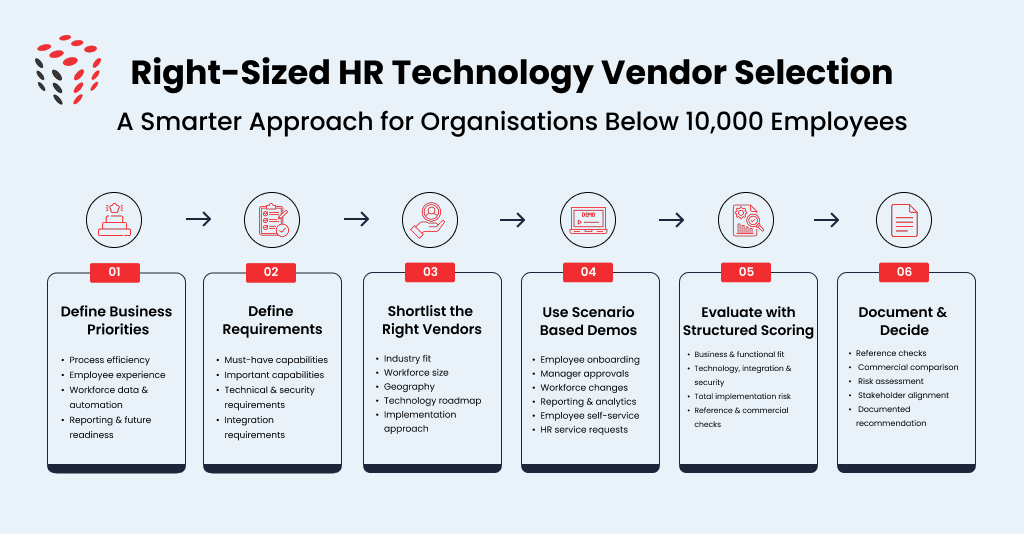
Define the Business Priorities
Start with the outcomes the organisation expects from the new HR technology.
Focus on areas such as:
- Process efficiency
- Employee experience
- Workforce data
- Automation
- Scalability
- Reporting and analytics
- Future AI capabilities
Create a Focused Requirement Set
Instead of documenting every possible feature, separate requirements into:
- Must have capabilities
- Important capabilities
- Future requirements
- Technical and security requirements
- Integration requirements
This makes vendor comparison easier and reduces unnecessary evaluation effort.
Shortlist the Right Vendors
A smaller, relevant vendor shortlist can produce better results than inviting every possible provider.
Evaluate vendors against the organisation’s actual requirements, industry context, workforce size, geography, and future roadmap.
Use Scenario Based Demonstrations
Vendor demonstrations should show how the technology handles real business situations.
For example:
- Employee onboarding
- Manager approvals
- Workforce changes
- Reporting
- Employee self service
- HR service requests
This allows stakeholders to evaluate how the solution would work in practice rather than relying on generic product presentations.
How Can Organisations Maintain Objectivity Without a Full RFP?
Organisations should define the scoring approach before vendor demonstrations begin.
Evaluate each vendor across:
- Business fit
- Functional capability
- User experience
- Technology and architecture
- Integration
- Security
- Implementation approach
- Total cost
- Scalability
- Future readiness
This creates a consistent basis for comparison while avoiding unnecessary documentation.
What Role Should Procurement Play?
For a smaller or less complex HR transformation, procurement can work with HR and technology leaders to determine:
- Whether a formal RFP is required
- Which commercial information vendors should provide.
- What evaluation and approval processes apply.
- How pricing should be compared.
- What contractual risks require review.
The goal is to balance governance with speed.
Does a Smaller Selection Process Mean a Smaller Decision?
No.
A right sized process does not mean lowering standards.
It means concentrating effort where the decision carries the greatest risk and value.
A focused evaluation can still provide:
- Clear requirements
- Comparable vendor evidence.
- Structured demonstrations.
- Commercial transparency.
- Stakeholder alignment.
- Documented decision criteria.
- A defensible recommendation.
The process becomes smaller.
The quality of the decision does not have to become smaller.
How Should Leaders Decide Whether They Need a Full RFP?
Ask:
- How complex is the organisation’s HR operating model?
- How many countries and business units are involved?
- How many integrations are required?
- How significant is the investment?
- How many vendors can realistically meet the requirements?
- Does procurement policy require a formal RFP?
- What level of documentation does the board require?
- What is the cost of delaying the decision?
For organisations below 10,000 employees, a structured and proportionate selection process can often provide the right balance between rigour, speed, and decision confidence.
Conclusion
A full RFP is not automatically the best way to select HR technology.
For organisations with fewer than 10,000 employees, the right approach may be a focused selection process that evaluates business fit, technology capability, implementation risk, commercial value, and future readiness without creating unnecessary administrative work.
The objective is not to make vendor selection smaller.
It is to make it smarter and proportionate to the decision.
The right selection process gives leaders enough evidence to make a confident technology decision while allowing the organisation to move toward transformation without unnecessary delay.
FAQ
Do organisations with fewer than 10,000 employees need a full HR technology RFP?
Not necessarily. Organisations with fewer than 10,000 employees may benefit from a right sized vendor selection process when their HR environment, geographic footprint, integrations, and requirements remain manageable. A full RFP may still make sense when complexity or procurement requirements justify it.
What is a right sized HR technology selection process?
A right sized selection process evaluates the organisation’s business requirements, technology needs, integrations, security, scalability, implementation approach, commercial value, and future readiness without creating unnecessary documentation or evaluation steps.
Does avoiding a full RFP reduce vendor selection quality?
No. A shorter process can still maintain strong decision quality when organisations use clear requirements, objective evaluation criteria, structured demonstrations, commercial comparisons, and documented decision making.
When should an organisation use a full HR technology RFP?
A full RFP may be appropriate when an organisation has multiple countries, complex integrations, significant workforce requirements, substantial investment, many stakeholder groups, or procurement policies that require a formal RFP.
How can organisations compare HR technology vendors without a lengthy RFP?
Organisations can create a focused requirement set, shortlist relevant vendors, use scenario based demonstrations, evaluate vendors against predefined criteria, compare commercial proposals, conduct reference checks, and document the final recommendation.
What should organisations evaluate when selecting HR technology?
Organisations should evaluate business fit, functional capability, user experience, technology architecture, integrations, security, implementation approach, total cost, scalability, and future readiness.
How should organisations decide whether they need an RFP?
Leaders should consider the complexity of their HR environment, geographic scope, integration requirements, investment level, number of realistic vendors, procurement requirements, documentation needs, and the cost of delaying the decision.
Is a right sized vendor selection suitable for every organisation below 10,000 employees?
No. Employee count alone should not determine the selection approach. Organisations should consider the overall complexity and risk of the HR technology decision before choosing between a full RFP and a more focused evaluation.




Share with your network
Get updates in your inbox