Table of Contents
- What Is a Big Bang HRIS Implementation?
- What Is a Phased HRIS Implementation?
- What Are the Advantages of a Big Bang Implementation?
- What Are the Advantages of a Phased Implementation?
- What Are the Risks of a Big Bang HRIS Implementation?
- What Are the Risks of a Phased HRIS Implementation?
- How Should You Choose Between Big Bang and Phased Implementation?
- Why Do Module Dependencies Matter?
- Should Countries Be Rolled Out One at a Time?
- How Does Data Readiness Affect the HRIS Rollout Strategy?
- How Do Integrations Influence the HRIS Implementation Approach?
- What Role Does Change Management Play?
- How Should Organisations Build an HRIS Implementation Plan?
- What Does a Strong HRIS Deployment Strategy Look Like?
- Is a Hybrid Rollout Strategy Possible?
- How Should HR Leaders Measure Rollout Success?
- Big Bang or Phased: The Decision Should Follow the Operating Reality
- Key Takeaways
- Frequently Asked Questions
Resources > Blog > Big Bang vs Phased HRIS Implementation: How to Choose the Right Rollout Strategy
Big Bang vs Phased HRIS Implementation: How to Choose the Right Rollout Strategy
October 30, 2026
A big bang approach moves multiple modules, business units, or countries onto the new platform within a defined go live window. A phased approach introduces the technology progressively, allowing the organisation to learn and adjust between releases.
Neither approach is automatically suitable for every organisation.
The right HRIS rollout strategy depends on factors such as process dependencies, country complexity, data readiness, integration architecture, organisational readiness, programme governance, and the organisation’s ability to absorb change.
The decision should therefore be made as part of the overall HRIS implementation plan, rather than based simply on which deployment model appears faster.
What Is a Big Bang HRIS Implementation?
For example, a global organisation might implement core HR, talent, payroll integrations, and employee self service across multiple business units during one coordinated deployment.
The approach can provide a clear transition point from the legacy environment to the new platform.
It can also simplify the period during which both old and new systems operate.
However, the scale of the deployment means that dependencies must be understood and managed carefully.
What Is a Phased HRIS Implementation?
Phases can be structured around:
- Countries
- Business units
- HR modules
- Employee populations
- Processes
- Geographic regions
For example, an organisation could first deploy core HR to one business unit, incorporate lessons from that deployment, and then expand into additional countries or modules.
This approach creates opportunities to validate the HRIS implementation process before expanding the programme.
What Are the Advantages of a Big Bang Implementation?
One Major Transition
The organisation works toward one defined transition from the legacy environment to the target platform.
Faster Enterprise Alignment
Multiple business areas can adopt the new operating model at the same time.
Reduced Extended Dual Running
The organisation may reduce the period during which legacy and new environments need to coexist.
Consistent Launch
Training, communication, governance, and change activities can be coordinated around one major deployment.
However, these advantages depend heavily on programme readiness.
A single deployment also means that unresolved dependencies can affect a much larger population.
What Are the Advantages of a Phased Implementation?
Controlled Scope
Teams can focus on a defined group of users, countries, or capabilities.
Learning Before Expansion
Lessons from earlier phases can inform later deployments.
Manageable Change
Employees and managers can adapt progressively to new processes and technology.
Risk Containment
Problems identified in one phase may be addressed before subsequent deployments.
This can be particularly useful when the organisation operates across countries with different processes, regulations, integrations, or workforce structures.
What Are the Risks of a Big Bang HRIS Implementation?
A big bang programme can involve multiple dependencies across:
- Data migration
- Integrations
- Security
- Business processes
- Payroll
- Reporting
- Employee experience
- Change management
If one critical dependency remains unresolved, it can affect the wider deployment.
For example, if a global HRIS depends on an identity management integration that has not completed end to end testing, the issue could affect employee access across the entire deployment population.
This makes readiness assessment particularly important.
What Are the Risks of a Phased HRIS Implementation?
The organisation may need to manage:
- Longer programme duration
- Multiple deployment cycles
- Repeated testing
- Extended programme governance
- Temporary coexistence with legacy systems
- Additional change management
- Integration complexity between phases
- Differences between early and later configurations
A phased approach therefore does not eliminate complexity.
It distributes complexity over time.
Organisations should also consider how they will respond if critical issues emerge after deployment. Understanding the potential challenges of HRIS implementation recovery can help programme teams establish contingency plans and minimise disruption during go-live.
How Should You Choose Between Big Bang and Phased Implementation?
Consider the following questions:
How complex is the organisation’s operating model?
How many countries are included?
How different are local HR processes?
How many critical integrations are involved?
How mature is the organisation’s data?
How much configuration variation exists across business units?
How ready are employees and managers for change?
How strong is programme governance?
How dependent are modules on one another?
The answers help determine whether a concentrated deployment or staged rollout provides a more manageable path.
Why Do Module Dependencies Matter?
Some capabilities depend on foundational data and processes.
For example:
Core HR → Employee Data → Reporting
Core HR → Position Management → Recruiting
Core HR → Employee Data → Payroll Integration
Core HR → Organisation Structure → Workflow
These dependencies can influence the sequence of deployment.
If a module relies heavily on another capability, deploying them separately may create temporary workarounds or duplicate integration effort.
The rollout strategy should therefore consider functional and technical dependencies, not simply organisational preference.
Should Countries Be Rolled Out One at a Time?
Country sequencing should consider:
- Local regulatory requirements
- Payroll complexity
- Workforce size
- Process variation
- Data readiness
- Integration requirements
- Business readiness
- Strategic importance
For example, a country with relatively simple HR processes and strong data readiness could potentially provide a useful early deployment environment.
A highly complex country may require more preparation.
The sequence should be based on readiness and dependency, rather than simply geography.
How Does Data Readiness Affect the HRIS Rollout Strategy?
Before deciding on a big bang or phased approach, organisations should assess:
- Data quality
- Data ownership
- Historical data requirements
- Data cleansing
- Migration rules
- Employee master data
- Organisation structures
- Effective dating
- Local data requirements
If data readiness varies significantly across countries or business units, a phased approach may allow teams to address these differences progressively.
If data is consistently ready across the deployment scope, a broader deployment may become more practical.
How Do Integrations Influence the HRIS Implementation Approach?
An organisation may need connections between the HRIS and:
- Payroll
- Finance
- Identity management
- Benefits
- Time management
- Recruitment
- Learning
- Enterprise reporting
If these integrations have complex dependencies, the deployment sequence should account for them.
A phased rollout may require temporary integration arrangements, while a big bang deployment requires all critical integrations to be production ready at the same time.
What Role Does Change Management Play?
A big bang approach can require a large coordinated communication, training, and support programme.
A phased approach provides opportunities to learn from user feedback and refine adoption activities before subsequent deployments.
However, phased programmes can also create change fatigue if employees repeatedly experience new processes and system changes over an extended period.
The question is therefore not simply how quickly can the technology be deployed?
It is also:
How much organisational change can the business absorb effectively?
How Should Organisations Build an HRIS Implementation Plan?
- Scope
- Business requirements
- Process design
- Module dependencies
- Data migration
- Integration architecture
- Testing
- Security
- Change management
- Training
- Cutover
- Support
- Governance
- Success measures
The deployment strategy should then be built around these dependencies.
This prevents the organisation from choosing big bang or phased implementation before understanding the actual programme requirements.
What Does a Strong HRIS Deployment Strategy Look Like?
What is being deployed?
Who is being deployed?
When will it be deployed?
What dependencies must be ready first?
How will success be measured?
For each phase or deployment wave, organisations should define clear entry and exit criteria.
For example:
Entry criteria: Data validated, integrations tested, business processes approved, users trained.
Exit criteria: Critical defects resolved, transactions working, support model active, business owners sign off.
This creates objective readiness gates instead of relying on programme optimism.
Is a Hybrid Rollout Strategy Possible?
Organisations do not always have to choose between a pure big bang and a traditional phased model.
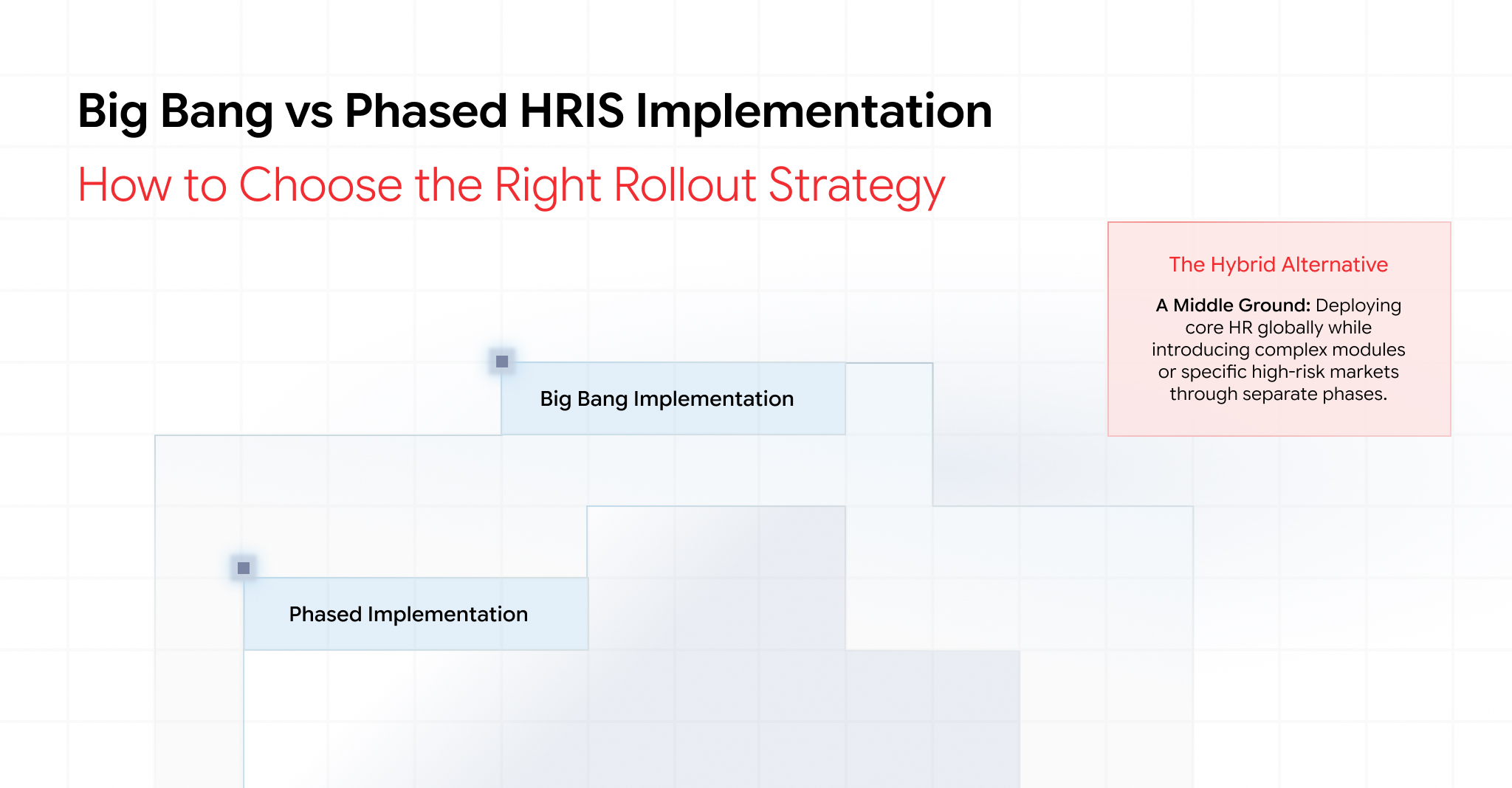
A hybrid strategy can combine approaches.
For example, an organisation might deploy core HR globally while introducing more complex modules through separate phases.
Another approach might deploy several countries together while treating highly complex markets as separate waves.
This can allow the organisation to align deployment sequencing with business and technical dependencies.
How Should HR Leaders Measure Rollout Success?
Organisations should also assess:
- User adoption
- Transaction completion
- Data accuracy
- Integration reliability
- Support volumes
- Process cycle times
- Employee experience
- Manager experience
- Business continuity
- Achievement of transformation objectives
A technically successful go live can still fail to deliver value if users avoid the system or critical processes remain manual.
Big Bang or Phased: The Decision Should Follow the Operating Reality
Key Takeaways
- Big bang and phased HRIS implementations each have different risk and complexity profiles.
- Big bang concentrates deployment activity into a defined transition.
- Phased implementation distributes deployment across controlled waves.
- Neither approach is universally appropriate.
- Data, integrations, module dependencies, country complexity, and organisational readiness should influence rollout decisions.
- A hybrid strategy can combine elements of both approaches.
- Clear entry and exit criteria can improve deployment governance.
- HRIS rollout success should be measured through adoption, stability, process performance, and business value, not simply go live.
Speak with our HR technology experts about building an implementation approach aligned with your business requirements.
FAQ
What is a big bang HRIS implementation?
A big bang HRIS implementation deploys the agreed HRIS scope to a large or complete target population during one coordinated go live.
What is a phased HRIS implementation?
A phased HRIS implementation deploys the system progressively across modules, countries, business units, processes, or employee groups.
Is big bang or phased implementation better?
Neither approach is universally better. The appropriate strategy depends on factors such as data readiness, integration complexity, module dependencies, country variation, organisational readiness, and programme governance.
What should an HRIS implementation plan include?
An HRIS implementation plan should address requirements, process design, configuration, data migration, integrations, testing, security, change management, training, cutover, support, governance, and success measures.
What is an HRIS rollout strategy?
An HRIS rollout strategy defines how and when the HRIS will be deployed across the organisation, including deployment sequencing, scope, dependencies, readiness criteria, and support requirements.
Can an organisation combine big bang and phased implementation?
Yes. A hybrid deployment can use a broader rollout for some capabilities or populations while introducing more complex modules, countries, or processes through separate phases.
Share with your network