Table of Contents
- Why Do Organisations Need a Structured Interview Process?
- How Should Organisations Design Structured Interview Questions?
- What Interview Evaluation Criteria Should You Use?
- How Do You Build an Interview Scoring Rubric?
- What Should an Interview Scorecard Include?
- How Can Organisations Implement a Standardized Interview Process?
- How Can Organisations Measure the Effectiveness of Interview Frameworks?
- How Can Rolling Arrays Help Organisations Improve Hiring Decisions?
- Frequently Asked Questions
Resources > Blog > How to Build a Structured Interview Framework for Consistent Hiring Decisions
How to Build a Structured Interview Framework for Consistent Hiring Decisions
November 02, 2026
Why Do Organisations Need a Structured Interview Process?
These differences can lead to inconsistent outcomes, even when interviewers assess candidates for the same role.
A structured interview process addresses this problem by establishing a common assessment approach before interviews begin. Candidates are evaluated against the same core competencies, using comparable questions and predefined criteria.
For organisations hiring across multiple teams, business units or locations, this consistency becomes particularly important. It helps HR teams maintain common hiring standards while allowing individual roles to retain their specific requirements.
The goal is not to make every interview identical. It is to ensure that hiring decisions reflect relevant evidence rather than differences in interviewer preference.
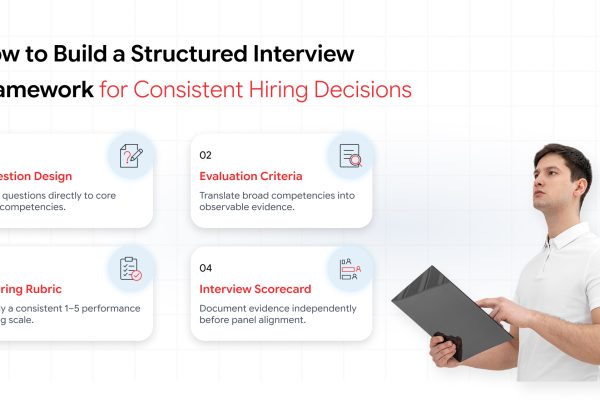
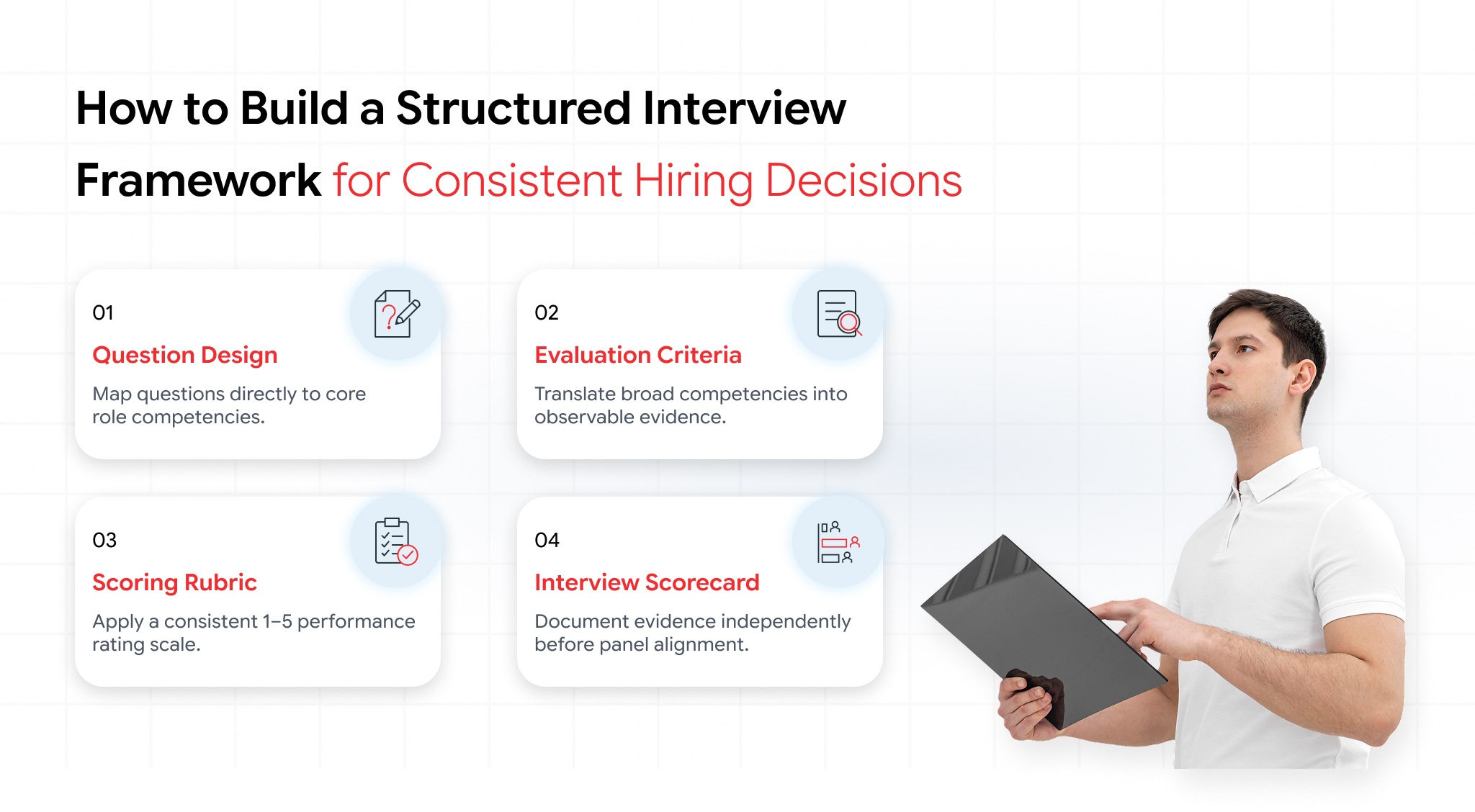
How Should Organisations Design Structured Interview Questions?
HR and hiring managers should first identify the capabilities that determine success in the position. Depending on the role, these may include technical knowledge, problem solving, stakeholder management, decision making, communication or people leadership. Structured questions can also help in assessing candidates’ capabilities and potential, including transferable skills, learning ability and behavioural strengths.
Each competency should then have questions designed to gather relevant evidence.
For example, a question assessing problem solving could ask a candidate to describe a complex problem they faced, the options they considered, the decision they made and the outcome.
A question assessing stakeholder management could explore how the candidate handled conflicting priorities, communicated trade offs and reached an agreement.
A strong question framework should include:
- Competency: What capability does the question assess?
- Question: What should the interviewer ask every candidate for the same role?
- Evidence sought: What information would demonstrate the capability?
- Follow up prompts: Which additional questions can clarify an incomplete answer?
- Rating guidance: What distinguishes a weak response from a strong one?
Organisations can also include role specific technical assessments or practical exercises where these provide meaningful evidence of capability.
What Interview Evaluation Criteria Should You Use?
Criteria should reflect what the candidate needs to demonstrate in the role. They should be specific enough to guide assessment without becoming unnecessarily complicated.
For example, stakeholder management might be assessed through the candidate’s ability to identify stakeholder needs, communicate competing priorities, manage disagreement and explain the outcome.
Before interviews begin, the hiring team should agree on the competencies to assess, their relative importance and the evidence required for each rating.
Not every competency needs equal weighting. A technical role may require greater emphasis on specialist capability, while a leadership position may place more weight on decision making, team development and strategic judgement.
The criteria should remain consistent for candidates applying for the same role, with any justified adjustments documented.
How Do You Build an Interview Scoring Rubric?
A practical rubric can use a five point scale.
Score 1: Does not meet expectations
The response lacks relevant evidence, demonstrates significant gaps or fails to address the competency.
Score 2: Partially meets expectations
The candidate demonstrates limited understanding but provides incomplete evidence or requires substantial support.
Score 3: Meets expectations
The response demonstrates the capability required for the role, supported by relevant examples or reasoning.
Score 4: Exceeds expectations
The candidate provides strong evidence of independent judgement, effective execution and relevant results.
Score 5: Significantly exceeds expectations
The response demonstrates exceptional capability, sound judgement and strong evidence of results beyond the normal requirements of the role.
These descriptions should be adapted to the competency being assessed. A score of five for technical problem solving should represent different evidence from a score of five for people leadership.
The organisation should also define what happens when evidence is insufficient. An interviewer should be able to record that a competency was not adequately assessed rather than assigning an arbitrary score.
What Should an Interview Scorecard Include?
A useful interview scorecard should include:
- Candidate name and role.
- Interview stage and interviewer details.
- Competencies and corresponding structured interview questions.
- Predefined interview evaluation criteria.
- Individual competency ratings and supporting evidence.
- Overall assessment and hiring recommendation.
- Areas requiring further assessment.
- Final decision rationale and any documented exceptions.
Interviewers should record evidence before discussing their overall impressions with other interviewers. This reduces the risk of one person’s opinion influencing the initial assessments of the entire panel.
The scorecard should support decision making rather than replace it. A total score can help organise evidence, but a hiring decision should also consider critical role requirements, assessment quality and any significant capability gaps.
How Can Organisations Implement a Standardized Interview Process?
Define role requirements
Work with hiring managers to identify the outcomes, competencies and essential requirements for the role.
Create a question bank
Develop structured interview questions mapped to each competency. Review questions for relevance, clarity and unnecessary barriers that could disadvantage suitable candidates.
Agree on scoring standards
Create a shared interview scoring rubric with examples of the evidence expected at each rating level.
Train interviewers
Explain how to ask questions consistently, take evidence based notes, avoid irrelevant personal impressions and apply the scoring criteria.
Calibrate assessments
Before or during implementation, use sample responses or practice interviews to check whether interviewers interpret the criteria consistently.
Review decisions and outcomes
Periodically examine score patterns, interviewer differences, candidate progression, hiring outcomes and feedback. Use these findings to improve the framework.
A standardised process should preserve appropriate flexibility. Follow up questions may be necessary to clarify a candidate’s response, but they should not fundamentally change the assessment applied to different candidates for the same role.
How Can Organisations Measure the Effectiveness of Interview Frameworks?
HR leaders can monitor several indicators:
- Assessment consistency: Whether interviewers apply comparable standards to similar evidence.
- Decision quality: Whether hiring decisions align with documented role requirements and assessment evidence.
- Candidate experience: Whether candidates understand the process and experience a fair, organised assessment.
- Hiring manager confidence: Whether managers trust the evidence used to make hiring decisions.
- Quality of hire: Whether new hires demonstrate the expected performance and capability after joining.
- Fairness across candidate groups: Whether assessment outcomes reveal unexplained differences that require further investigation.
Organisations should review these indicators together. A consistent scoring process does not automatically guarantee a successful hire, and a high interview score does not guarantee future performance.
Over time, comparing interview assessments with subsequent employee outcomes can help organisations determine which competencies and questions provide useful evidence of job performance. This also helps HR leaders focus on measuring quality of hire through indicators such as employee performance, retention and productivity.
How Can Rolling Arrays Help Organisations Improve Hiring Decisions?
Rolling Arrays helps organisations approach workforce and HR transformation through structured decision frameworks that connect business priorities with people, processes and technology. This perspective can support organisations seeking to strengthen recruitment governance, improve the quality of workforce decisions and build more consistent talent practices.
The objective is to establish a hiring approach that is repeatable, transparent and relevant to business needs, while allowing hiring teams to exercise informed judgement.
FAQ
What Is a Structured Interview Process?
A structured interview process uses predefined questions, consistent evaluation criteria and a common scoring approach to assess candidates against role requirements.
What Is the Difference Between Structured and Unstructured Interviews?
Structured interviews use agreed questions and assessment standards. Unstructured interviews give interviewers greater freedom to choose questions and evaluate candidates, which can introduce more variation between assessments.
What Is an Interview Scoring Rubric?
An interview scoring rubric defines performance levels and the evidence expected at each level. It helps interviewers assess candidate responses against consistent standards.
What Should an Interview Scorecard Include?
An interview scorecard should include role competencies, interview questions, evaluation criteria, ratings, supporting evidence, areas requiring further assessment and a hiring recommendation.
Does a Structured Interview Process Eliminate Hiring Bias?
No. Structure can reduce some sources of inconsistency and subjective judgement, but bias can still affect question design, criteria, scoring and final decisions. Organisations should review their processes and outcomes regularly.
How Can Organisations Know Whether Their Interview Framework Works?
Organisations can examine assessment consistency, candidate experience, hiring decisions and subsequent employee performance. Reviewing interview scores against later outcomes can help identify which assessments provide useful evidence of job success.
Share with your network