
Table of Contents
- Why Does an HRIS Fail to Deliver the Expected Value?
- What Are the Three Paths Out of a Disappointing HRIS?
- How Do You Know Which Path Is Right?
- What Does Each Option Cost?
- How Long Does Each Path Take?
- What Should Leaders Compare Before Choosing a Path?
- Why Should Organizations Calculate the Cost of Staying With the Current HRIS?
- What Are the Risks of Repairing an HRIS?
- When Does Reimplementation Make More Sense Than Repair?
- When Should Organizations Seriously Consider Replacing Their HRIS?
- What Happens If an Organization Chooses the Wrong Path?
- How Should Leaders Build the Business Case for the Three Options?
- How Can an HRIS Health Check Help Leaders Choose Between the Three Paths?
- How Should Organizations Sequence the Decision?
- What Should Leaders Ask Before Making an HRIS Decision?
Resources > Blog > Should You Replace, Reimplement, or Repair a Disappointing HRIS?
Should You Replace, Reimplement, or Repair a Disappointing HRIS?
September 2, 2026
Overview
A disappointing HRIS does not automatically mean an organization needs a new platform. The underlying problem may sit in the implementation, process design, governance, adoption, data, or the technology itself. Before committing to another major investment, leaders need to understand which problem they are actually trying to solve. This article examines three practical paths: repair the existing environment, reimplement it, or replace it, including the cost, timeline, risks, and situations that make each option appropriate.
Why Does an HRIS Fail to Deliver the Expected Value?
The platform may be live, employees may have access, and core processes may function. Yet HR teams can still rely on spreadsheets, managers may avoid self service, processes may require manual intervention, and leadership may struggle to trust workforce data.
When this happens, organizations often reach a familiar conclusion:
“The system isn’t working. We need a new one.”
That conclusion may be correct.
But it may also solve the wrong problem.
A disappointing HRIS can result from several different issues:
- Poor process design before implementation.
- Excessive customization.
- Weak data quality.
- Incomplete integrations.
- Low employee or manager adoption.
- Inadequate training and change management.
- Unclear process ownership.
- Weak governance after go live.
- Underused platform capabilities.
- Technology limitations that genuinely restrict future requirements.
These problems require different responses.
Replacing the platform may address a technology limitation, but it will not automatically fix poor processes or weak governance.
Reimplementing may correct a poorly designed implementation, but it requires significant investment and organizational commitment.
Repairing the existing environment may deliver the fastest improvement when the underlying platform remains capable.
The first decision should therefore not be:
“Which new HRIS should we buy?”
It should be:
“Why is our current HRIS failing to deliver the outcomes we expected?”
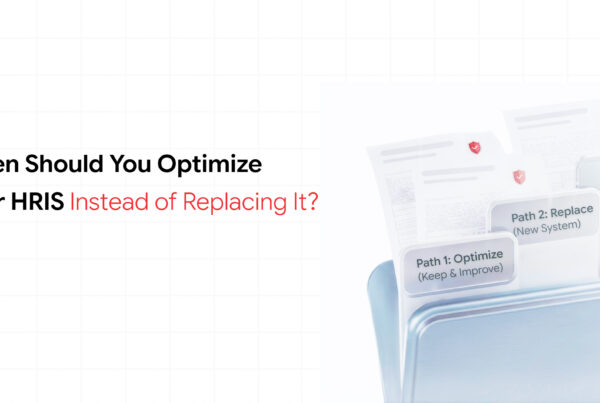
What Are the Three Paths Out of a Disappointing HRIS?
- Repair the existing environment.
- Reimplement the existing platform.
- Replace the platform with a different technology.
Each path addresses a different type of problem.
Path 1: Repair the Existing HRIS
Repair means keeping the current platform while addressing the specific issues preventing it from delivering value.
This can involve:
- Simplifying processes.
- Removing unnecessary customizations.
- Improving configuration.
- Fixing integrations.
- Cleaning workforce data.
- Improving security and governance.
- Increasing employee and manager adoption.
- Activating underused platform capabilities.
- Redesigning inefficient workflows.
- Strengthening reporting and analytics.
Repair often makes sense when the technology remains capable but the organization has not fully optimized how it uses the platform.
Path 2: Reimplement the Existing HRIS
Reimplementation means retaining the same core technology but redesigning the implementation.
This option becomes relevant when the original implementation created structural problems that organizations cannot easily correct through incremental changes.
For example, the organization may have:
- Designed processes around legacy practices.
- Created excessive customizations.
- Built complicated integrations.
- Configured the platform inconsistently.
- Failed to establish appropriate governance.
- Implemented without sufficient business ownership.
- Created a poor employee experience.
- Made decisions that no longer support the current operating model.
Reimplementation allows the organization to revisit these decisions without changing the underlying platform.
This can be particularly relevant when the organization still believes the existing technology meets its future requirements.
Path 3: Replace the HRIS
Replacement means selecting and implementing a different HR technology platform.
This is the most significant of the three options.
Replacement may make sense when the current platform has fundamental limitations that prevent it from supporting the organization’s future requirements.
Examples include:
- The platform cannot support critical business requirements.
- Architecture creates unacceptable integration constraints.
- The technology cannot scale with the organization.
- Required capabilities remain unavailable or immature.
- Vendor direction no longer aligns with the organization’s strategy.
- Total cost of ownership has become difficult to justify.
- The organization requires capabilities that the existing platform cannot reasonably provide.
Replacement can create a fresh technology foundation.
However, it also introduces significant implementation, migration, change, integration, and adoption requirements.
How Do You Know Which Path Is Right?
A useful diagnostic starts by separating the symptoms from their underlying causes.
Repair is usually worth considering when:
- The platform supports the organization’s future requirements.
- Core architecture remains sound.
- Most problems relate to configuration or process design.
- Adoption remains below expectations.
- The organization underuses existing capabilities.
- Data and integration issues are fixable.
- The business can improve outcomes without changing platforms.
Reimplementation is usually worth considering when:
- The platform remains strategically suitable.
- The original implementation created significant structural problems.
- Process design requires substantial redesign.
- Customization has become difficult to manage.
- Governance decisions made during the original implementation no longer work.
- Incremental fixes would create more complexity than a controlled redesign.
Replacement is usually worth considering when:
- The technology cannot support important future requirements.
- Fundamental architecture limitations constrain transformation.
- The platform creates unacceptable business or technology risk.
- The organization has evaluated realistic optimization opportunities and still sees a significant capability gap.
- The future HR operating model requires capabilities the existing platform cannot reasonably deliver.
The key is to evaluate the root cause before choosing the remedy.
What Does Each Option Cost?
Therefore, leaders should avoid treating any cost range as a guaranteed project price.
A useful planning model is to compare the relative investment profile.
Repair
Typical investment profile: Low to medium
Repair usually focuses on targeted improvements rather than rebuilding the entire environment.
Costs may include:
- Consulting and optimization.
- Configuration changes.
- Process redesign.
- Integration fixes.
- Data remediation.
- Training and adoption.
- Governance improvements.
Cost advantage: Organizations can target the highest value problems without funding a complete implementation.
Reimplementation
Typical investment profile: Medium to high
Reimplementation requires substantial redesign and delivery effort while retaining the underlying platform.
Costs may include:
- Process redesign.
- New configuration.
- Data migration or remediation.
- Integration redesign.
- Testing.
- Change management.
- Training.
- Program management.
Cost advantage: Organizations retain existing platform knowledge and infrastructure while addressing structural implementation problems.
Replacement
Typical investment profile: High to very high
Replacement typically requires a full technology selection and implementation program.
Costs may include:
- Software licensing.
- Technology implementation.
- Data migration.
- Integration development.
- Process redesign.
- Testing.
- Change management.
- Training.
- Program management.
- Parallel operations or transition costs.
Cost consideration: The organization should also account for the cost of retiring the existing platform and supporting the transition.
The most expensive option is not always replacement.
Keeping a poorly performing platform for several more years can also create significant costs through manual work, low adoption, poor data quality, operational inefficiency, and missed business opportunities.
How Long Does Each Path Take?
Repair
Indicative timeline: Several weeks to several months
Targeted improvements can often move faster because organizations do not need to redesign the entire HR environment.
The timeline depends on:
- Number of issues.
- Integration complexity.
- Data quality.
- Configuration changes.
- Testing requirements.
- Organizational readiness.
Reimplementation
Indicative timeline: Several months to more than a year
A reimplementation requires significant redesign, configuration, testing, migration activities, and organizational change.
The timeline increases when the organization operates across multiple countries or has complex integrations.
Replacement
Indicative timeline: Approximately one to three years for a large enterprise transformation
A replacement typically requires:
- Technology selection.
- Business case approval.
- Future state design.
- Implementation.
- Data migration.
- Integration.
- Testing.
- Change management.
- Training.
- Deployment.
- Post go live stabilization.
The actual timeline depends heavily on scope, geography, workforce size, technology complexity, and implementation strategy.
The important point is that replacement represents a transformation program, not simply a software purchase.
What Should Leaders Compare Before Choosing a Path?
A practical assessment should consider:
- Business fit: Can the solution support the future HR operating model?
- Technology capability: Can the platform support current and future requirements?
- Process maturity: Are process problems driving the dissatisfaction?
- Data quality: Can the organization trust its workforce data?
- Adoption: Are employees and managers using the system effectively?
- Integration: Can the existing architecture support future requirements?
- Total cost: What will the organization spend over the next three to five years?
- Transformation risk: What could delay or disrupt the business?
- Time to value: How quickly can the organization achieve measurable improvements?
- Future readiness: Can the environment support automation, analytics, and AI enabled capabilities?
A decision that focuses only on software functionality can miss several of the factors that determine long term success.
Why Should Organizations Calculate the Cost of Staying With the Current HRIS?
Leaders often compare the cost of replacement against the current technology budget.
That comparison may be incomplete.
The organization should also consider:
- Manual work created by inefficient processes.
- Additional HR administration.
- Rework caused by poor data quality.
- Integration maintenance.
- Low employee and manager adoption.
- Unused technology capabilities.
- Customization and support costs.
- Compliance and data risks.
- Delayed workforce insights.
- Missed opportunities to automate repetitive work.
- Delayed AI adoption.
This creates a more complete investment question:
What will each option cost, and what value can each option create?
A repair strategy may require less investment but deliver limited future capability.
A replacement may require significant investment but create a stronger long term foundation.
Reimplementation may sit between the two.
The right decision depends on the organization’s specific situation.
What Are the Risks of Repairing an HRIS?
Repairing an HRIS can deliver faster improvements, but it can also create a cycle of incremental fixes if the organization does not address the underlying problems.
The repair approach becomes risky when teams continue adding configuration changes without revisiting the original process design.
Common warning signs include:
- New fixes repeatedly create new workarounds.
- Customizations continue to increase.
- Different business units request separate solutions for similar problems.
- Integration complexity continues to grow.
- Employees still avoid the intended processes.
- HR teams continue relying on spreadsheets after multiple optimization efforts.
- Technology limitations remain unresolved.
When these patterns continue, leaders should reconsider whether repair remains the right strategy.
The objective should not be to keep the existing system at any cost.
The objective should be to create the best balance between business value, investment, risk, and future readiness.
When Does Reimplementation Make More Sense Than Repair?
For example, an organization may have implemented its HRIS several years ago around processes that no longer reflect how the business operates.
Since then, the organization may have:
- Expanded into new markets.
- Changed its operating model.
- Added new business units.
- Introduced new workforce policies.
- Built additional integrations.
- Added customizations to address short term requirements.
- Changed employee expectations.
- Introduced new automation or AI priorities.
At this point, fixing individual problems may only address symptoms.
A reimplementation gives the organization an opportunity to step back and redesign the environment around current and future requirements.
The critical question is:
Can the existing platform support the future state if the organization implements it correctly?
If the answer is yes, reimplementation may provide a stronger path than replacement.
When Should Organizations Seriously Consider Replacing Their HRIS?
Leaders should consider replacement when:
- The platform cannot support critical business requirements.
- The technology architecture creates significant constraints.
- Integration limitations restrict the organization’s future operating model.
- The vendor roadmap does not align with strategic priorities.
- Required capabilities remain unavailable.
- Security, compliance, or scalability concerns cannot be adequately addressed.
- The total cost of continuing with the platform no longer makes business sense.
- The organization has evaluated repair and reimplementation and still identifies a significant capability gap.
Replacement should not begin with a vendor shortlist.
It should begin with a clear understanding of the business requirements and the reasons the current environment cannot support them.
This prevents organizations from repeating the same implementation problems with a different platform.
What Happens If an Organization Chooses the Wrong Path?
Choosing Repair When Replacement Is Necessary
The organization may continue investing in a platform that cannot meet future requirements.
This can lead to:
- Repeated consulting costs.
- Growing customization.
- Increasing technical debt.
- Delayed transformation.
- Continued employee frustration.
- Missed opportunities for automation and AI.
Choosing Replacement When Repair Would Have Worked
The organization may spend years and significant capital replacing a platform that could have delivered sufficient value through optimization.
This can create:
- Unnecessary implementation costs.
- Data migration risk.
- Employee disruption.
- Change fatigue.
- New integration challenges.
- Delayed business benefits.
Choosing Reimplementation When the Platform Has Fundamental Limitations
The organization may invest heavily in redesigning a platform that still cannot support its future requirements.
This creates the worst of both worlds: significant implementation effort without resolving the underlying technology problem.
The decision therefore requires an objective assessment before committing to a path.
Choosing Repair When Replacement Is Necessary
The organization may continue investing in a platform that cannot meet future requirements.
This can lead to:
- Repeated consulting costs.
- Growing customization.
- Increasing technical debt.
- Delayed transformation.
- Continued employee frustration.
- Missed opportunities for automation and AI.
Choosing Replacement When Repair Would Have Worked
The organization may spend years and significant capital replacing a platform that could have delivered sufficient value through optimization.
This can create:
- Unnecessary implementation costs.
- Data migration risk.
- Employee disruption.
- Change fatigue.
- New integration challenges.
- Delayed business benefits.
Choosing Reimplementation When the Platform Has Fundamental Limitations
The organization may invest heavily in redesigning a platform that still cannot support its future requirements.
This creates the worst of both worlds: significant implementation effort without resolving the underlying technology problem.
The decision therefore requires an objective assessment before committing to a path.
Choosing Repair When Replacement Is Necessary
The organization may continue investing in a platform that cannot meet future requirements.
This can lead to:
- Repeated consulting costs.
- Growing customization.
- Increasing technical debt.
- Delayed transformation.
- Continued employee frustration.
- Missed opportunities for automation and AI.
Choosing Replacement When Repair Would Have Worked
The organization may spend years and significant capital replacing a platform that could have delivered sufficient value through optimization.
This can create:
- Unnecessary implementation costs.
- Data migration risk.
- Employee disruption.
- Change fatigue.
- New integration challenges.
- Delayed business benefits.
Choosing Reimplementation When the Platform Has Fundamental Limitations
The organization may invest heavily in redesigning a platform that still cannot support its future requirements.
This creates the worst of both worlds: significant implementation effort without resolving the underlying technology problem.
The decision therefore requires an objective assessment before committing to a path.
How Should Leaders Build the Business Case for the Three Options?
A practical business case should consider:
Current state cost
- Existing licensing and support.
- Manual HR effort.
- Customization and maintenance.
- Integration costs.
- Data remediation.
- Operational inefficiencies.
Repair case
Required optimization investment.
Expected efficiency improvements.
Adoption improvements.
Time to value.
Remaining technology limitations.
Reimplementation case
Redesign and implementation investment.
Data and integration work.
Change and adoption costs.
Expected process improvements.
Future scalability.
Replacement case
New technology investment.
Implementation and migration costs.
Integration and data costs.
Change management.
Transition and retirement costs.
Expected future business value.
The business case should also consider the cost of doing nothing.
Sometimes the most expensive option is not the one with the largest implementation budget.
It is the option that leaves the organization with a poorly performing HR environment for another three to five years.
How Can an HRIS Health Check Help Leaders Choose Between the Three Paths?
The assessment should examine more than technology.
It should evaluate:
- Business and HR strategy alignment
- HR operating model
- End to end processes
- Platform capabilities
- Configuration
- Integrations
- Workforce data
- Security and governance
- Employee and manager adoption
- Reporting and analytics
- Automation opportunities
- AI readiness
- Total cost of ownership
- Business value and ROI
This provides leaders with evidence before they commit to a major technology decision.
The outcome should not be predetermined.
A good assessment may conclude that the organization should optimize the current platform.
It may recommend a structured reimplementation.
It may also demonstrate that replacement offers the strongest long term business case.
The value comes from making the decision based on evidence rather than frustration with the current system.
How Should Organizations Sequence the Decision?
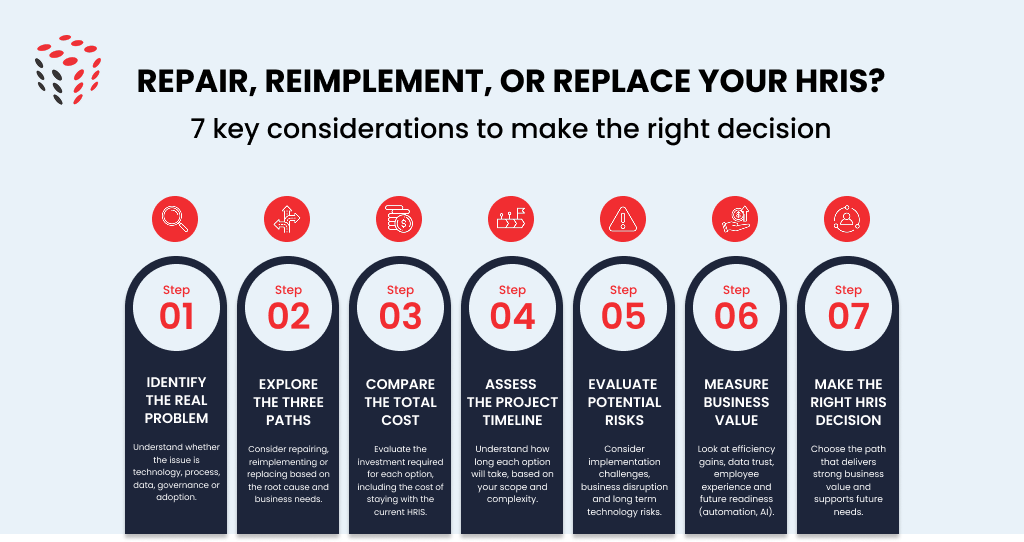
Step 1: Define the Business Problem
Start with the business outcomes the organization needs from HR.
Identify where the current environment creates measurable problems in efficiency, employee experience, workforce decision making, compliance, scalability, or business support.
Step 2: Diagnose the Root Cause
Separate technology limitations from process, data, governance, adoption, and operating model problems.
This prevents organizations from treating every problem as a software problem.
Step 3: Compare Repair, Reimplementation, and Replacement
Evaluate each path against:
- Cost
- Timeline
- Risk
- Business value
- Technology capability
- Future readiness
- Time to value
Step 4: Build the Transformation Roadmap
Once the preferred path is clear, define the sequence of changes required to achieve the future state.
The roadmap should establish:
- Priorities
- Investment requirements
- Ownership
- Key milestones
- Business outcomes
- Adoption requirements
- Governance
- Measurement
This creates a decision process that leaders can defend to the board and Finance rather than simply presenting a preferred technology.
What Should Leaders Ask Before Making an HRIS Decision?
- What exactly is disappointing about the current HRIS?
- Is the problem technology, process, data, governance, or adoption?
- Can the existing platform support our future operating model?
- Which problems can we fix within the current environment?
- What would a clean reimplementation solve?
- What problems would remain even after reimplementation?
- What would replacement solve that the other options cannot?
- What will each option cost over the next three to five years?
- How quickly can each option create measurable value?
- What business disruption will each option create?
- How will the organization support adoption?
- Can the chosen environment support future automation and AI enabled capabilities?
These questions help move the discussion away from “Which platform should we buy?” toward the more important question:
“Which path creates the strongest business outcome for our organization?”
Conclusion
A disappointing HRIS does not automatically require replacement.
Organizations have three strategic paths: repair the existing environment, reimplement the current platform, or replace it.
Repair can make sense when the technology remains capable and the problems sit mainly in process, configuration, data, governance, or adoption.
Reimplementation can make sense when the platform remains strategically appropriate but the original implementation created structural complexity.
Replacement becomes more compelling when the technology itself creates fundamental limitations that prevent the organization from supporting future business requirements.
The right decision requires more than comparing software features or implementation costs.
Leaders should evaluate the root cause, total cost, timeline, business risk, time to value, and future readiness of each option.
The best HRIS decision is not necessarily the decision to buy new technology.
It is the decision that creates the strongest foundation for the organization’s future workforce, operating model, and business priorities.
FAQ
Should an organization replace an HRIS that is not delivering expected value?
Not necessarily. Organizations should first determine whether the problem comes from technology limitations or from processes, configuration, data, governance, or adoption. Repair or reimplementation may create better value when the existing platform remains capable.
What is the difference between repairing and reimplementing an HRIS?
Repair focuses on targeted improvements within the existing environment. Reimplementation involves redesigning and rebuilding the implementation while retaining the same core HR technology.
When should an organization replace its HRIS?
Replacement becomes appropriate when the existing technology cannot reasonably support critical current or future business requirements, and repair or reimplementation cannot address the underlying limitations.
Which HRIS option is the cheapest?
Repair generally requires the lowest initial investment, while reimplementation and replacement require greater investment. However, leaders should evaluate total cost and business value over several years rather than comparing implementation costs alone.
How long does an HRIS replacement take?
A large enterprise HRIS replacement can take approximately one to three years, depending on scope, workforce size, countries, integrations, data complexity, and implementation approach. Smaller or more focused programs can take less time.
How can organizations decide between repair, reimplementation, and replacement?
A structured HRIS health check can assess the current technology, processes, operating model, data, integrations, governance, adoption, cost, and future requirements. This provides evidence for choosing the most appropriate path.




Share with your network
Get updates in your inbox