
Table of Contents
- Why Should Organizations Assess AI Readiness Before Evaluating AI Agents?
- What Makes AI Agent Readiness Different from Traditional Technology Readiness?
- What Six Foundations Determine Whether HR Is Ready for AI Agents?
- What Warning Signs Show That Your HR Function Is Not Ready for AI Agents?
- How Can Leaders Assess Their Current HR Technology Environment?
- How Should Organizations Prioritize AI Agent Use Cases?
- What Is the Right Path from AI Readiness to Agentic AI Execution?
- How Does Align, Automate, Adopt Support AI Agent Readiness?
- What Questions Should Leaders Answer Before Approving an AI Agent Initiative?
Resources > Blog >Is Your HR Function Ready for AI Agents? What Leaders Should Assess Before Evaluating Technology
Is Your HR Function Ready for AI Agents? What Leaders Should Assess Before Evaluating Technology
July 17, 2026
Overview
AI agents are creating new opportunities for HR teams to automate work, support employees, and improve workforce decision-making. However, adopting agentic AI requires more than selecting technology or identifying an interesting use case. AI agents depend on reliable workforce data, connected processes, clear system permissions, strong governance, technology integration, and defined human oversight. Organizations should evaluate these foundations before scaling AI across the HR function. This article explores how leaders can assess AI readiness, identify gaps in their existing HR environment, and build a practical path from AI opportunities to responsible enterprise adoption.
Why Should Organizations Assess AI Readiness Before Evaluating AI Agents?
Organizations should assess AI readiness before evaluating AI agents because the value of agentic AI depends on the business, process, data, technology, and governance foundations that support it.
Vendor demonstrations can show what an AI agent can do under controlled conditions. Enterprise deployment presents a different challenge. The agent must work within real HR processes, access appropriate workforce data, interact with existing systems, follow organizational policies, and operate within clearly defined boundaries.
When organizations evaluate AI capabilities before assessing these foundations, they may select attractive use cases that become difficult to scale.
Common challenges include:
- Workforce data spread across disconnected systems.
- Different business units following inconsistent HR processes.
- Unclear ownership of workforce data and AI outcomes.
- Integrations that cannot support reliable data exchange.
- System permissions that do not reflect how AI agents will access information or perform actions.
- Limited processes for human review, escalation, and intervention.
- Employees and managers who do not understand how to work with AI-enabled processes.
An AI readiness assessment helps leaders identify these gaps before committing significant resources to technology selection, pilots, or enterprise deployment.
The objective is not to delay AI adoption. It is to create a stronger foundation for selecting the right opportunities, reducing implementation risks, and scaling successful AI initiatives.
What Makes AI Agent Readiness Different from Traditional Technology Readiness?
AI agent readiness requires organizations to evaluate autonomy, data access, decision rights, accountability, and human oversight in addition to the infrastructure, integration, and implementation capabilities assessed during traditional technology initiatives.
Traditional HR technology implementations usually follow predictable workflows. Organizations define business requirements, configure systems, establish integrations, assign user permissions, and train employees to use the platform.
AI agents introduce a different operating model.
Depending on the use case and level of autonomy, an AI agent may:
- Interpret employee requests.
- Retrieve information from multiple enterprise systems.
- Recommend actions or decisions.
- Initiate workflows.
- Coordinate activities across applications.
- Perform tasks on behalf of employees or managers.
- Escalate exceptions that require human intervention.
These capabilities create new questions for HR, IT, security, risk, and business leaders.
Who can authorize an AI agent to perform an action?
Which workforce data can the agent access?
What happens when the agent encounters incomplete or conflicting information?
When must a person review or approve an AI-supported action?
Who owns the outcome when an agent makes an incorrect recommendation or performs the wrong action?
Organizations need clear answers before they scale agentic AI.
Traditional HR Technology Readiness vs AI Agent Readiness
Traditional HR technology readiness focuses on whether an organization can implement the system, whether integrations are available, whether user roles are configured, and whether processes are properly documented. It also considers whether users are adequately trained, who owns the system, and whether the platform meets organizational requirements.
AI Agent Readiness goes a step further by assessing whether the organization can govern autonomous or semi-autonomous actions. It examines whether agents can access and exchange reliable data across systems, whether agent permissions, identities, and action boundaries are clearly defined, and whether processes are standardized enough for agents to interpret and execute reliably. It also considers whether employees and managers can work effectively with AI agents while providing appropriate oversight, who owns AI decisions, actions, risks, and outcomes, and whether the organization can continuously evaluate agent performance, risk, and business value.
The difference is significant.
Traditional technology readiness asks whether the organization can implement and operate a system.
AI agent readiness asks whether the organization can safely delegate specific tasks, decisions, and actions to AI while maintaining accountability and business control.
What Six Foundations Determine Whether HR Is Ready for AI Agents?
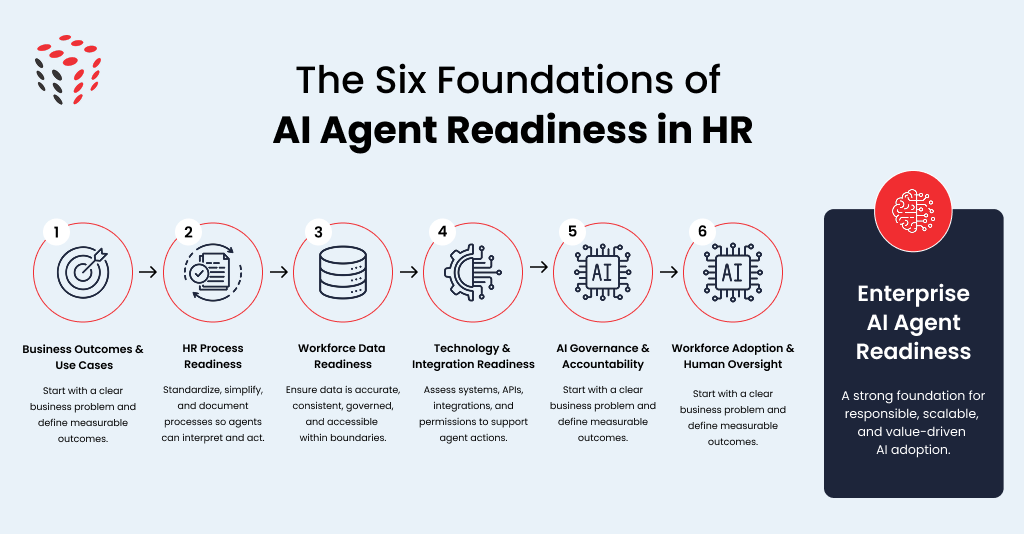
Six connected foundations determine whether an HR function can adopt and scale AI agents effectively: business outcomes, process readiness, workforce data, technology and integration, AI governance, and workforce adoption.
Organizations do not need perfect maturity across every foundation before starting an AI initiative. However, leaders should understand their current readiness, identify gaps that could prevent successful deployment, and prioritize improvements based on the AI use cases they want to pursue.
Business Outcomes and Use Cases
Organizations should not begin by asking:
Where can we deploy an AI agent?
They should begin by asking:
What HR or workforce problem are we trying to solve, and does agentic AI provide the right approach?
Potential objectives may include:
- Reducing repetitive HR administration.
- Improving employee access to HR services.
- Accelerating HR service delivery.
- Supporting managers with workforce insights.
- Coordinating activities across multiple HR systems.
- Improving compliance monitoring and exception management.
Each use case should connect to a measurable business outcome.
Without that connection, organizations risk creating AI pilots that demonstrate technical capability but fail to generate meaningful enterprise value.
HR Process Readiness
When the same HR process operates differently across business units, countries, or teams, organizations may struggle to define how an agent should behave.
Before introducing AI agents, leaders should evaluate:
- Whether the process has a clear business objective.
- Whether process steps and decision points are documented.
- Whether unnecessary approvals and manual handoffs remain.
- Whether teams follow consistent processes across the organization.
- Where exceptions occur and how the organization manages them.
- Which activities require human judgment or approval.
Organizations should simplify and standardize processes where possible before introducing intelligent automation.
The goal is not to force every HR process into a single model. Leaders need enough clarity and consistency to define where AI agents can act, where they should recommend, and where people must remain responsible.
Workforce Data Readiness
Fragmented, inconsistent, or poorly governed data can reduce the reliability of AI-supported actions and make enterprise scaling difficult.
Organizations should assess:
- Where workforce data resides.
- Whether systems use consistent data definitions.
- Who owns workforce data quality.
- Whether the organization regularly identifies and corrects data issues.
- Whether integrations provide timely and reliable information.
- Which sensitive employee data AI agents can access.
- Whether privacy, security, and retention requirements restrict data use.
- Whether the organization can trace the data that informs important AI-supported actions.
Workforce data readiness requires more than cleaning data for an AI pilot.
Organizations need clear ownership, common standards, appropriate access controls, and continuous data quality practices that support AI-enabled HR capabilities over time.
Technology and Integration Readiness
Organizations do not necessarily need to replace their existing HR platforms to adopt agentic AI. However, they should understand whether their current SAP SuccessFactors, Workday, or broader HR technology environment can support the AI use cases they want to pursue.
Leaders should assess:
- Whether HR systems provide the APIs and integration capabilities required for AI agents.
- Whether integrations exchange data reliably across enterprise systems.
- Whether identity and access controls can manage agent permissions.
- Whether the organization can restrict the actions an AI agent may perform.
- Whether technology teams can monitor agent activity and system interactions.
- Whether the architecture can support new AI-enabled capabilities without creating unnecessary complexity.
- Whether existing customizations or disconnected applications could limit scalability.
This assessment helps organizations identify where they can optimize their existing HR technology environment and where they need additional capabilities to support the AI roadmap.
The objective is not to pursue new technology for every AI opportunity. Leaders should determine how they can use, optimize, integrate, and extend their current technology investments to support business priorities.
AI Governance and Accountability
Traditional governance models may not fully address the questions that emerge when AI agents interact with workforce data, recommend decisions, or perform actions across enterprise systems.
Organizations should establish clear governance for:
- AI use case approval and prioritization.
- Agent identity, permissions, and access controls.
- Workforce data access and privacy.
- Human review and approval requirements.
- Escalation procedures for exceptions.
- Monitoring agent performance and outcomes.
- Managing inaccurate, biased, or inappropriate outputs.
- Documenting important AI-supported decisions and actions.
- Reviewing AI agents as regulations, technology, and business requirements evolve.
Accountability should remain clear even when an AI agent performs part of the work.
Leaders should know who owns the business process, who manages the technology, who monitors risk, and who has the authority to pause or modify an AI agent when performance falls below expectations.
Strong governance allows organizations to scale AI with greater confidence while maintaining appropriate business and human control.
Workforce Adoption and Human Oversight
Introducing AI agents changes more than technology. It can change how employees access HR services, how HR teams perform work, how managers make decisions, and how responsibilities move between people and intelligent systems.
Organizations should prepare the workforce by:
- Explaining where and why the organization will use AI agents.
- Clarifying which activities agents can perform.
- Defining when employees should review, approve, or challenge AI-supported actions.
- Training users to work effectively with AI-enabled processes.
- Establishing clear channels for feedback and escalation.
- Monitoring adoption, trust, and user experience.
- Updating roles and responsibilities as AI capabilities evolve.
Organizations should not measure adoption only through usage.
Leaders should evaluate whether AI agents improve the way people work, whether employees trust the processes around them, and whether human oversight remains effective as the organization scales AI.
What Warning Signs Show That Your HR Function Is Not Ready for AI Agents?
Common warning signs include:
- Leaders cannot clearly explain the business problem an AI agent should solve.
- Different teams follow significantly different versions of the same HR process.
- Workforce data remains fragmented across disconnected systems and spreadsheets.
- HR teams frequently question the accuracy of workforce data.
- Existing integrations require significant manual intervention.
- Organizations have not defined how AI agents will access systems or data.
- No leader or function clearly owns AI outcomes and risks.
- Teams launch AI pilots without defining measurable business outcomes.
- Employees do not understand when to trust, review, or challenge AI-supported actions.
- Organizations evaluate vendors before assessing whether their existing HR environment can support the proposed AI use cases.
These warning signs do not mean organizations should stop exploring AI.
They indicate where leaders should strengthen the HR environment before moving from isolated experiments to enterprise-scale agentic AI adoption.
- Local languages and communication preferences.
- Manager readiness to support new ways of working.
- Employee familiarity with digital HR services.
- Access to technology across different workforce groups.
- Cultural expectations around leadership, feedback, and organizational change.
- Availability of local HR teams and change champions.
Successful multi-country transformations establish common adoption objectives while allowing country teams to adapt how they communicate, train, and support employees.
The goal is not to create a different change strategy for every country. Leaders should establish enterprise-wide principles and give regional and local teams enough flexibility to make adoption relevant to their workforce.
How Can Leaders Assess Their Current HR Technology Environment?
Leaders can assess their current HR technology environment by evaluating whether existing processes, configurations, integrations, workforce data, governance, and adoption support current business priorities and future AI use cases.
For organizations already using SAP SuccessFactors or Workday, the first question should not automatically be whether they need another platform.
Leaders should first understand how effectively the existing HR technology environment supports the organization today.
A structured HR technology assessment should examine:
The assessment covers eight key areas. Business Alignment evaluates whether the current HR technology environment supports changing business and workforce priorities. Process Effectiveness examines whether inefficient processes, manual workarounds, or unnecessary variations have developed over time. Platform Optimization assesses whether the organization is fully utilizing the capabilities available within its existing HR technology environment.
Integrations focus on whether systems can exchange reliable and timely information across the enterprise, while Workforce Data evaluates whether leaders can trust the data required for reporting, analytics, automation, and AI. Governance considers whether ownership, decision rights, access controls, and accountability are clearly defined.
Adoption assesses whether employees and managers consistently use the processes and capabilities available to them. Finally, AI Readiness evaluates whether the existing environment can support prioritized AI use cases and future agentic AI adoption.
This type of assessment helps organizations identify optimization opportunities, technical constraints, governance gaps, and AI readiness priorities before making additional investments.
It also creates a stronger foundation for developing an AI roadmap based on the organization’s actual HR technology environment rather than isolated technology trends.
How Should Organizations Prioritize AI Agent Use Cases?
Not every technically possible use case deserves immediate investment.
Leaders should evaluate each opportunity across six factors:
- Business Value: What measurable business or workforce outcome will the use case improve?
- Process Readiness: Is the underlying process clear, stable, and suitable for agentic AI?
- Data Readiness: Can the agent access reliable and appropriately governed data?
- Technology Readiness: Can existing systems and integrations support the required interactions and actions?
- Risk and Governance: What level of autonomy, oversight, security, and accountability does the use case require?
- Adoption Requirements: Are employees, managers, and HR teams prepared to work with the AI agent?
A simple prioritization model can help leaders decide what to do next.
The assessment categorizes opportunities based on business value and AI readiness. Opportunities with high business value and high AI readiness should be prioritized for the roadmap and execution. Those with high business value but low AI readiness should focus on strengthening foundational capabilities before scaling.
Opportunities with low business value but high AI readiness can be considered after higher-value opportunities are addressed. Finally, opportunities with low business value and low AI readiness should be reassessed or avoided.
This approach helps organizations focus resources on AI initiatives that combine meaningful business value with a realistic path to enterprise execution.
What Is the Right Path from AI Readiness to Agentic AI Execution?
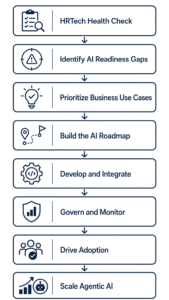
A structured journey can follow this sequence:
HRTech Health Check → AI Readiness Gaps → Prioritized Use Cases → AI Roadmap → Build → Govern → Adopt → Scale
The journey begins by evaluating the existing HR technology environment and determining whether processes, data, integrations, governance, and adoption can support future AI capabilities.
Leaders can then identify readiness gaps and prioritize use cases based on business value and feasibility.
The AI roadmap should define:
- Business outcomes and prioritized use cases.
- Required process and data improvements.
- Technology and integration requirements.
- AI governance and accountability.
- Build and execution priorities.
- Human oversight requirements.
- Workforce adoption and change activities.
- Measures of business value, agent performance, and risk.
- A phased approach to scaling successful AI capabilities.
This sequence helps organizations move from AI experimentation to structured enterprise adoption without treating the vendor demo or technology selection as the starting point.
From HRTech Health Check to Agentic AI Execution
How Does Align, Automate, Adopt Support AI Agent Readiness?
Align, Automate, and Adopt provide a practical framework for connecting AI strategy with technology execution and long-term workforce adoption.
Align
Organizations should align business priorities, AI opportunities, governance, and measurable outcomes before selecting or building AI agents.
This includes understanding the current HR technology environment, identifying readiness gaps, prioritizing use cases, and defining clear accountability.
Alignment helps organizations invest in AI capabilities that solve meaningful business problems rather than pursuing technology without a clear path to value.
Automate
Organizations should automate processes that are clear, connected, and appropriately governed.
This requires leaders to simplify HR processes, strengthen workforce data, optimize existing HR technology, establish reliable integrations, and define appropriate boundaries for AI agents.
Automation should support the operating model and business strategy while creating the foundation required to scale agentic AI responsibly.
Adopt
Organizations should prepare employees, managers, HR teams, and leaders to work effectively with AI agents.
Adoption requires communication, training, leadership engagement, feedback, human oversight, and continuous monitoring of how AI changes work across the organization.
Organizations create sustainable value when AI-enabled capabilities become part of everyday work while people retain clear responsibility for decisions, exceptions, and outcomes.
Together, Align, Automate, and Adopt help organizations connect AI readiness assessment, roadmap development, technology execution, governance, and workforce adoption.
What Questions Should Leaders Answer Before Approving an AI Agent Initiative?
Before approving an AI agent initiative, leaders should confirm that the organization understands the business value, readiness requirements, risks, accountability, and path to adoption.
Leadership teams should ask:
- What business or workforce problem will the AI agent solve?
- What measurable outcome will determine whether the initiative succeeds?
- Is the underlying HR process clear and mature enough for agentic AI?
- Can the organization provide reliable, appropriately governed data?
- Can the existing HR technology environment support the required integrations and actions?
- What level of autonomy will the AI agent have?
- Where must people review, approve, or intervene?
- Who owns the AI agent’s actions, risks, performance, and outcomes?
- How will employees and managers learn to work with the AI agent?
- How will the organization monitor business value, agent performance, and risk after deployment?
Clear answers help leaders distinguish between an attractive AI demonstration and an initiative that the organization can responsibly build, adopt, and scale.
Conclusion
AI agents can create significant opportunities for HR teams to improve service delivery, automate work, support employees, and enable better workforce decisions. Organizations will realize greater value when they assess whether their existing HR environment can support these capabilities before selecting technologies or scaling use cases.
An AI readiness assessment helps leaders understand the maturity of HR processes, workforce data, technology integrations, governance, and adoption. It also identifies the gaps organizations should address before moving from AI experimentation to enterprise execution.
For existing SAP SuccessFactors and Workday customers, the path to agentic AI does not necessarily begin with replacing the current HR platform. Organizations should first evaluate and optimize their existing HR technology environment, identify readiness gaps, and build an AI roadmap that connects prioritized use cases with business outcomes, governance, execution, and adoption.
Organizations that take this approach can move beyond isolated AI pilots and create a stronger foundation for responsible, scalable, and sustainable agentic AI adoption.
About Rolling Arrays
For more than 16 years, Rolling Arrays has helped enterprises across Asia make strategic HR technology decisions, optimize existing HR environments, and create long-term business value from transformation investments.
Through the R7 HRTech Health Check, we help SAP SuccessFactors and Workday customers evaluate their current HR technology environment across processes, platform optimization, integrations, workforce data, governance, adoption, and AI readiness.
The R7 AI Roadmap helps enterprises move from readiness assessment to prioritized agentic AI use cases, roadmap development, build, execution, governance, adoption, and scale.
Through our Align, Automate, Adopt approach, we connect business priorities, HR technology foundations, AI execution, and workforce adoption to help organizations build a practical path toward AI-enabled HR transformation.
FAQ
What Is an AI Readiness Assessment for HR?
An AI readiness assessment for HR evaluates whether an organization’s business priorities, HR processes, workforce data, technology environment, governance, and workforce adoption capabilities can support AI-enabled and agentic AI use cases.
How Are AI Agents Different from Traditional HR Automation?
Traditional HR automation typically follows predefined rules and workflows. AI agents can interpret requests, access information, coordinate activities across systems, recommend actions, and, within defined boundaries, perform tasks with varying levels of autonomy.
Does an Organization Need to Replace Its Existing HR Platform to Adopt AI Agents?
No. Organizations can often optimize and extend their existing SAP SuccessFactors or Workday environments through integrations, AI-enabled capabilities, complementary solutions, and agentic AI use cases based on business requirements and technology readiness.
What Should Organizations Assess Before Selecting AI Agent Use Cases?
Organizations should assess business value, process maturity, workforce data quality, technology and integration readiness, AI governance, risk, human oversight requirements, and workforce adoption before prioritizing AI agent use cases.
How Does an AI Roadmap Support Agentic AI Adoption?
An AI roadmap connects business priorities with readiness gaps, prioritized use cases, process and data improvements, technology requirements, governance, build and execution plans, workforce adoption, and measures of business value and risk. It helps organizations move from AI experimentation to structured enterprise adoption.



Share with your network
Get updates in your inbox