Table of Contents
- Why Should Employee Performance Be Linked to Role Requirements?
- What Is Role Based Employee Performance?
- Should Every Employee Have the Same Performance Metrics?
- How Should Organisations Define Performance Expectations by Role?
- How Can Organisations Create Consistent Performance Evaluation?
- What Are the Risks of Using the Same Metrics for Every Role?
- How Should Employee Performance Metrics Be Selected?
- How Can Organisations Distinguish Performance From Potential?
- Should Performance Classification Be Permanent?
- How Can Calibration Improve Performance Assessment?
- How Should Organisations Connect Performance With Development?
- How Can HR Technology Support Role Based Performance Management?
- What Should Leaders Look for in Employee Performance Data?
- From Performance Ratings to Better Talent Decisions
- Key Takeaways
- Frequently Asked Questions
Resources > Blog >How to Classify Employee Performance Based on Role Requirements
How to Classify Employee Performance Based on Role Requirements
October 23, 2026
But a sales leader, software engineer, plant manager, HR business partner, and customer service specialist contribute to the organisation in very different ways.
Their objectives differ. Their responsibilities differ. Their capabilities differ. And the outcomes expected from their roles differ.
This creates an important question for organisations:
Should employee performance be evaluated using the same measures for every role?
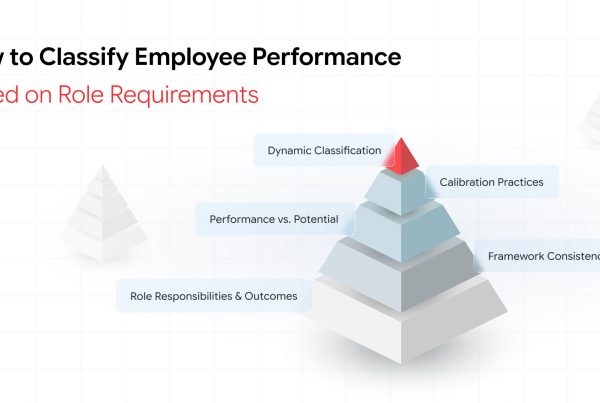
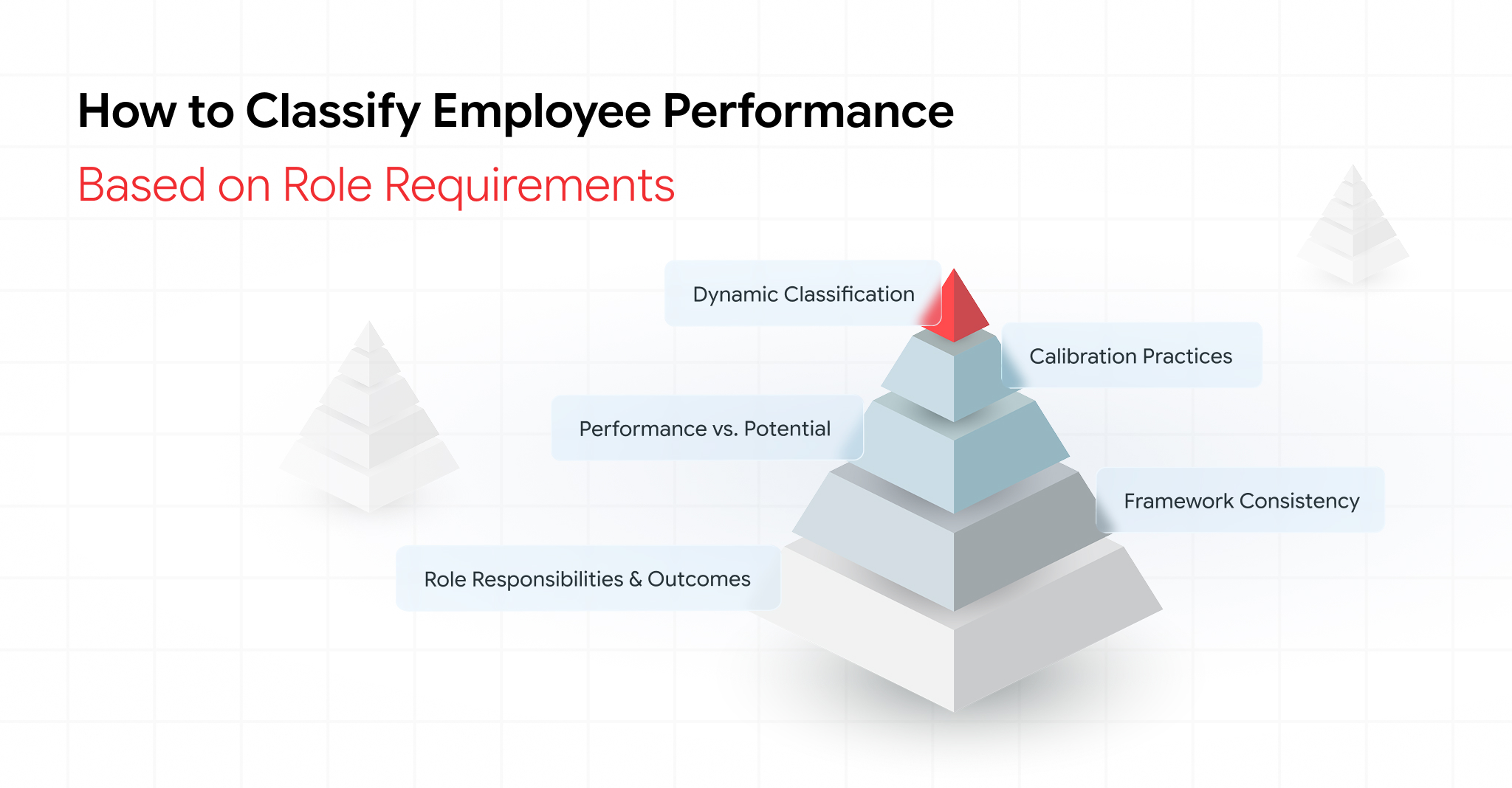
A stronger employee performance management approach recognises that performance should be assessed against the requirements and outcomes of the role, while maintaining consistent principles across the organisation.
Role based performance assessment helps organisations distinguish between performance level, role expectations, capability requirements, and business impact without turning performance classifications into permanent labels.
Why Should Employee Performance Be Linked to Role Requirements?
Consider two employees who both receive a rating of “high performance.”
One may consistently exceed a sales target.
Another may deliver highly reliable infrastructure that prevents operational disruption.
The outcomes are different, but both can represent strong performance within their respective roles.
This is why organisations should define performance in relation to:
- Role responsibilities
- Expected outcomes
- Required capabilities
- Business objectives
- Behavioural expectations
- Relevant employee performance metrics
The objective is not to make roles directly comparable.
It is to make performance expectations clear and evidence based within each role.
What Is Role Based Employee Performance?
A role based approach can consider:
What is this role responsible for?
What outcomes should this role deliver?
Which capabilities are essential?
What does effective performance look like?
How should performance be measured?
This creates a stronger foundation for performance evaluation than applying identical metrics across unrelated roles.
Should Every Employee Have the Same Performance Metrics?
Organisations should maintain consistency in the performance management framework, but the actual measures can vary by role.
For example:
A sales role may be assessed using revenue, customer acquisition, pipeline quality, and retention.
A software engineering role may consider delivery quality, reliability, technical contribution, and development outcomes.
A customer service role may consider resolution quality, customer outcomes, productivity, and service standards.
The metrics differ because the work differs.
However, each role should still follow a common organisational framework for setting expectations, reviewing performance, providing feedback, and documenting outcomes.
How Should Organisations Define Performance Expectations by Role?
Organisations can identify:
- Core responsibilities
- Key business outcomes
- Critical capabilities
- Expected behaviours
- Role specific objectives
- Quality requirements
- Relevant performance indicators
The next step is to distinguish between activities and outcomes.
For example, completing 100 customer calls is an activity.
Improving customer resolution rates may represent an outcome.
A strong performance assessment framework should therefore avoid measuring activity simply because it is easy to count.
How Can Organisations Create Consistent Performance Evaluation?
That can create inconsistency across the organisation.
A common performance management framework can establish:
- Goal setting principles
- Review cycles
- Rating definitions
- Evidence requirements
- Feedback expectations
- Calibration processes
- Development planning
- Documentation standards
Within that framework, individual roles can use appropriate objectives and performance indicators.
This creates consistency in the process while allowing flexibility in the measures.
What Are the Risks of Using the Same Metrics for Every Role?
A uniform measurement system can create unintended consequences.
Employees may focus on metrics that are easy to measure rather than outcomes that genuinely matter.
Managers may struggle to assess specialist contributions.
Important work may receive less recognition simply because it does not translate easily into a standard metric.
For example, a cybersecurity specialist may prevent an incident that never occurs. A purely volume based measurement approach could fail to capture the value of that work.
Performance management should therefore consider both measurable outcomes and meaningful contribution.
How Should Employee Performance Metrics Be Selected?
Metrics should be relevant to the role and influenceable by the employee.
Useful measures should ideally be:
- Relevant to role responsibilities
- Connected to business outcomes
- Clearly defined
- Measurable where appropriate
- Within reasonable employee influence
- Balanced across quality and quantity
- Reviewed regularly
Not every aspect of performance needs to become a numerical KPI.
For some roles, expert judgement, quality assessment, peer input, project outcomes, or customer feedback may provide valuable evidence.
How Can Organisations Distinguish Performance From Potential?
Performance and potential are related but different concepts.
Performance asks:
“What has this employee delivered in the current role?”
Potential asks:
“What could this employee successfully take on in the future?”
An employee can perform exceptionally well in their current role without necessarily being ready for a substantially different role.
Similarly, an employee may demonstrate strong potential while still developing current role capabilities.
Keeping these concepts separate creates better decisions around development, succession, and talent management.
Should Performance Classification Be Permanent?
No.
Performance classification should reflect performance over a defined period and against defined expectations.
Employees can improve through development, coaching, experience, role changes, and changing business circumstances.
Similarly, strong past performance does not guarantee future performance.
Organisations should therefore treat performance assessments as evidence for current talent decisions, not permanent labels attached to employees.
How Can Calibration Improve Performance Assessment?
Calibration can help organisations improve consistency across managers and teams.
During calibration, leaders can examine whether performance assessments are supported by comparable evidence and whether managers are applying the organisation’s performance framework consistently.
The discussion can explore:
- What outcomes were achieved?
- How challenging were the objectives?
- What evidence supports the assessment?
- Were expectations appropriate for the role?
- How did performance compare with defined role requirements?
- What development support is required?
The purpose is not to force employees into a fixed distribution.
It is to improve the quality and consistency of performance evaluation.
How Should Organisations Connect Performance With Development?
Performance assessment becomes more valuable when it leads to action.
If an employee has a capability gap, the organisation can determine whether the appropriate response involves:
- Coaching
- Training
- Mentoring
- Job rotation
- Stretch assignments
- Reskilling
- Process support
- Role redesign
Similarly, strong performance can inform opportunities for greater responsibility, specialised development, or internal mobility.
This connects performance management with capability development rather than treating the annual review as an isolated HR process.
How Can HR Technology Support Role Based Performance Management?
Modern HCM platforms can help organisations connect role expectations, goals, performance reviews, feedback, skills, development, and succession data.
Technology can support:
- Goal setting
- Continuous feedback
- Performance reviews
- Role based objectives
- Manager workflows
- Calibration
- Development planning
- Performance analytics
However, technology cannot determine what good performance means for every role.
The organisation must first establish clear role expectations and a sound performance assessment framework.
Technology can then make the process more consistent and scalable.
Build a more effective HR operating model by aligning people processes, technology, and business outcomes.
What Should Leaders Look for in Employee Performance Data?
Leadership should avoid relying on a single performance score.
A broader view can combine:
- Performance against objectives
- Quality of outcomes
- Capability development
- Behavioural expectations
- Role criticality
- Feedback
- Career progression
- Development needs
This helps leaders understand not just who received a high rating, but why the employee performed well and where the organisation needs to strengthen capability.
From Performance Ratings to Better Talent Decisions
A strong performance management system should help the organisation answer meaningful business questions.
Are employees meeting the expectations of their roles?
Which capabilities are strong?
Where are capability gaps emerging?
Which employees need development support?
Where can internal mobility address workforce requirements?
Which roles require stronger succession coverage?
These questions make performance data more useful for workforce planning and talent management.
The objective is not to create more classifications.
It is to create a clearer connection between role expectations, employee performance, development, and business outcomes.
Key Takeaways
- Employee performance should be assessed against clear role requirements.
- The performance management process can remain consistent while role specific measures vary.
- Performance metrics should focus on meaningful outcomes rather than activity alone.
- Performance and potential should be assessed separately.
- Calibration can improve consistency without forcing employees into artificial categories.
- Performance classifications should not become permanent employee labels.
- Performance assessment should lead to meaningful development and talent decisions.
- HR technology can support role based performance management, but clear organisational principles must come first.
Ready to make your HR processes more effective?
Explore how the right HR strategy, operating model, and technology can support better workforce decisions.
FAQ
What is employee performance assessment?
Employee performance assessment is the structured evaluation of an employee’s results, capabilities, behaviours, and contribution against defined expectations for their role.
Why should performance be assessed based on role requirements?
Different roles contribute to the organisation in different ways. Role based assessment allows organisations to evaluate employees against relevant outcomes and capabilities rather than applying identical measures to unrelated positions.
What are employee performance metrics?
Employee performance metrics are measures used to evaluate aspects of performance. They can include business outcomes, quality, productivity, customer outcomes, project delivery, capability development, and other role relevant indicators.
What is a performance assessment framework?
A performance assessment framework provides a consistent structure for setting expectations, measuring performance, providing feedback, conducting reviews, calibrating assessments, and supporting employee development.
How can organisations make performance evaluation more consistent?
Organisations can establish common rating definitions, review processes, evidence requirements, manager guidance, and calibration practices while allowing performance measures to reflect different role requirements.
Should employee performance be measured only through KPIs?
No. KPIs can provide useful evidence, but performance assessment can also consider quality, behaviours, capability development, project outcomes, customer feedback, and other relevant evidence depending on the role.
Share with your network