Table of Contents
- What Can an HRIS Measure Well?
- Why Are Standard HR Metrics Not Enough?
- What Workforce Metrics Should Organisations Look Beyond?
- What Is the Difference Between HR Metrics and Workforce Metrics?
- Which Workforce Performance Metrics Matter Most?
- How Can Workforce Analytics Connect HR Data With Business Outcomes?
- What Are Strategic Workforce Metrics?
- Can an HRIS Measure Workforce Analytics?
- How Should Organisations Decide Which HR Metrics Matter?
- What Makes a Workforce Metric Useful?
- How Can HR Avoid Creating Too Many Workforce Metrics?
- How Does This Connect HR Technology With Talent Strategy?
- From HR Reporting to Workforce Intelligence
- Key Takeaways
- Frequently Asked Questions
Resources > Blog > What Your HRIS Cannot Measure: The Workforce Metrics That Matter
What Your HRIS Cannot Measure: The Workforce Metrics That Matter
October 26, 2026
It can show headcount, employee movements, compensation, absence, organisational structures, and other operational information. Modern platforms can also provide dashboards, reports, and increasingly sophisticated analytics.
But having workforce data is not the same as understanding workforce performance.
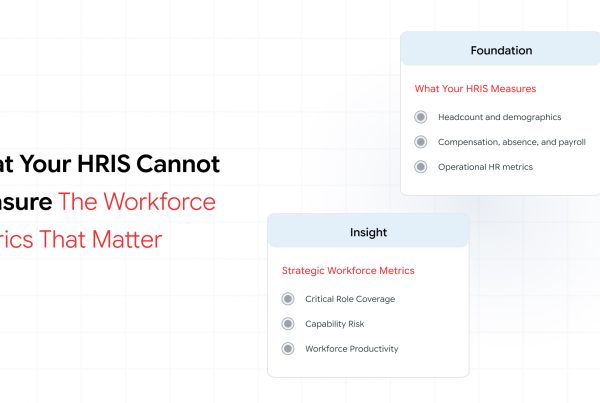
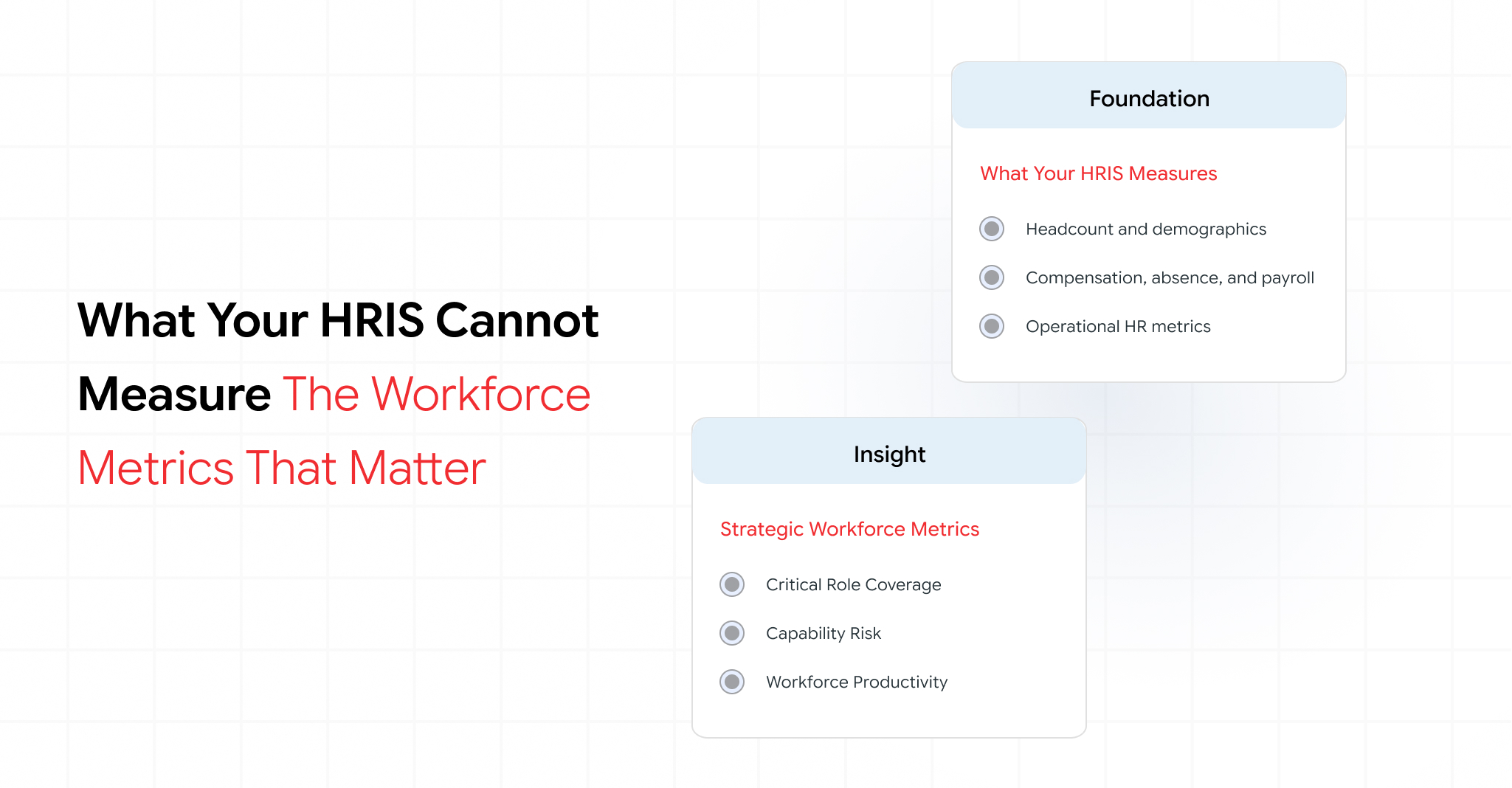
Some of the questions that matter most to business leaders sit beyond the standard HRIS:
Are our most critical roles adequately covered?
Where are capability gaps likely to constrain growth?
Which workforce segments create the greatest business value?
Where are we losing critical talent?
Are our workforce investments producing the outcomes we expected?
These questions require organisations to connect HR data with business context.
That is where workforce analytics becomes more valuable than simply reporting what the HRIS already stores.
What Can an HRIS Measure Well?
Depending on the platform, this may include:
- Headcount
- Employee demographics
- Organisation structures
- Compensation
- Absence
- Employee movements
- Employment information
- Position data
- Recruitment information
- Performance records
- Learning records
These metrics are important because they provide the foundation for workforce reporting.
However, operational data often describes what happened.
Strategic workforce analytics needs to help organisations understand why it happened, what it means, and what should happen next.
Why Are Standard HR Metrics Not Enough?
An HRIS can tell you that turnover increased from one year to another.
But the number alone does not answer the questions leadership may actually care about:
- Which roles are experiencing the highest loss?
- Are critical roles disproportionately affected?
- Which skills are leaving the organisation?
- What is the replacement cost?
- How long does it take to restore capability?
- Are high performers leaving?
- Does turnover affect customer or business outcomes?
This illustrates the difference between an HR metric and a strategic workforce metric.
The first measures an event.
The second places the event in a business context.
What Workforce Metrics Should Organisations Look Beyond?
Critical Role Coverage
Which roles are essential to business continuity or strategic growth, and how well are they covered?
Capability Risk
Where does the organisation have insufficient skills or capabilities to execute its strategy?
Talent Concentration
Where is critical knowledge, expertise, or performance concentrated among a small number of employees?
Internal Mobility
How effectively does the organisation move existing talent into roles where their capabilities are needed?
Quality of Hire
Are new hires performing at the level expected after joining?
Regrettable Attrition
Which departures represent a material loss of capability or business knowledge?
Workforce Productivity
How do workforce capacity and capability relate to business output?
These metrics provide a richer perspective than headcount or turnover alone.
What Is the Difference Between HR Metrics and Workforce Metrics?
Examples include:
- Headcount
- Absence rate
- Turnover
- Time to hire
- Cost per hire
- Training participation
Workforce metrics can go further by connecting these measures to organisational priorities.
For example:
HR metric: 12% annual turnover.
Strategic workforce metric: 18% turnover in critical roles, with replacement taking an average of nine months.
The second measure creates a stronger basis for business discussion because it connects workforce movement with capability and operational risk.
Which Workforce Performance Metrics Matter Most?
The appropriate metrics depend on the organisation’s strategy and workforce model.
A manufacturing organisation may prioritise workforce productivity, skills availability, safety, absenteeism, and critical role coverage.
A technology organisation may focus more heavily on specialist skills, engineering capacity, quality of hire, internal mobility, and regrettable attrition.
A professional services organisation may examine utilisation, capability availability, succession coverage, and workforce capacity.
The principle is:
Measure the workforce factors that can materially influence the organisation’s ability to execute its strategy.
How Can Workforce Analytics Connect HR Data With Business Outcomes?
For example, an organisation could examine whether:
- Critical role vacancies affect delivery timelines
- Capability gaps affect project performance
- Attrition affects customer retention
- Quality of hire affects productivity
- Workforce capacity affects revenue generation
- Internal mobility reduces external hiring requirements
This moves analytics from descriptive reporting toward decision support.
What Are Strategic Workforce Metrics?
They can include:
- Critical role coverage
- Capability availability
- Succession readiness
- Quality of hire
- Regrettable attrition
- Internal mobility
- Workforce productivity
- Talent concentration
- Skills supply and demand
- Workforce capacity
These measures should connect directly to strategic priorities rather than becoming another long list of HR KPIs.
Can an HRIS Measure Workforce Analytics?
The limitation is often not the absence of data.
The challenge is connecting data from different sources and applying the appropriate business context.
Workforce analytics may require information from:
- Core HR
- Recruitment
- Performance
- Learning
- Compensation
- Workforce management
- Finance
- Sales
- Operations
- Customer systems
This is why workforce analytics and HR technology strategy are increasingly connected.
A strong HRIS provides the foundation, while broader analytics capabilities can help turn fragmented information into actionable insight.
How Should Organisations Decide Which HR Metrics Matter?
Instead of asking:
“What can our HRIS report?”
Ask:
“What workforce decisions does leadership need to make?”
Then determine which data is required to support those decisions.
For example:
Business question: Can we support planned expansion?
Workforce questions: Do we have enough critical skills? Which roles will become constrained? Where should we hire or develop talent?
Required metrics: Skills availability, workforce capacity, critical role coverage, internal mobility, and hiring pipeline.
This approach prevents organisations from creating dashboards filled with metrics that do not influence decisions.
What Makes a Workforce Metric Useful?
Relevant
It should relate to an important business or workforce question.
Reliable
The underlying data should be consistent and trustworthy.
Actionable
Leadership should be able to identify a potential response when the metric changes.
Comparable
Where appropriate, the metric should allow comparison across time, business units, roles, or workforce segments.
A metric that looks impressive on a dashboard but does not influence a decision adds limited strategic value.
How Can HR Avoid Creating Too Many Workforce Metrics?
A leadership dashboard should prioritise a small number of measures that answer important questions.
For example, instead of reporting dozens of talent indicators, leadership could focus on:
- Critical role coverage
- Quality of hire
- Regrettable attrition
- Capability risk
- Internal mobility
- Workforce productivity
The exact measures should depend on the organisation’s strategic priorities.
The objective is decision relevant workforce analytics, not metric accumulation.
How Does This Connect HR Technology With Talent Strategy?
Talent strategy determines what the organisation needs to understand.
This creates a connection between the HR technology stack and the talent lifecycle.
An organisation may have sophisticated HR technology but still struggle to answer strategic workforce questions if its data architecture, metrics, processes, and business context remain disconnected.
The goal should therefore be to design HR technology and analytics around the decisions the organisation needs to make.
From HR Reporting to Workforce Intelligence
Headcount, turnover, absence, recruitment, and compensation data remain essential.
The opportunity is to build on that foundation.
When organisations connect operational HR data with role criticality, capability, performance, talent movement, and business outcomes, workforce metrics become more useful for strategic decision making.
The HRIS tells you what is happening across the workforce.
A well designed workforce analytics approach helps explain why it matters and where action may be required.
Key Takeaways
- An HRIS provides essential workforce data but does not automatically provide strategic workforce insight.
- Traditional HR metrics often describe activity or outcomes without sufficient business context.
- Workforce analytics connects HR data with business priorities and decisions.
- Critical role coverage, capability risk, quality of hire, internal mobility, and regrettable attrition can provide deeper workforce insight.
- The right workforce metrics depend on the organisation’s strategy and operating model.
- Organisations should start with business questions rather than simply reporting the data available in the HRIS.
- A smaller set of decision relevant metrics can be more valuable than a large HR dashboard.
- Strong HR technology and analytics should support the decisions that HR and business leaders need to make.
FAQ
What is workforce analytics?
Workforce analytics is the use of workforce data to understand patterns, risks, capabilities, performance, and trends that can support workforce and business decisions.
What are workforce metrics?
Workforce metrics are measures used to understand workforce composition, capability, performance, movement, capacity, and other factors that influence organisational outcomes.
What is the difference between HR metrics and workforce metrics?
HR metrics often measure specific HR activities or outcomes, while workforce metrics can connect those measures with broader workforce capability, business priorities, and organisational performance.
What are strategic workforce metrics?
Strategic workforce metrics are measures that help organisations understand whether their workforce has the capacity, capabilities, and talent required to execute business strategy.
What workforce metrics should HR track?
The appropriate metrics depend on organisational priorities, but can include critical role coverage, quality of hire, regrettable attrition, internal mobility, capability availability, succession readiness, workforce productivity, and skills supply and demand.
Can an HRIS provide workforce analytics?
An HRIS can provide much of the underlying workforce data, but broader workforce analytics may require data from multiple HR and business systems to provide the context needed for strategic decision making.
Share with your network