Table of Contents
- Why Do Organisations Continue Parallel Payroll Checks After HCM Implementation?
- What Is the Payroll Reconciliation Process After HCM Implementation?
- What Should a Payroll Reconciliation Checklist Include?
- How Can Organisations Reduce Manual Payroll Balancing and Reconciliation?
- How Does Payroll System Integration Affect Reconciliation?
- When Can Organisations Safely Eliminate Parallel Payroll Checks?
- How Can Organisations Automate the Payroll Process Without Losing Control?
- How Should Multi Country Payroll Teams Manage Reconciliation Across APAC?
- How Can Organisations Measure the Success of Payroll Reconciliation Improvements?
- How Can Rolling Arrays Help Organisations Improve Payroll Operations?
- Frequently Asked Questions
Resources > Blog > How to Eliminate Parallel Payroll Checks After HCM Implementation
How to Eliminate Parallel Payroll Checks After HCM Implementation
November 16, 2026
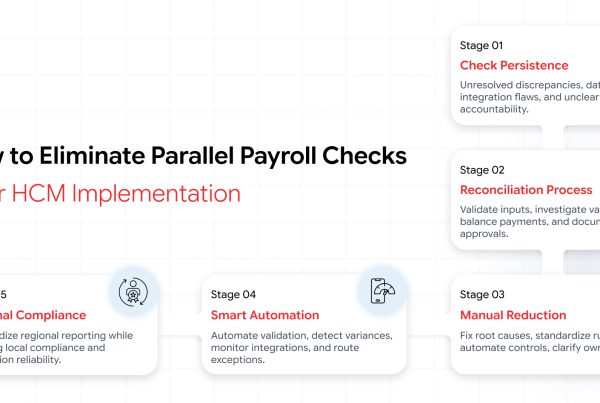
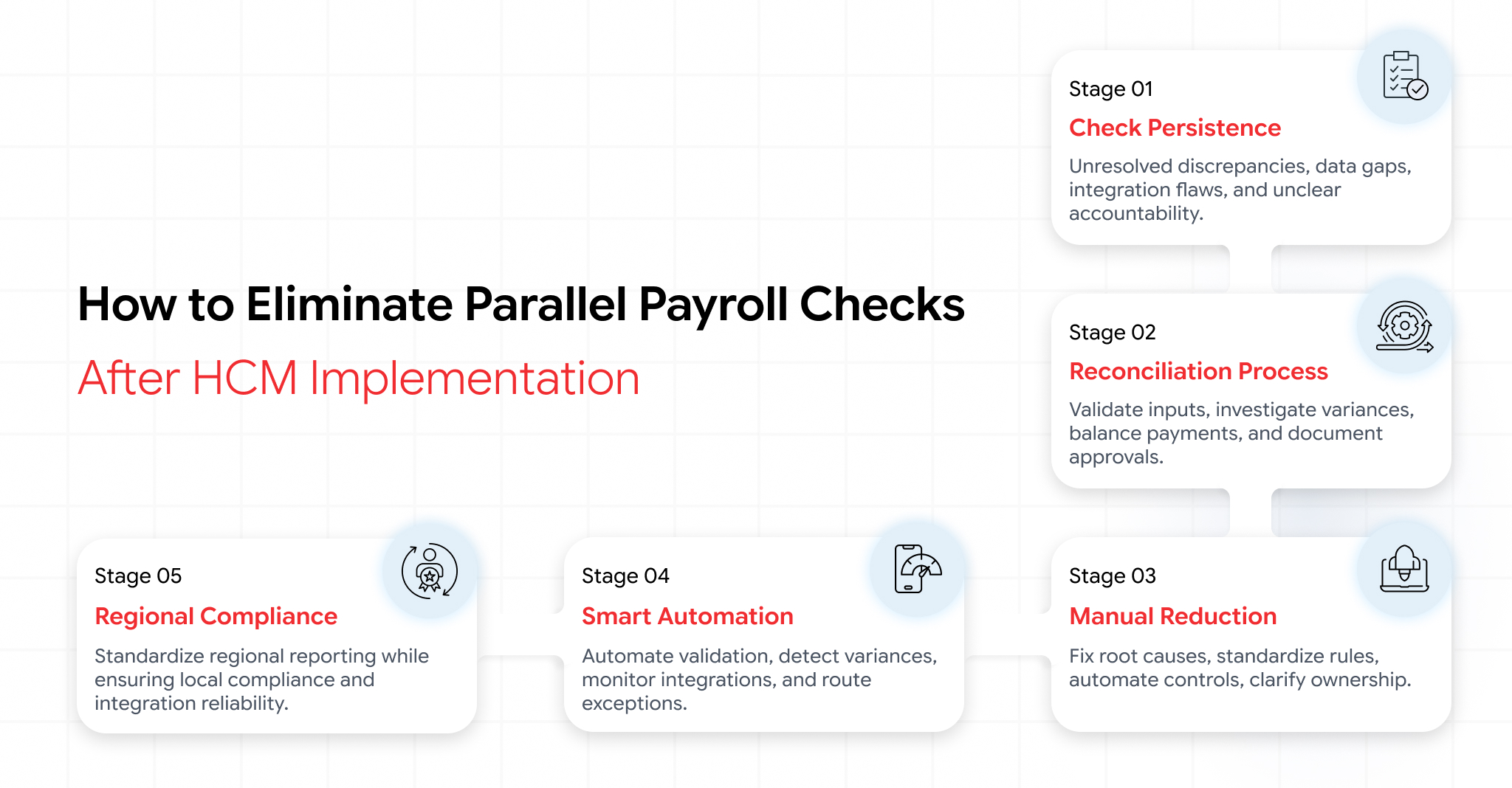
Why Do Organisations Continue Parallel Payroll Checks After HCM Implementation?
The difficulty begins when organisations continue these checks without a clear exit plan.
Several issues can keep manual verification in place:
- Unresolved payroll variances: Differences between expected and calculated results remain unexplained across pay cycles.
- Unreliable employee data: Incorrect salary, working hours, bank details, deductions or employment information affect payroll calculations.
- Incomplete integrations: Data from core HR, time and attendance, benefits or other systems does not transfer accurately.
- Limited confidence in configuration: Payroll teams do not have sufficient evidence that earnings, deductions, taxes and other rules work as intended.
- Unclear accountability: HR, payroll, Finance and implementation teams disagree about who must investigate and resolve discrepancies.
- Weak exception management: Teams use spreadsheets to track issues because the system does not provide a dependable process for identifying, assigning and resolving them.
In these circumstances, manual checking becomes a safety net. Removing it before the underlying problems are resolved could increase payroll risk.
The goal is therefore not to eliminate verification immediately. It is to replace repetitive manual checking with reliable controls that provide equivalent or better assurance.
What Is the Payroll Reconciliation Process After HCM Implementation?
After an HCM implementation, reconciliation should cover both financial results and the data flows that produce them.
A structured process includes the following steps.
Validate Employee and Payroll Input Data
Confirm that the new system contains accurate employee information, salary details, working hours, overtime, leave, allowances, deductions and other relevant inputs.
Where data originates in another system, verify that the correct records reached payroll before calculations began.
Compare Payroll Results
Compare current payroll results against an appropriate reference, such as the previous payroll cycle, approved employee changes, expected calculations or the legacy system during the transition period.
Historical comparisons can identify unusual movements, but they should not be treated as definitive proof of accuracy. Legitimate salary changes, bonuses, new joiners and departures can create expected differences.
Investigate Variances
Classify discrepancies by cause, such as data errors, configuration problems, integration failures, calculation differences or valid business changes.
Each material variance should have an owner, a documented explanation and a resolution status.
Confirm Financial Balancing
Reconcile relevant payroll totals, deductions, employer contributions and payment amounts against the appropriate control totals and financial records.
The objective is to confirm that the payroll results agree with the expected financial obligations and payment instructions.
Approve and Document the Results
Payroll owners should review unresolved exceptions, confirm that required controls have passed and record approval before payroll is released.
This creates an auditable process and reduces dependence on informal checks performed by individual team members.
What Should a Payroll Reconciliation Checklist Include?
Organisations should adapt the checklist to their payroll model, country requirements, system design and risk profile.
Data validation
- Confirm employee records and payroll changes are complete.
- Verify salary, allowances, deductions and payment details.
- Check joiners, leavers and employee transfers.
- Confirm time, attendance, overtime and leave inputs where relevant.
System and integration validation
- Confirm that required data transfers completed successfully.
- Investigate failed, delayed or duplicated records.
- Check that payroll calculations use the approved configuration.
- Verify that interface errors have been resolved or formally assessed.
Payroll balancing and reconciliation
- Compare payroll totals with the appropriate reference.
- Review unusual changes in gross pay, net pay and deductions.
- Reconcile relevant employer contributions and liabilities.
- Confirm payment files and financial totals agree with approved results.
Exception management
- Document material variances and their causes.
- Assign owners and resolution deadlines.
- Escalate unresolved issues according to their risk.
- Record approved exceptions and corrective actions.
Approval and audit
- Confirm that required payroll reviews are complete.
- Document approvals and outstanding risks.
- Retain reconciliation evidence.
- Confirm that payroll release criteria have been met.
A checklist creates consistency, but it does not by itself prove that payroll is accurate. The controls must operate effectively, and teams must investigate exceptions rather than simply mark them complete.
How Can Organisations Reduce Manual Payroll Balancing and Reconciliation?
Start by analysing the manual checks performed during recent payroll cycles. Identify which checks detect genuine errors, which repeatedly confirm expected results and which compensate for unresolved system limitations.
Then prioritise improvements.
Resolve recurring variances at their source. If differences consistently arise from incorrect employee data, fix the source data and its ownership process rather than adding another spreadsheet check.
Standardise payroll rules. Ensure that earnings, deductions, eligibility rules, effective dates and relevant calculations reflect approved policies and country requirements.
Improve integration reliability. Investigate failed transfers, inconsistent field mappings, duplicated records and timing problems between HCM and connected systems.
Create risk based controls. Apply stronger scrutiny to material or unusual exceptions while automating routine checks that consistently pass established validation rules.
Define ownership. Make it clear who investigates payroll differences, approves corrections and confirms readiness for payroll release.
Review recurring issues. Track the frequency, cause and impact of exceptions to determine whether corrective actions are preventing repeat failures.
Over time, this shifts the payroll team from checking every result manually towards managing exceptions and maintaining reliable controls.
How Does Payroll System Integration Affect Reconciliation?
A typical payroll environment may receive data from core HR, time and attendance, benefits, compensation, expense systems and other business applications. Payroll outputs may then flow to banking platforms, Finance and general ledger systems.
If any connection fails, payroll teams may need to compare records manually to confirm completeness and accuracy.
Common integration problems include:
- Incorrect field mapping between systems.
- Missing or duplicated employee records.
- Incorrect effective dates for employee changes.
- Delayed time and attendance information.
- Inconsistent treatment of earnings and deductions.
- Failed transfers that do not trigger clear alerts.
- Differences between payroll results and financial postings.
Organisations should test these interfaces using representative scenarios, including new joiners, leavers, salary changes, retroactive adjustments, variable pay and other relevant transactions.
They should also establish monitoring, error handling and ownership for each critical interface.
A successful integration test demonstrates that expected transactions work under defined conditions. Ongoing monitoring is still necessary to detect failures that occur after deployment.
When Can Organisations Safely Eliminate Parallel Payroll Checks?
A decision to stop parallel checking should consider several conditions.
- Reconciliation is stable: Material differences have been explained and recurring causes have been resolved.
- Critical scenarios have been tested: Relevant payroll calculations, employee changes, exceptions and integration paths have been validated.
- Controls operate reliably: Required approvals, validation rules, monitoring and exception handling work as intended.
- Financial totals agree: Payroll outputs reconcile with the relevant payment and accounting controls.
- Payroll owners have confidence in the process: Responsible teams understand how to investigate issues and when to escalate them.
- Evidence is documented: The organisation can demonstrate why it considers the new process reliable.
The required evidence will vary with payroll complexity, country coverage, risk and the nature of the implementation.
For some organisations, a defined number of successful payroll cycles may form part of the exit criteria. However, no universal number of cycles guarantees that every risk has been addressed.
The exit decision should depend on the results of testing, the severity of unresolved issues and the effectiveness of the control environment.
Where risk remains, organisations can retire redundant checks in stages while retaining targeted controls for higher risk transactions.
How Can Organisations Automate the Payroll Process Without Losing Control?
Before automating a check, organisations should understand what it detects, how important the control is and what should happen when it fails.
Useful automation opportunities include:
- Automated data validation: Flag missing or invalid employee and payroll inputs before calculation.
- Variance detection: Identify unusual movements in payroll totals or individual employee results.
- Integration monitoring: Alert responsible teams when required data transfers fail or produce unexpected records.
- Exception routing: Assign discrepancies to the appropriate owner and track resolution.
- Reconciliation reporting: Generate repeatable comparisons and preserve supporting evidence.
- Approval workflows: Ensure that required reviews and approvals occur before payroll release.
Automation should also preserve human review where judgement is necessary, such as investigating unusual payments or approving material corrections.
Organisations should measure whether automation reduces repetitive checking, shortens issue resolution time and maintains or improves payroll accuracy. The aim is controlled efficiency, not the removal of essential safeguards.
How Should Multi Country Payroll Teams Manage Reconciliation Across APAC?
A common regional control framework can improve visibility, but organisations must still accommodate country specific requirements. Teams should standardise reconciliation reporting where practical, maintain local compliance controls, monitor integrations and define clear ownership across regional HR, local payroll teams, Finance and payroll providers.
For a broader overview of regional payroll options, read our guide to payroll solutions in Asia. It explains how organisations can evaluate payroll providers, localisation, integration, scalability and support requirements across Asia Pacific.
These resources complement the reconciliation process by helping organisations assess both their current payroll controls and the technology needed to support multi country operations.
How Can Organisations Measure the Success of Payroll Reconciliation Improvements?
Organisations can track:
- The number and value of unresolved payroll variances.
- The proportion of discrepancies caused by recurring issues.
- Time spent on manual reconciliation each payroll cycle.
- The time required to investigate and resolve exceptions.
- The number of integration failures and duplicated records.
- The frequency of payroll corrections after approval.
- The proportion of routine checks completed automatically.
- Compliance with payroll approval and audit requirements.
These measures should be interpreted together. A reduction in reported exceptions may indicate improved payroll accuracy, but it may also mean that the process no longer detects errors effectively.
Leaders should therefore assess efficiency alongside control effectiveness, payroll accuracy and compliance.
The desired outcome is a payroll process that requires less repetitive manual intervention while maintaining dependable assurance.
How Can Rolling Arrays Help Organisations Improve Payroll Operations?
Rolling Arrays supports HR technology transformation by helping organisations assess system capabilities, identify process and integration gaps, and connect technology improvements with business requirements.
A structured assessment can help determine which manual controls remain necessary, which recurring discrepancies require corrective action and where automation can improve payroll operations.
The objective is not simply to remove spreadsheets. It is to establish a payroll environment where reliable data, effective controls and clear accountability allow teams to operate with greater confidence.
FAQ
What are parallel payroll checks?
Parallel payroll checks compare results from a new payroll system with an existing system, spreadsheet or independent calculation to identify differences and validate payroll accuracy.
How long should parallel payroll checks continue after HCM implementation?
There is no universal duration. Organisations should define exit criteria based on successful testing, resolved material variances, reliable integrations, effective controls and documented approval.
What is the payroll reconciliation process?
Payroll reconciliation compares payroll inputs, calculated results, payment amounts and relevant financial totals against appropriate reference information. Teams investigate discrepancies and document the results before approving payroll.
How can organisations automate payroll reconciliation?
Organisations can automate data validation, variance detection, integration monitoring, exception routing, reconciliation reports and approval workflows. They should retain appropriate review for material or unusual exceptions.
Why do payroll discrepancies continue after implementation?
Recurring discrepancies can result from inaccurate employee data, incorrect configuration, integration failures, incomplete inputs, unclear ownership or unresolved implementation issues.
Does eliminating parallel payroll checks mean eliminating payroll controls?
No. Organisations should remove redundant manual comparisons only when reliable controls replace them. Payroll validation, reconciliation, exception management and approval remain essential.
Share with your network