Table of Contents
- Do Performance Ratings Predict Business Outcomes?
- How Can Organisations Evaluate a Performance Management System?
- Which Performance Management KPIs Should Organisations Track?
- How Can Employee Performance Analytics Validate Performance Ratings?
- How Can Data Driven Performance Management Improve Decisions?
- How Does HR Technology Value Realization Support Performance Management?
- How Does Performance Management Evaluation Support HR Transformation?
- Frequently Asked Questions
Resources > Blog > Do Performance Ratings Predict Business Outcomes? How to Validate Your Performance Management System
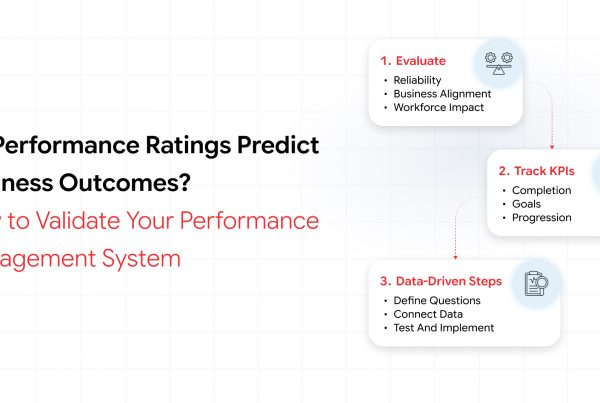
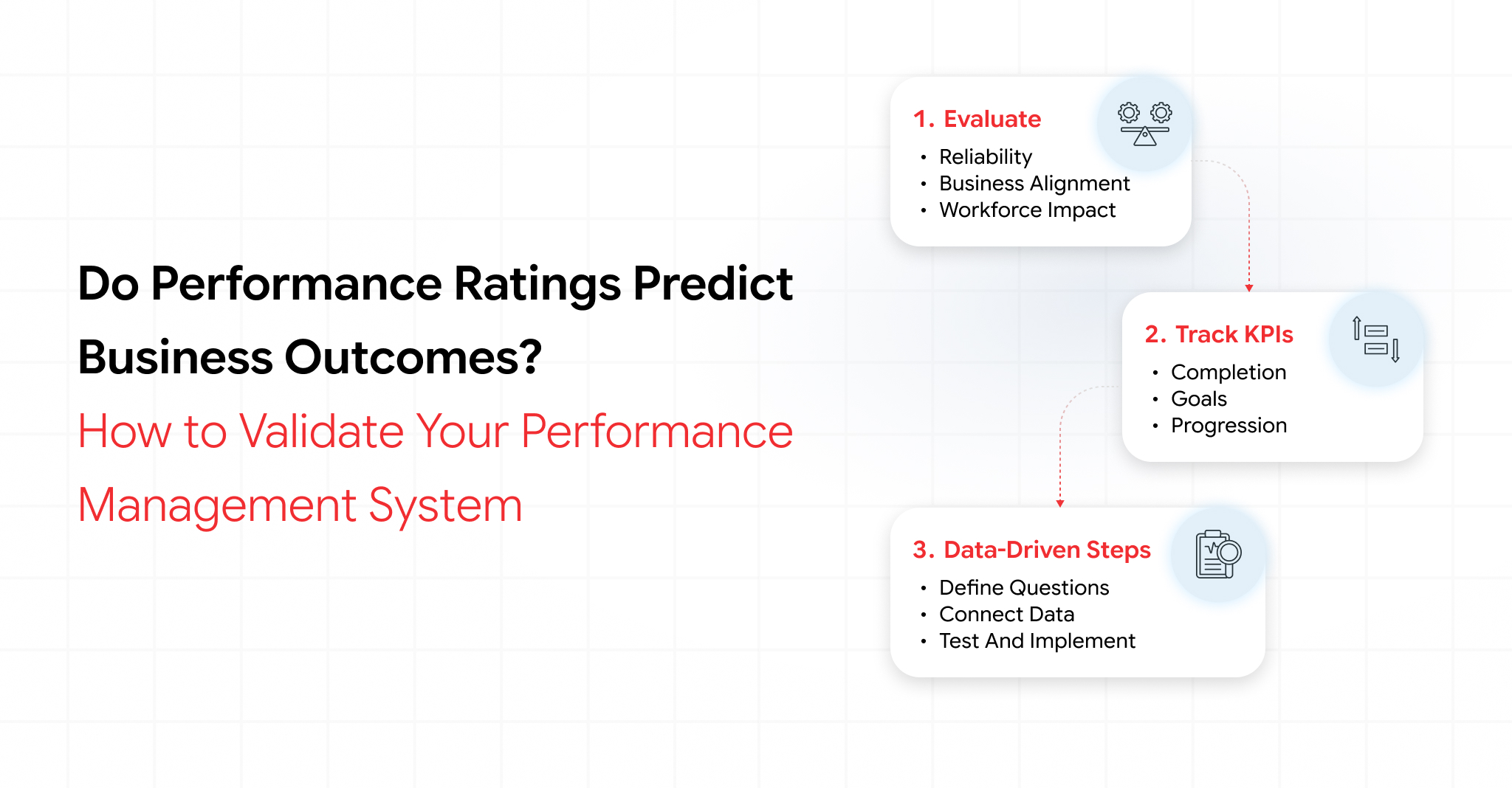
Do Performance Ratings Predict Business Outcomes? How to Validate Your Performance Management System
November 13, 2026
Does Performance Management Effectiveness Translate into Business Outcomes?
To evaluate performance management effectiveness, organisations must examine what happens after performance assessments inform business decisions.
For example, a business may expect performance management to improve sales productivity, operational quality, customer satisfaction or leadership capability. The organisation should then test whether performance ratings help identify employees and teams that contribute to those outcomes.
The relationship will vary by role. Sales performance may connect directly with revenue and customer retention, while operational roles may influence quality, safety, reliability or service delivery. For knowledge based roles, relevant outcomes may include project delivery, problem solving, innovation or the quality of decisions.
The key question is not whether high ratings correlate with business success in every situation. It is whether the performance management system provides useful, reliable evidence for the decisions the organisation needs to make.
How Can Organisations Evaluate a Performance Management System?
Are Performance Assessments Reliable?
Managers should assess employees against relevant expectations and supporting evidence. Organisations can examine whether ratings reflect documented contribution, whether comparable performance receives comparable assessments and whether managers understand the rating criteria.
Inconsistent ratings can weaken the relationship between employee assessments and actual performance. However, rating differences alone do not establish that a system is ineffective. Differences in role complexity, opportunity and operating conditions may also explain variations.
Do Performance Ratings Help Explain Business Results?
Organisations should test whether performance ratings align with outcomes that matter to the business.
For example, they can examine whether employees with stronger performance assessments also demonstrate higher productivity, better quality, stronger customer outcomes or more consistent achievement of role objectives.
The measures should reflect the employee’s responsibilities. A single business metric will rarely capture contribution accurately across every role.
Do Performance Decisions Improve Workforce Outcomes?
Performance assessments should inform meaningful actions. Organisations can evaluate whether development plans address identified capability gaps, whether promotion decisions reflect demonstrated readiness and whether workforce planning uses performance evidence appropriately.
If ratings have little influence on development, deployment or other talent decisions, leaders should question whether the system is delivering its intended purpose.
Which Performance Management KPIs Should Organisations Track?
Organisations can start with the following indicators:
- Performance review completion: Whether managers complete reviews within the expected timeframe.
- Goal achievement: Whether employees and teams achieve relevant objectives.
- Rating consistency: Whether managers apply performance criteria consistently across comparable roles.
- Development plan progress: Whether agreed development actions address capability gaps and progress over time.
- Internal progression: Whether performance evidence supports appropriate promotion and career development decisions.
- Business outcome alignment: Whether performance assessments are associated with relevant measures such as productivity, quality, revenue or customer outcomes.
- Manager effectiveness: Whether managers provide useful feedback, set clear expectations and support employee improvement.
These indicators serve different purposes. Completion and timeliness measure process execution, while goal achievement and business outcome alignment provide insight into results.
Organisations should avoid treating any single KPI as proof of effectiveness. A system with high completion rates may still produce weak assessments, and a high average performance rating does not necessarily demonstrate stronger business performance.
How Can Employee Performance Analytics Validate Performance Ratings?
A practical evaluation can follow five steps.
- Define the business question. Identify what the organisation expects performance management to improve, such as productivity, quality, customer outcomes or readiness for critical roles.
- Establish a baseline. Capture existing performance ratings, business measures and relevant workforce information before making changes to the process.
- Connect relevant data. Bring together performance reviews, objectives, role information and appropriate business outcome measures. Check that the data uses consistent definitions and time periods.
- Test the relationship. Examine whether ratings align with subsequent outcomes, whether patterns differ across roles and whether other factors may explain the results.
- Review the findings and act. Use the evidence to improve assessment criteria, manager guidance, development priorities and performance management practices.
Timing matters. A rating recorded at the end of the year should not be compared carelessly with a business outcome that occurred before the review period. Organisations should define when ratings are assigned and when outcomes are measured.
Most importantly, correlation does not prove causation. Higher ratings may coincide with better business results without causing them. Experience, resources, market conditions, team composition and role design can also influence outcomes. A stronger evaluation considers these factors and, where feasible, tests whether changes to the performance management process lead to better results.
How Can Data Driven Performance Management Improve Decisions?
Analytics may reveal that a particular capability is associated with stronger results in a specific role, that development plans are not addressing recurring performance gaps, or that different teams apply assessment standards inconsistently.
Leaders can use these findings to refine objectives, improve manager training, direct development investment and identify where the performance management process needs attention.
However, analytics should support human judgement rather than replace it. Organisations must account for data quality, privacy, fairness and differences in working conditions. Automated recommendations should not determine promotions, rewards or employment decisions without appropriate review.
The aim is to make performance decisions more evidence based, explainable and relevant to business priorities.
How Does HR Technology Value Realization Support Performance Management?
Organisations need to establish what the technology should improve, measure the starting position and assess whether the expected benefits materialise.
This is the foundation of HR technology value realization: evaluating whether technology and related process changes deliver the outcomes the organisation expected.
Performance management should be assessed in the same way. Leaders should look beyond deployment and review completion to determine whether the system improves the quality of workforce decisions and contributes to business priorities.
How Does Performance Management Evaluation Support HR Transformation?
For example, unclear objectives may point to a need for stronger business alignment. Inconsistent assessments may indicate gaps in manager capability or process governance. Limited insight into performance outcomes may highlight data integration or reporting requirements.
The objective is to connect performance management with a broader operating model in which people, processes, data and technology support business priorities.
How Does Performance Management Evaluation Support HR Transformation?
Performance management system evaluation can reveal whether an organisation’s goals, processes, data and technology support the workforce outcomes it needs.
For example, unclear objectives may indicate a need for stronger business alignment. Inconsistent assessments may reveal gaps in manager capability or process governance. Limited visibility into performance outcomes may highlight data integration or reporting requirements.
These findings can inform broader transformation priorities rather than prompting organisations to introduce technology before understanding the underlying problem.
For a broader perspective, explore Rolling Arrays’ HR transformation roadmap to understand what organisations should expect during HR transformation and how the work can progress over time.
The objective is to connect performance management with a broader operating model in which people, processes, data and technology support business priorities.
FAQ
What is performance management effectiveness?
Performance management effectiveness describes how well a performance management system helps organisations assess contribution, develop employee capability and support decisions that align with business goals.
How can organisations evaluate a performance management system?
Organisations can review assessment reliability, goal achievement, development outcomes, rating consistency and the relationship between performance ratings and relevant business results.
Which performance management KPIs matter most?
Relevant KPIs include review completion, goal achievement, rating consistency, development plan progress and alignment between employee assessments and role specific business outcomes. The right measures depend on organisational priorities.
What is the role of employee performance analytics?
Employee performance analytics helps organisations examine patterns between performance ratings, employee capabilities and business outcomes. It can identify relationships worth investigating, but it does not prove causation on its own.
Do higher performance ratings always lead to better business outcomes?
No. Higher ratings may align with stronger outcomes in some contexts, but ratings can also reflect inconsistent standards, different operating conditions or measurement limitations. Organisations need to validate the relationship using relevant evidence.
How does HR technology value realization relate to performance management?
HR technology value realization evaluates whether technology investments deliver their expected benefits. In performance management, this means assessing whether systems and processes improve decision quality and support measurable workforce and business outcomes.
Share with your network