
Table of Contents
- Why Do HCM Implementations Underdeliver?
- Where Does HCM Value Get Lost?
- How Can Organisations Realize More Value?
- What Should Leaders Measure After Go Live?
- How Can Organisations Build a Value Realization Playbook?
- Establish the Baseline
- Define the Expected Value
- Identify Value Gaps
- Prioritize Improvements
- Measure and Optimize
- What Happens When Value Realization Becomes Continuous?
- Frequently Asked Questions
Resources > Blog > Why HCM Implementations Underdeliver and How to Realize Value
Why HCM Implementations Underdeliver and How to Realize Value?
September 10, 2026
Why Do HCM Implementations Underdeliver?
Where Does HCM Value Get Lost?
- Low employee and manager adoption
- Unused system capabilities
- Inefficient processes
- Poor workforce data quality
- Weak governance
- Limited measurement of business outcomes
How Can Organisations Realize More Value?
- Establish baseline performance before implementation
- Define measurable business outcomes
- Track adoption and process performance
- Identify capability and process gaps
- Prioritize improvements based on business impact
- Continuously optimize the HCM environment
- Connect improvements to measurable business value
What Should Leaders Measure After Go Live?
The goal is not simply to implement HCM technology. It is to ensure the technology continues creating measurable value after implementation.
How Can Organisations Build a Value Realization Playbook?
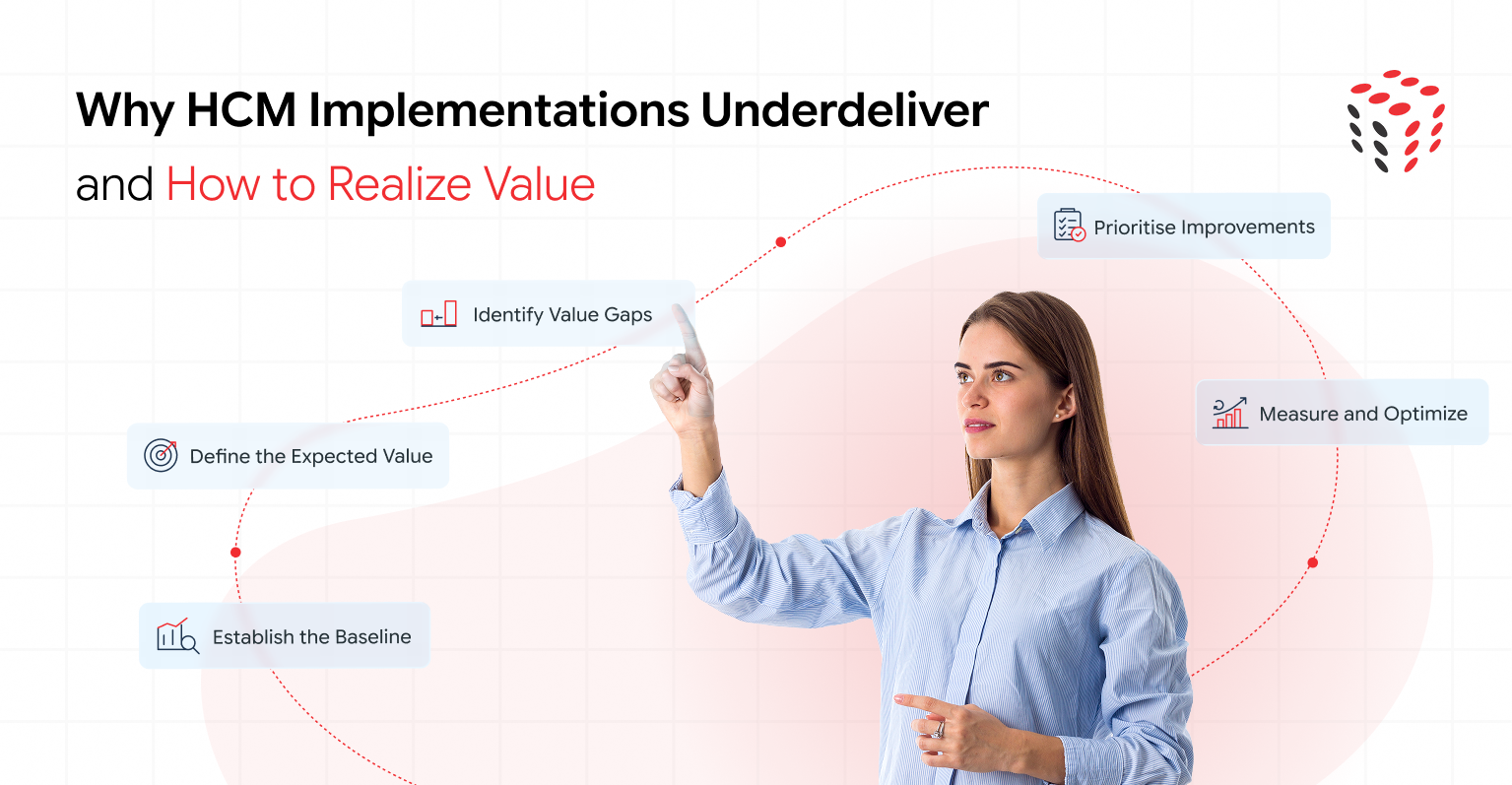
1. Establish the Baseline
Measure current process performance, adoption, data quality, manual effort, and business outcomes before making changes.
2. Define the Expected Value
Connect HCM capabilities with specific outcomes such as improved productivity, better workforce decisions, reduced administrative effort, and stronger employee experience.
3. Identify Value Gaps
Review where the expected value is being lost. Gaps may come from configuration, processes, integrations, data, adoption, or governance.
4. Prioritize Improvements
Focus improvement efforts on the gaps with the greatest impact rather than treating every issue equally.
5. Measure and Optimize
Track performance regularly, review adoption, identify emerging gaps, and continuously improve the HCM environment.
What Happens When Value Realization Becomes Continuous?
HR leaders can use performance data to decide where to optimize processes, activate existing capabilities, improve adoption, or introduce new technology.
This creates a shift from “Did we implement the system?” to “Are we getting the value we expected from it?”
FAQ
Why do HCM implementations underdeliver?
HCM implementations can underdeliver when organisations focus heavily on deployment while overlooking adoption, process efficiency, data quality, governance, and ongoing optimization.
What is HCM value realization?
HCM value realization is the process of ensuring that investments in HCM technology produce measurable improvements in business and workforce outcomes.
When should value realization begin?
Value realization should begin before implementation by establishing baselines and defining expected outcomes, then continue through adoption, optimization, and ongoing improvement.
What should organisations measure after HCM implementation?
Organisations should monitor adoption, process efficiency, data quality, employee experience, automation, and measurable business outcomes.