Table of Contents
- What Does a Failed HRIS Go Live Look Like?
- What Should You Do First When an HRIS Go Live Fails?
- How Do You Diagnose an HRIS Implementation Failure?
- Was the Problem Really the HRIS Platform?
- How Should Organisations Prioritise HRIS Recovery?
- How Important Is Data in HRIS Implementation Recovery?
- How Should HRIS Integration Failures Be Recovered?
- What Role Does Testing Play in HRIS Implementation Failure?
- How Should Organisations Handle Manual Workarounds?
- How Can Organisations Rebuild User Confidence After a Failed Go Live?
- Who Should Own HRIS Implementation Recovery?
- Should Organisations Continue With the Existing HRIS or Consider Replacing It?
- What Should an HRIS Recovery Roadmap Include?
- How Can Organisations Prevent Another HRIS Implementation Failure?
- From Failed Go Live to HRIS Value Realisation
- Key Takeaways
- Frequently Asked Questions
Resources > Blog > HRIS Implementation Recovery: What to Do When Go Live Fails
HRIS Implementation Recovery: What to Do When Go Live Fails
October 28, 2026
But what happens when employees cannot complete basic transactions, integrations fail, data is unreliable, managers cannot access required information, or HR teams are forced to create manual workarounds?
A failed go live does not necessarily mean the HRIS platform was the wrong choice.
The underlying problem may sit within data migration, process design, configuration, integrations, testing, change management, governance, or implementation planning.
The immediate priority is not to assign blame or rush into another technology decision.
It is to stabilise the environment, understand what went wrong, protect critical HR operations, and create a structured path toward recovery.
This article explains how organisations can approach HRIS implementation recovery when go live does not deliver the expected outcome.
What Does a Failed HRIS Go Live Look Like?
Common symptoms include:
- Employees unable to complete essential transactions
- Managers unable to perform required approvals
- Incorrect or incomplete employee data
- Payroll or finance integration failures
- Broken workflows
- Reporting inaccuracies
- High volumes of support tickets
- Manual workarounds
- Low user adoption
- Critical processes reverting to legacy systems
- Delayed business operations
Not every post go live issue represents implementation failure.
Some issues are normal during stabilisation.
The important distinction is whether the organisation is dealing with isolated defects or systemic problems that prevent the HRIS from delivering its intended business outcomes.
What Should You Do First When an HRIS Go Live Fails?
Organisations should identify processes that are critical to business continuity and protect them immediately.
These may include:
- Payroll
- Employee data
- Time and attendance
- Benefits
- Hiring and onboarding
- Regulatory reporting
- Manager approvals
- Employee self service
Create a clear incident structure with defined owners, escalation paths, priorities, and response timelines.
The objective is to restore operational stability before attempting major redesign.
How Do You Diagnose an HRIS Implementation Failure?
Review the implementation across key areas:
Requirements
Were business requirements clearly defined and approved?
Process Design
Were existing processes redesigned appropriately for the new operating model?
Configuration
Was the system configured according to approved requirements?
Data
Was employee data complete, accurate, and appropriately migrated?
Integrations
Were interfaces between HR, payroll, finance, identity, and other systems properly designed and tested?
Testing
Were realistic end to end scenarios tested before go live?
Change Management
Were employees, managers, and HR teams adequately prepared?
Governance
Were decisions, risks, dependencies, and escalations managed effectively?
This creates a fact based view of where the implementation broke down.
Was the Problem Really the HRIS Platform?
A common mistake after a difficult implementation is to conclude that the technology itself has failed.
Consider an organisation where managers cannot complete a particular HR transaction.
The root cause could be:
- Incorrect configuration
- Poor workflow design
- Missing role permissions
- Inadequate training
- Incorrect master data
- Integration failure
Replacing the platform without identifying the root cause can recreate the same problem in a new system.
A recovery assessment should therefore distinguish between platform limitations and implementation execution problems.
How Should Organisations Prioritise HRIS Recovery?
A useful recovery approach categorises issues according to business impact.
Critical
Issues affecting payroll, legal compliance, employee access, major business operations, or data integrity.
High
Issues that significantly disrupt important HR processes or affect large user groups.
Medium
Issues that create inefficiency but have viable workarounds.
Low
Usability improvements and enhancements that do not materially affect operations.
This prevents recovery teams from spending critical resources on lower priority enhancements while fundamental issues remain unresolved.
How Important Is Data in HRIS Implementation Recovery?
Organisations should validate:
- Employee master data
- Organisational structures
- Job and position data
- Compensation information
- Historical records
- Effective dates
- Manager relationships
- Country specific information
Data validation should focus not only on whether records migrated successfully but also whether the data supports the business processes that depend on it.
Where appropriate, organisations should establish a controlled process for correcting data and preventing the same issues from recurring.
How Should HRIS Integration Failures Be Recovered?
A recovery assessment should map the flow of information between systems.
For example:
HRIS → Payroll
HRIS → Finance
HRIS → Identity Management
Recruitment → HRIS
Time Management → Payroll
For each integration, teams should establish:
- What data should move?
- Which system owns the data?
- When should it move?
- What happens when the transfer fails?
- How are errors detected?
- Who owns resolution?
This helps move integration recovery from reactive troubleshooting to controlled operational management.
What Role Does Testing Play in HRIS Implementation Failure?
Organisations should examine whether testing covered:
- End to end business processes
- Integration scenarios
- Negative scenarios
- Country specific requirements
- Security roles
- Manager and employee journeys
- Data migration
- High volume scenarios
- Payroll dependencies
Testing should reflect how the organisation actually operates.
A technically successful test does not necessarily demonstrate that a complete business process will work successfully in production.
How Should Organisations Handle Manual Workarounds?
However, they should be controlled.
For each workaround, define:
- Owner
- Business purpose
- Duration
- Data handling requirements
- Reconciliation process
- Exit criteria
Otherwise, temporary workarounds can become permanent processes and create additional operational risk.
The recovery plan should therefore include a clear path to eliminate each temporary workaround.
How Can Organisations Rebuild User Confidence After a Failed Go Live?
Employees and managers may lose confidence in the HRIS if they experience repeated errors or unclear communication.
A recovery programme should provide:
- Clear communication
- Known issue updates
- Practical user guidance
- Targeted training
- Support channels
- Manager specific assistance
- Transparent escalation
Communication should explain what has been fixed, what remains under investigation, and what users should do in the meantime.
Who Should Own HRIS Implementation Recovery?
The organisation should establish ownership across:
- HR
- IT
- HRIS
- Business process owners
- Integration teams
- Data teams
- Implementation partner
- Technology vendor
A recovery governance structure should define who makes decisions, who resolves issues, who approves changes, and who communicates with stakeholders.
Without clear ownership, recovery can become another cycle of unresolved issues and escalation.
Should Organisations Continue With the Existing HRIS or Consider Replacing It?
Leadership should first determine whether the platform can support the required future state.
Key questions include:
Does the platform meet the core business requirements?
Are the major issues technically fixable?
Are the problems caused by implementation decisions rather than platform limitations?
Can the organisation stabilise the current environment within an acceptable timeframe and investment?
Does the vendor roadmap address important capability gaps?
If the platform itself has fundamental limitations, replacement may eventually need to be considered.
But that decision should follow a structured assessment rather than an emotional response to a difficult go live.
What Should an HRIS Recovery Roadmap Include?
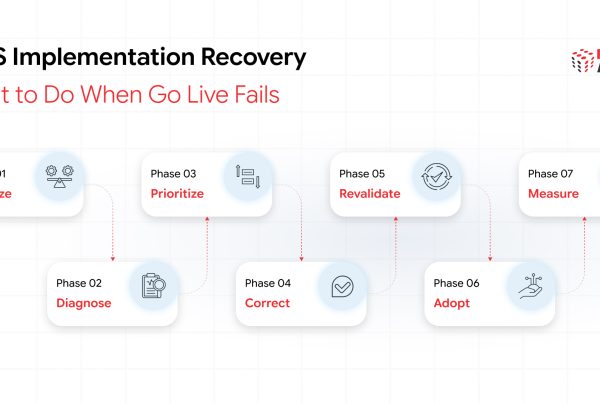
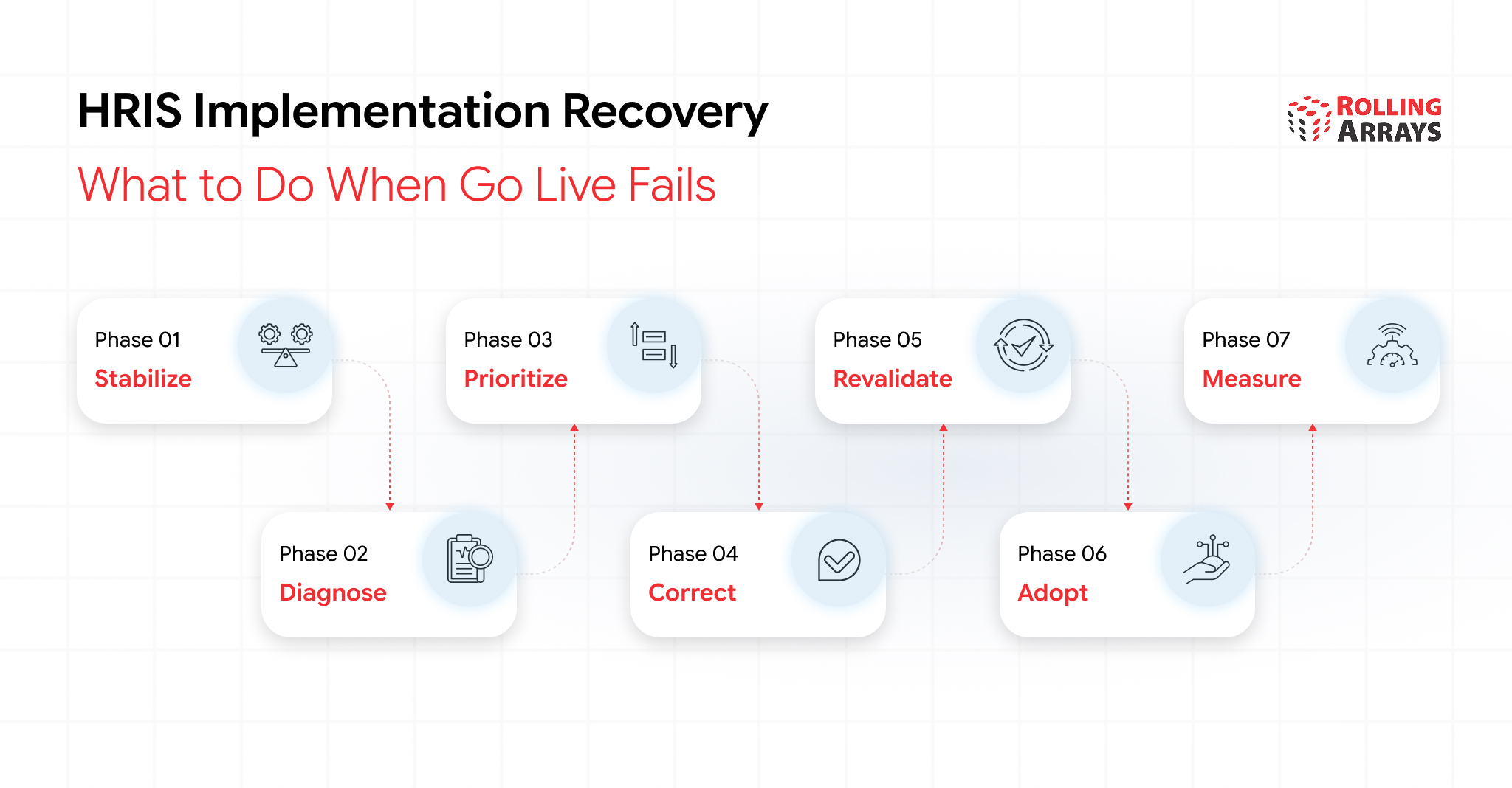
Phase 1: Stabilise
Protect critical HR operations and resolve high severity incidents.
Phase 2: Diagnose
Identify root causes across process, configuration, data, integrations, testing, and adoption.
Phase 3: Correct
Implement prioritised fixes and validate them against business scenarios.
Phase 4: Revalidate
Conduct controlled testing before releasing significant changes.
Phase 5: Adopt
Provide targeted training, communication, and support.
Phase 6: Optimise
Address remaining process improvements and remove temporary workarounds.
Phase 7: Measure
Track whether the HRIS is delivering the expected operational and business outcomes.
This creates a structured path from crisis management to value realisation.
How Can Organisations Prevent Another HRIS Implementation Failure?
Organisations should strengthen:
- Business requirement definition
- Process ownership
- Data governance
- Integration architecture
- End to end testing
- Change management
- Implementation governance
- Risk management
- Cutover planning
- Post go live support
The objective is not simply to fix today’s problems.
It is to address the weaknesses that allowed those problems to reach production.
From Failed Go Live to HRIS Value Realisation
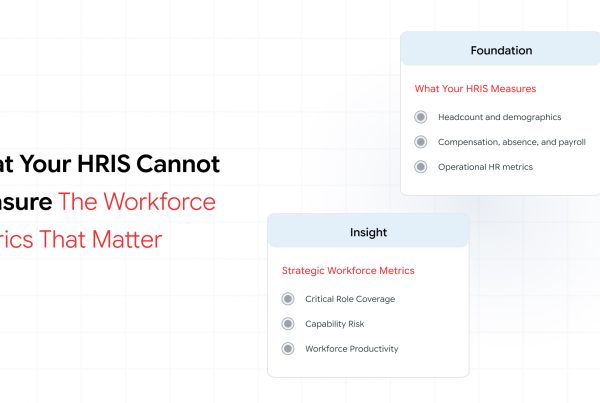
What matters is how quickly the organisation establishes control, identifies root causes, prioritises recovery, and rebuilds the connection between the technology and business requirements.
The recovery process should ultimately answer three questions:
Is the system stable?
Is the system being used effectively?
Is the system delivering the business outcomes it was intended to deliver?
Once these questions can be answered with evidence, the organisation can move beyond implementation recovery and focus on long term HR technology value.
Key Takeaways
- A difficult go live does not automatically mean the HRIS platform is unsuitable.
- Stabilise critical HR operations before attempting broad redesign.
- Diagnose root causes across requirements, processes, configuration, data, integrations, testing, and adoption.
- Prioritise issues according to business impact.
- Control manual workarounds and define clear exit criteria.
- Rebuild user confidence through transparent communication and targeted support.
- Establish clear recovery governance and ownership.
- Consider replacement only after assessing whether the existing platform can support the required future state.
- Use the recovery process to strengthen future HRIS implementation practices.
FAQ
What is HRIS implementation recovery?
HRIS implementation recovery is the structured process of stabilising, diagnosing, correcting, and improving an HRIS environment after significant problems emerge during or after go live.
What are common HRIS implementation challenges?
Common challenges can involve requirements, process design, configuration, data migration, integrations, testing, change management, user adoption, and governance.
What causes HRIS implementation failure?
Implementation failure can result from multiple factors, including unclear requirements, inadequate testing, poor data quality, integration problems, ineffective change management, configuration issues, or misalignment between the technology and business operating model.
What should you do when an HRIS implementation fails?
Start by stabilising critical business processes, establish recovery governance, identify root causes, prioritise issues by business impact, implement controlled fixes, and validate the solution through realistic business scenarios.
Should an organisation replace an HRIS after a failed implementation?
Not necessarily. Organisations should first determine whether the problems result from implementation execution or fundamental platform limitations. Replacement should be considered when the existing technology cannot support important current or future requirements.
What is the role of HRIS implementation support after go live?
HRIS implementation support can help organisations resolve technical and process issues, stabilise operations, improve adoption, address integration and data problems, and transition from implementation into sustainable HR technology operations.
Share with your network