Table of Contents
- Why Do Organisations Consider Replacing Their HRIS?
- Is the HRIS the Problem or the Process?
- When Does HRIS Optimization Make More Sense?
- When Should You Upgrade Your HRIS?
- What Should Organisations Assess Before Replacing an HRIS?
- How Can Organisations Measure HRIS Improvement?
- What Is the Cost of Replacing an HRIS?
- When Is HRIS Replacement Justified?
- How Can Organisations Compare Optimization With Replacement?
- Can HRIS Optimization Support Digital Transformation?
- What Role Does User Adoption Play in HRIS Optimization?
- When Should You Keep Your Existing HRIS?
- When Should You Replace Your HRIS?
- From HRIS Replacement to Evidence Based Decision Making
- Key Takeaways
- Frequently Asked Questions
Resources > Blog > When Should You Optimize Your HRIS Instead of Replacing It?
HRIS Optimization: When to Improve Your Existing System Instead of Replacing It
October 21, 2026
But a new HRIS does not automatically solve inefficient processes, poor data quality, weak adoption, integration issues, or unclear ownership. If those underlying problems remain, an organisation can spend significant time and money implementing a new platform only to recreate many of the same challenges.
Before starting another major implementation, organisations should ask a more fundamental question:
Is the HRIS actually the problem, or is the way we use and manage it the problem?
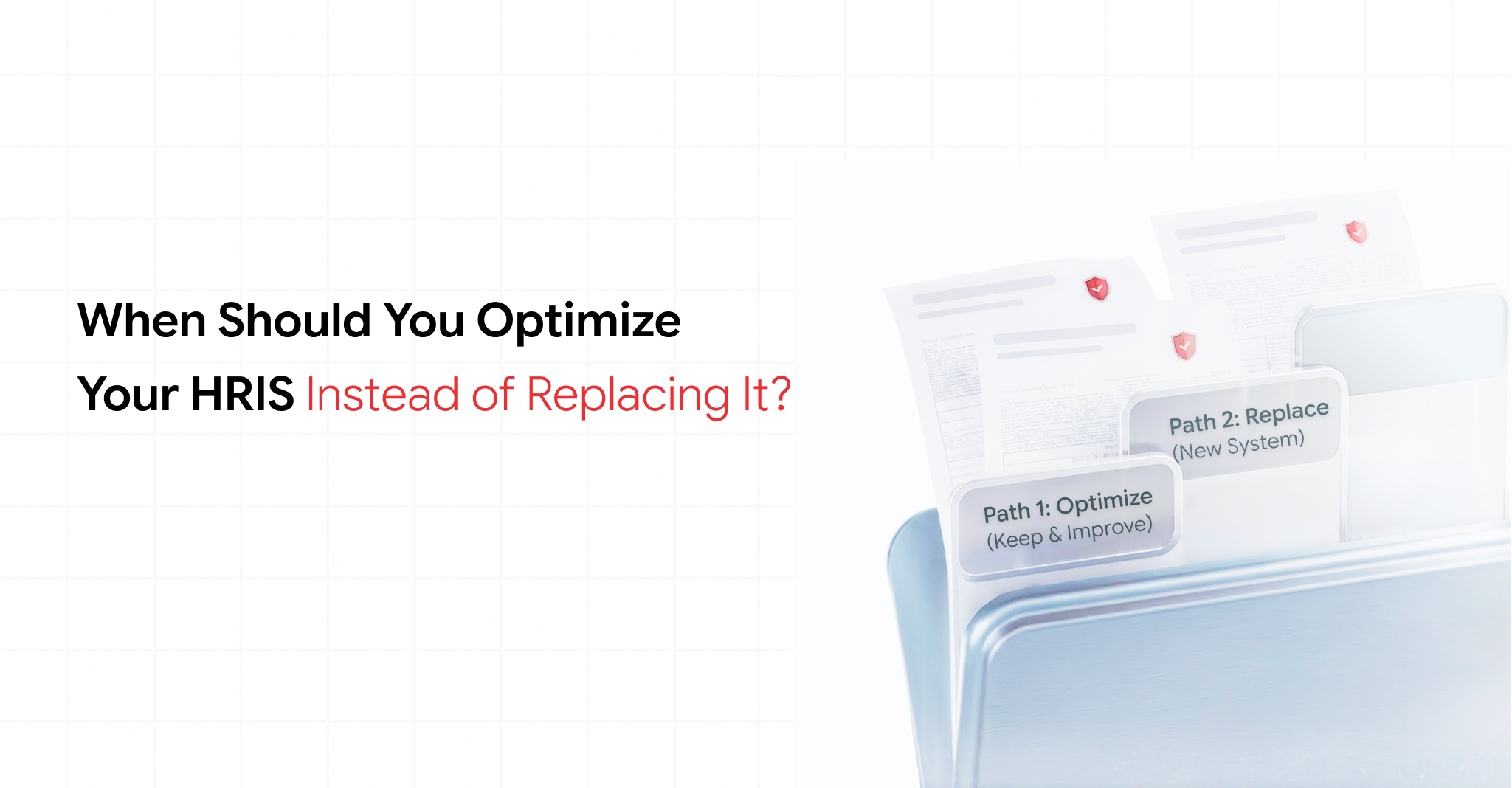
HRIS optimization provides a structured way to answer that question. It helps organisations determine whether they should improve the existing environment, upgrade selected capabilities, redesign processes, or consider a full replacement.
Why Do Organisations Consider Replacing Their HRIS?
The existing system may have:
- Low employee or manager adoption
- Inefficient HR processes
- Poor reporting
- Integration challenges
- Limited automation
- Data quality issues
- Difficult user experiences
- Outdated configurations
- Functional gaps
- High support requirements
However, these symptoms do not necessarily mean the underlying platform needs to be replaced.
The first step should be identifying the root cause of the problem.
Is the HRIS the Problem or the Process?
The immediate conclusion might be that the HRIS needs to be replaced.
But further investigation may reveal that the organisation has a complicated approval process, excessive fields, unclear ownership, or poorly designed workflows.
Replacing the HRIS would not necessarily solve those issues.
An HRIS optimization exercise can identify whether the problem comes from:
Technology → Process → Configuration → Data → Integration → Adoption → Governance
This distinction can prevent organisations from using technology replacement to solve problems that are primarily organisational or process related.
When Does HRIS Optimization Make More Sense?
Potential indicators include:
- Significant unused functionality
- Outdated configurations
- Poorly designed workflows
- Duplicate processes
- Weak reporting structures
- Low adoption of available capabilities
- Integration inefficiencies
- Inconsistent data practices
- Excessive customisation
- Limited process governance
In these situations, improving the existing environment may address the business problem without the disruption of a full replacement.
When Should You Upgrade Your HRIS?
An upgrade or targeted enhancement may be appropriate when:
- The core platform remains fit for purpose
- New functionality can address important gaps
- The vendor’s roadmap aligns with business requirements
- Existing integrations can be retained or improved
- Current data architecture remains suitable
- Users can transition without major disruption
An upgrade should therefore be evaluated as part of a broader HRIS transformation roadmap rather than treated as an automatic response to dissatisfaction.
What Should Organisations Assess Before Replacing an HRIS?
Business Fit
Does the current platform support the organisation’s HR strategy and operating model?
Functional Fit
Which requirements does the system meet, partially meet, or fail to support?
Process Effectiveness
Are inefficient HR processes creating problems that technology alone cannot solve?
Configuration
Is the system configured in a way that reflects current business requirements?
Integration
Are integration problems caused by the platform itself or by the surrounding technology architecture?
Data
Is poor data quality limiting the value of the HRIS?
Adoption
Are employees and managers using the capabilities already available?
Cost
What is the current cost of ownership compared with the investment required for replacement?
Future Fit
Can the existing platform support the organisation’s next phase of growth and transformation?
This creates a fact based foundation for the decision.
How Can Organisations Measure HRIS Improvement?
Organisations can track:
- Employee adoption
- Manager adoption
- Process completion times
- HR transaction volumes
- Manual activities
- Support tickets
- Data quality
- Reporting accuracy
- Integration failures
- Workflow completion
- User satisfaction
- Cost of ownership
For example, if an organisation redesigns an onboarding workflow, it can measure whether completion times, manual intervention, and support requests improve after the change.
This creates evidence that optimization is generating business value.
What Is the Cost of Replacing an HRIS?
A new implementation can involve:
- Vendor selection
- Programme management
- Process redesign
- Configuration
- Data migration
- Integration development
- Testing
- Change management
- Training
- Parallel operations
- Deployment
- Post go live support
There can also be business disruption during the transition.
This does not mean replacement is the wrong decision. It means organisations should understand the full transformation investment before deciding that replacement is necessary.
When Is HRIS Replacement Justified?
Examples may include:
- The platform cannot support critical business requirements
- The technology architecture is no longer sustainable
- The vendor cannot support required capabilities
- Scalability requirements exceed platform limitations
- Integration constraints materially restrict transformation
- Regulatory or security requirements cannot be adequately addressed
- The platform no longer aligns with the future HR operating model
In these circumstances, optimization may only delay the need for a broader technology change.
The decision should therefore consider both current performance and future requirements.
How Can Organisations Compare Optimization With Replacement?
Ask:
What business problem are we trying to solve?
Can the existing platform solve it?
What would optimization require?
What would replacement require?
What risks would each option create?
What investment would each option require?
Which option better supports the future HR operating model?
This reframes the discussion from “new system versus old system” to “which transformation path creates the required business outcome?”
Can HRIS Optimization Support Digital Transformation?
Optimization does not mean maintaining the status quo.
A structured HRIS transformation programme can redesign processes, simplify configurations, improve integrations, strengthen data governance, increase adoption, and introduce new capabilities while retaining the core platform.
For organisations with a suitable technology foundation, this can provide a practical path toward transformation without immediately undertaking a full replacement.
What Role Does User Adoption Play in HRIS Optimization?
An organisation may already own capabilities that employees and managers rarely use.
Before replacing the system, HR should understand:
- Which capabilities are being used
- Which capabilities are underused
- Why adoption is low
- Whether processes are intuitive
- Whether users understand the available functionality
- Whether managers receive sufficient support
Improving adoption can sometimes unlock value from existing technology without requiring another platform.
When Should You Keep Your Existing HRIS?
- The core architecture remains sound
- Critical requirements are supported
- Major gaps can be addressed
- Users can be brought to higher adoption
- Processes can be improved
- Integration challenges are manageable
- The vendor roadmap supports future needs
The objective should not be to replace technology simply because newer platforms exist.
The objective should be to ensure the technology continues to support the organisation’s business and HR strategy.
When Should You Replace Your HRIS?
A replacement decision becomes more compelling when multiple fundamental constraints exist across functionality, architecture, scalability, integration, security, and future business requirements.
The key is to distinguish between fixable performance problems and structural platform limitations.
From HRIS Replacement to Evidence Based Decision Making
A structured assessment can reveal whether the organisation has a technology problem, a process problem, an adoption problem, a data problem, or a combination of several issues.
For some organisations, the right answer may be optimization.
For others, it may be a targeted upgrade.
And where the existing platform cannot support the required future state, replacement may be necessary.
The important decision is not whether the organisation should have newer technology.
It is whether the technology investment can deliver the business outcomes the organisation needs.
Key Takeaways
- An underperforming HRIS does not automatically require replacement.
- Organisations should identify the root cause before selecting a technology response.
- HRIS optimization can address process, configuration, integration, data, and adoption issues.
- Upgrades can be appropriate when the existing platform remains strategically viable.
- Replacement may be justified when fundamental platform limitations prevent future requirements from being met.
- Total transformation costs should be considered before replacing an HRIS.
- Adoption and process effectiveness are critical to realising HR technology value.
- The decision should be based on business outcomes, future requirements, risk, and evidence.
FAQ
What is HRIS optimization?
HRIS optimization is the process of improving an existing HRIS through better configuration, processes, integrations, data, governance, adoption, and use of available functionality.
When should you upgrade an HRIS?
An HRIS upgrade may make sense when the existing platform remains fit for purpose but new capabilities or improvements are needed to support evolving business requirements.
How do you know when to replace an HRIS?
Replacement should be considered when fundamental platform limitations prevent the organisation from meeting important current or future business requirements and those limitations cannot be addressed effectively through optimization.
How can I improve my HRIS without replacing it?
Organisations can improve their HRIS by reviewing processes, simplifying configurations, improving data quality, strengthening integrations, increasing user adoption, and activating underused platform capabilities.
Is HRIS optimization cheaper than replacement?
It can be, but the answer depends on the scale of required changes. Organisations should compare the full cost, risk, effort, and expected outcomes of optimization against replacement.
What is the difference between HRIS optimization and HRIS transformation?
HRIS optimization focuses on improving the effectiveness of the existing environment, while HRIS transformation can involve broader changes to processes, operating models, technology, data, and employee experiences. Optimization can form part of a wider HRIS transformation strategy.
Share with your network