
Table of Contents
- Why Is HR Transformation More Complex Across Asian Markets?
- Why Does a Global HR Template Struggle Without Local Context?
- What Should Organizations Standardize and What Should They Localize?
- How Can Leaders Govern a Multi-Country HR Transformation?
- Why Does Employee Adoption Vary Across Asian Markets?
- How Should Multi-Country Organizations Prepare for AI-Enabled HR?
- How Can Organizations Turn Regional Complexity into a Transformation Advantage?
- What Questions Should Leaders Ask Before Scaling HR Transformation Across Asia?
Resources > Blog >Why Global HR Transformation Playbooks Fall Short in Multi-Country Asian Organizations
Why Global HR Transformation Playbooks Fall Short in Multi-Country Asian Organizations
July 16, 2026
Overview
HR transformation becomes more complex when organizations operate across multiple Asian markets. A global strategy may provide direction, but differences in regulation, payroll, workforce expectations, languages, operating practices, and digital maturity influence how organizations execute transformation in each country. Leaders must decide which capabilities require enterprise-wide consistency, which processes need local flexibility, and who should govern those decisions. This article explores why global HR transformation playbooks often fall short in multi-country Asian organizations and how leaders can build a regional approach that combines scale, local relevance, stronger adoption, and long-term business value.
Why Is HR Transformation More Complex Across Asian Markets?
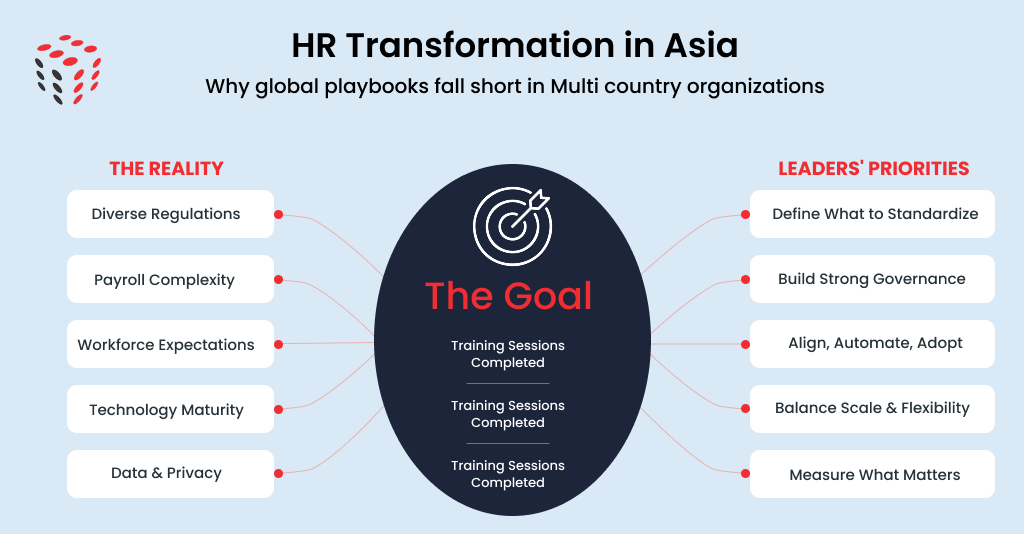
HR transformation becomes more complex across Asia because organizations must balance enterprise-wide objectives with different regulatory requirements, workforce practices, technology environments, and employee expectations across markets.
A transformation strategy designed at global headquarters may define common business objectives, governance principles, and technology standards. However, teams in Singapore, Malaysia, Thailand, Vietnam, Indonesia, and other Asian markets often operate within different business and workforce environments.
Multi-country organizations commonly need to manage differences in:
- Employment regulations and statutory requirements.
- Payroll practices and country-specific integrations.
- Languages and employee communication preferences.
- Workforce structures and HR service delivery models.
- Technology maturity and existing HR systems.
- Manager capabilities and employee expectations.
- Data privacy, security, and cross-border data requirements.
The challenge does not come from regional diversity alone. It comes from deciding where the organization needs consistency and where local requirements justify variation.
When organizations impose a single approach across every market, local teams may create workarounds to meet operational needs. When organizations allow every country to design its own processes, complexity increases and enterprise-wide visibility becomes harder to achieve.
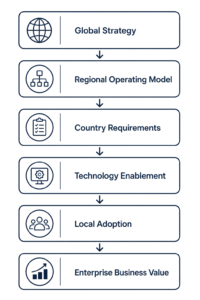
Successful HR transformation in Asia therefore requires a deliberate regional operating model that connects global direction with country-level execution.
The Multi-Country HR Transformation Challenge
The transformation focuses on six key enterprise priorities. Consistent HR operations require clear standards while allowing controlled flexibility to address different market requirements. Connected workforce data requires common data definitions and clear ownership to overcome differences in systems and data practices.
Scalable HR technology requires a technology architecture that supports justified localization while addressing country-specific processes and integrations. Consistent employee experience must account for different languages and workforce expectations across regions.
For AI-enabled HR capabilities, organizations need trusted data and clear AI governance to address uneven data quality and governance. Finally, faster decision-making requires comparable workforce insights across markets to overcome fragmented regional reporting.
Why Does a Global HR Template Struggle Without Local Context?
A global HR template struggles when organizations treat standardization as uniformity and expect every country to follow identical processes regardless of local business requirements.
Global templates can create significant value. They help organizations establish common data structures, simplify governance, improve reporting, and scale HR technology across markets.
Problems emerge when leaders define the global template without sufficient input from regional and country teams.
A process that works effectively in one market may require adjustment because of statutory requirements, payroll dependencies, local approval structures, employee expectations, or existing technology environments in another.
Organizations may then face several challenges:
- Country teams create manual workarounds outside the HR platform.
- Local exceptions increase after go-live.
- Employees experience processes that do not reflect local needs.
- Regional teams struggle to produce consistent workforce reporting.
- Technology teams manage growing customization and integration complexity.
- Leaders lose confidence in whether the global model supports business requirements across the region.
The solution is not to abandon global standardization. Organizations need a clear framework for deciding which elements remain consistent, which require localization, and who has the authority to approve exceptions.
This approach allows the organization to protect the value of enterprise standards without ignoring legitimate country requirements.
What Should Organizations Standardize and What Should They Localize?
Organizations should standardize the capabilities that create enterprise scale, trusted workforce data, and consistent governance while localizing only the processes that respond to genuine regulatory, operational, or workforce requirements.
The following framework provides a practical starting point.
- HR Governance: Decision rights, accountability, and escalation principles should be standardized across the enterprise, while country-level regulatory oversight should be localized where required.
- Workforce Data: Core data definitions, ownership, and quality standards should be standardized across the enterprise, with legally required country-specific data localized as necessary.
- HR Processes: Common process principles and approval logic should be standardized, while statutory steps and justified operational requirements should be localized by country.
- Payroll: Governance, controls, reporting standards, and integration principles should be standardized across the enterprise, while country-specific payroll regulations and calculations should be localized.
- Employee Experience: Common experience principles and service standards should be standardized, while language, communication, and relevant local practices should be adapted to each country.
- HR Technology: Enterprise architecture and integration standards should be standardized, with required local systems and statutory interfaces incorporated where necessary.
- Reporting and Analytics: Common definitions and enterprise KPIs should be standardized, while country-specific regulatory and operational reporting should be localized.
- AI Governance: Enterprise principles, accountability, and risk controls should be standardized, with adjustments made where required by local regulations and data restrictions.
- Does regulation require the variation?
- Does a genuine business requirement justify it?
- Can the organization achieve the same outcome through the enterprise standard?
If the answer to all three questions is no, the organization should challenge whether the local variation adds enough value to justify additional complexity.
How Can Leaders Govern a Multi-Country HR Transformation?
Leaders can govern a multi-country HR transformation by establishing clear decision rights across global, regional, and country teams before implementation and maintaining that governance after go-live.
Governance becomes particularly important when organizations need to decide whether a country requirement justifies changing an enterprise standard.
Without clear ownership, global teams may impose decisions without understanding local realities, while country teams may introduce exceptions that gradually increase complexity.
A practical governance model separates responsibilities across three levels:
Global Leadership
Global leaders define the enterprise transformation strategy, business outcomes, HR operating model principles, technology architecture, data standards, and governance requirements.
Regional Leadership
Regional leaders connect enterprise priorities with the realities of Asian markets. They identify common regional requirements, challenge unnecessary country variations, coordinate cross-market dependencies, and escalate decisions that require enterprise approval.
Country Leadership
Country leaders provide regulatory and operational expertise, identify legitimate local requirements, support employee adoption, and ensure that transformation decisions work within the local business environment.
Strong governance does not remove local decision-making. It clarifies where decisions belong.
This clarity helps organizations control customization, protect enterprise standards, resolve conflicts faster, and maintain transformation momentum across multiple markets.
Global Direction, Regional Governance, Local Execution
Why Does Employee Adoption Vary Across Asian Markets?
Employee adoption varies across Asian markets because workforce expectations, languages, manager capabilities, communication preferences, and levels of digital maturity differ across countries and employee groups.
A common technology platform does not automatically create a common employee experience.
Organizations may introduce the same HR processes across multiple markets, but employees and managers can respond differently to new ways of working. Communication methods that generate engagement in one country may have limited impact in another. Manager-led change may work effectively in one market, while employees in another may require more structured guidance and local support.
Organizations should consider several factors when planning adoption across Asia:
- Local languages and communication preferences.
- Manager readiness to support new ways of working.
- Employee familiarity with digital HR services.
- Access to technology across different workforce groups.
- Cultural expectations around leadership, feedback, and organizational change.
- Availability of local HR teams and change champions.
Successful multi-country transformations establish common adoption objectives while allowing country teams to adapt how they communicate, train, and support employees.
The goal is not to create a different change strategy for every country. Leaders should establish enterprise-wide principles and give regional and local teams enough flexibility to make adoption relevant to their workforce.
How Should Multi-Country Organizations Prepare for AI-Enabled HR?
Multi-country organizations should prepare for AI-enabled HR by establishing common data standards, clear governance, connected processes, and market-specific controls before scaling AI capabilities across the region.
AI can help organizations automate work, improve workforce insights, personalize employee experiences, and support faster decision-making. However, organizations will struggle to scale these capabilities when workforce data, processes, and governance differ significantly across countries.
Before expanding AI-enabled HR capabilities, leaders should assess:
- Whether countries use consistent workforce data definitions.
- Who owns workforce data quality across global, regional, and local teams.
- Whether HR processes produce reliable and comparable data.
- How organizations manage data privacy and cross-border data requirements.
- Who remains accountable for AI-supported decisions.
- Where local regulations require different controls or human oversight.
- Whether existing HR technology can support integration, automation, and AI use cases at scale.
AI readiness does not require every country to operate identically.
It requires organizations to establish a trusted enterprise foundation while identifying where local regulations and business requirements need different controls.
This distinction becomes increasingly important as organizations move from experimenting with AI to building an enterprise-wide roadmap for agentic AI adoption.
What Does AI Readiness Require Across Multiple Markets?
- Process Standardization: Do core HR processes generate consistent and usable data?
- Governance: Who owns AI decisions, risks, and outcomes?
- Technology Architecture: Can existing HR technology support AI-enabled capabilities at scale?
- Regulatory Readiness: Where do country-level requirements affect AI deployment?
- Workforce Adoption: Are employees and managers prepared to work with AI-enabled processes?
Organizations that answer these questions before scaling AI can build a more practical roadmap from experimentation to enterprise adoption.
How Can Organizations Turn Regional Complexity into a Transformation Advantage?
Organizations can turn regional complexity into an advantage by aligning enterprise priorities with local realities, automating processes that can scale responsibly, and driving adoption through market-relevant change strategies.
A practical approach focuses on three connected priorities.
Align
Organizations should align business strategy, the HR operating model, governance, workforce data, and regional requirements before making major transformation decisions.
Alignment helps leaders identify which capabilities require enterprise-wide consistency and where justified localization creates greater value.
For multi-country organizations, this step creates the foundation for better technology decisions, stronger governance, and a clearer AI roadmap.
Automate
Organizations should automate standardized and well-governed processes while preserving the local requirements that regulations or genuine business needs justify.
Automation creates greater value when organizations simplify processes before applying technology. This approach helps enterprises reduce unnecessary complexity, strengthen integration, and create a more scalable foundation for AI-enabled capabilities.
Adopt
Organizations should drive adoption through communication, leadership engagement, training, and support that reflect local workforce realities.
A common transformation strategy can provide direction, but employees experience change locally. Regional and country teams therefore play an important role in helping new processes, technologies, and AI-enabled capabilities become part of everyday work.
Together, Align, Automate, and Adopt provide a practical way to connect enterprise strategy with regional execution and long-term value realization.
What Questions Should Leaders Ask Before Scaling HR Transformation Across Asia?
Before expanding HR transformation across multiple Asian markets, leadership teams should confirm that the organization can balance enterprise scale with local relevance.
Leaders should ask:
- Which HR processes should remain consistent across every market?
- Which country-level variations do regulations or genuine business requirements justify?
- Who has the authority to approve exceptions to enterprise standards?
- Can leaders trust and compare workforce data across countries?
- Does the existing HR technology environment support current business needs and future AI priorities?
- How will the organization measure employee adoption and business outcomes across markets?
- What capabilities must the organization strengthen before scaling agentic AI adoption?
These questions help leaders identify gaps in the existing HR environment before committing to additional technology investments or large-scale AI initiatives.
Conclusion
HR transformation across Asia requires more than deploying a global template across multiple countries.
Organizations need an operating model that connects enterprise strategy with regional governance and country-level execution. They must standardize the foundations that create scale, localize where regulations and genuine business requirements demand flexibility, and establish clear ownership for the decisions that sit between the two.
Technology plays an important role in enabling this transformation. Organizations create greater value when they continuously evaluate whether their HR technology, processes, governance, and workforce data support changing business priorities.
As AI becomes a larger part of the enterprise HR agenda, this regional foundation becomes even more important. Organizations that strengthen data, governance, technology architecture, and adoption can build a clearer path from their current HR environment to scalable AI-enabled capabilities.
The goal is not to eliminate complexity across Asia. It is to govern complexity well enough to create consistency where it adds value, flexibility where the business needs it, and a stronger foundation for long-term transformation.
FAQ
Why is HR transformation more complex in Asia?
HR transformation becomes more complex in Asia because organizations operate across markets with different regulations, payroll requirements, workforce expectations, languages, technology environments, and levels of digital maturity. Successful transformation requires organizations to combine enterprise standards with controlled local flexibility.
Should multi-country organizations use one global HR template?
Multi-country organizations should use a common global framework for governance, workforce data, technology architecture, and core process principles. However, they should allow controlled localization when regulations or genuine country-level business requirements justify variation.
How can organizations balance HR standardization and localization?
Organizations can balance standardization and localization by defining clear enterprise standards, establishing criteria for local variations, and assigning decision rights across global, regional, and country teams. This approach helps organizations scale while controlling unnecessary complexity.
How does an HRTech Health Check support multi-country organizations?
An HRTech Health Check helps organizations evaluate whether their existing HR technology, processes, integrations, data, governance, and adoption continue to support business requirements across markets. The assessment can identify optimization opportunities and establish priorities for future transformation and AI adoption.
How should organizations prepare for agentic AI adoption across Asia?
Organizations should strengthen workforce data, process standardization, governance, technology architecture, regulatory controls, and workforce adoption before scaling agentic AI. A structured AI roadmap can help leaders prioritize use cases, define accountability, and move from experimentation to responsible enterprise execution.





Share with your network
Get updates in your inbox