
Resources > Blog >The HR Yield Model: Why Every HR Transformation Needs a Better Way to Measure Business Value
The HR Yield Model: Why Every HR Transformation Needs a Better Way to Measure Business Value
July 14, 2026
Overview
For decades, manufacturers have measured yield to understand how efficiently resources become finished products. This simple concept helps organizations reduce waste, improve quality, and maximize operational performance. HR transformation follows a similar principle, yet many organizations still lack reliable HR transformation metrics to show whether their investments are working. Organizations invest in technology, processes, and people with the expectation of creating measurable business value. Yet many HR teams continue measuring activities instead of outcomes. This article explores how the concept of yield can help organizations evaluate HR transformation more effectively and identify the metrics that truly demonstrate business impact.
Why Manufacturing Measures Yield
Manufacturing organizations rarely measure success by the number of machines operating or the number of production hours completed. Instead, they evaluate how efficiently inputs are converted into high quality outputs.
Yield provides that measurement.
It shows whether investments in materials, technology, and production processes create the expected business results. When yield declines, leaders investigate the underlying causes, improve processes, and reduce waste.
This principle has helped manufacturers improve efficiency, quality, and profitability for decades.
HR transformation deserves the same level of measurement.
Organizations invest significant time, budget, and leadership effort in transforming HR. They redesign processes, implement technology, and train employees to support new ways of working. The real question is not whether these activities happened. It is whether they created measurable business value.
Yield provides that measurement
It shows whether investments in materials, technology, and production processes create the expected business results. When yield declines, leaders investigate the underlying causes, improve processes, and reduce waste.
This principle has helped manufacturers improve efficiency, quality, and profitability for decades
HR transformation deserves the same level of measurement
Organizations invest significant time, budget, and leadership effort in transforming HR. They redesign processes, implement technology, and train employees to support new ways of working. The real question is not whether these activities happened. It is whether they created measurable business value.
From Investment to Business Value
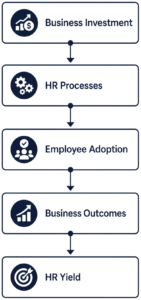
Why HR Still Measures Activities Instead of Outcomes
Many HR dashboards report operational metrics that help teams manage daily activities. These measures are valuable for monitoring performance, but they do not explain whether HR transformation is improving organizational outcomes.
Organizations often monitor:
- Training sessions completed
- HR cases resolved
- Performance reviews completed
- Employee self service usage
- System logins
These metrics indicate that work is taking place, but they do not show whether the organization has improved workforce productivity, strengthened employee retention, or increased business performance.
In PwC’s August 2023 Pulse Survey, 88% of executives said they struggle to capture value from their technology investments, and 85% said updating operating models to support a new vision is a challenge. This same gap shows up in HR: organizations generate more value from transformation when they connect operational improvements to measurable business outcomes, rather than evaluating implementation activities alone.
[Source: PwC, “How to create measurable outcomes through digital value transformation“]As executive teams demand stronger evidence of return on investment, HR leaders must demonstrate how transformation contributes to broader business objectives.
Activity Does Not Always Create Value
Completing more activities does not automatically improve organizational performance.
Consider the following comparison.
More training sessions lead to higher workforce capability, while more HR tickets resolved result in faster employee support. More performance reviews contribute to better employee performance, and more digital workflows improve operational efficiency. Finally, more reports generated support better business decisions.
The distinction is important because boards invest in HR transformation to improve business performance, not simply to increase operational activity.
Introducing the HR Yield Mindset
Manufacturing organizations evaluate how efficiently investments are converted into valuable outputs. HR transformation should follow the same principle.
An HR yield mindset shifts the conversation from measuring completed activities to evaluating how effectively HR investments create business value.
Instead of asking whether a project was completed or a process was automated, leaders should evaluate questions such as:
- Are HR investments improving workforce performance?
- Are standardized processes reducing operational complexity?
- Are employees adopting new ways of working across the organization?
- Are managers making faster and more informed workforce decisions?
- Is every investment in HR generating measurable business value?
This perspective encourages organizations to evaluate transformation as a continuous value creation journey rather than a series of completed activities. The higher the business value generated from every investment, the higher the organization’s HR yield.
HR Activities vs HR Yield
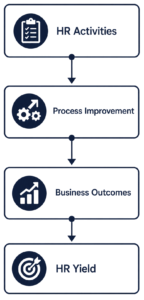
Four Characteristics of a High HR Yield Organization
Organizations with high manufacturing yield consistently convert investments into valuable outcomes. The same principle applies to HR transformation. High HR yield organizations maximize the value of their investments by aligning people, processes, technology, and governance with business objectives. They typically demonstrate four key characteristics.
They Align HR Metrics with Business Goals
High HR yield organizations begin by defining the business outcomes they want to achieve. Every HR initiative supports objectives such as improving workforce productivity, strengthening employee retention, or accelerating talent acquisition.
As a result, HR metrics become an extension of business strategy rather than standalone operational measures.
They Continuously Improve HR Processes
Successful organizations do not stop optimizing after implementation. They regularly review HR processes, eliminate inefficiencies, and simplify employee experiences to improve operational performance.
Continuous improvement helps maintain transformation momentum while increasing the return on HR investments.
They Build Strong Workforce Adoption
Technology delivers value only when employees consistently use it.
High HR yield organizations invest in communication, leadership engagement, and ongoing training to ensure new HR processes become part of everyday operations.
Higher adoption leads to better data quality, greater operational consistency, and more reliable workforce insights.
They Measure Long Term Business Impact
Rather than celebrating implementation milestones, these organizations evaluate how HR contributes to broader business outcomes. They monitor measures such as:
- Workforce productivity
- Employee retention
- Time to hire
- HR service efficiency
- Data quality and AI readiness
This long term perspective helps leadership teams make informed investment decisions while continuously improving HR performance.
The HR Yield Model
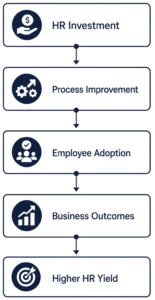
How Leaders Can Measure HR Yield
HR yield is not a single KPI. It is a combination of business outcomes that demonstrate whether HR investments create measurable organizational value.
Leadership teams should regularly evaluate questions such as:
- Has workforce productivity improved?
- Has voluntary turnover decreased?
- Has recruitment become faster and more efficient?
- Do managers trust workforce data when making decisions?
- Has manual HR administration declined?
- Is the organization becoming more prepared for AI enabled workforce management?
When organizations consistently answer these questions with measurable evidence, they gain a clearer understanding of their HR transformation performance.
Measuring Activities vs Measuring HR Yield
Traditional measurement focuses on activities completed, implementation milestones, operational efficiency, platform usage, and system reports. In contrast, HR yield measurement focuses on the actual value created, including business value created, workforce improvements, organizational performance, employee adoption and productivity, and strategic business insights.
This shift helps executive teams evaluate HR transformation as a strategic business investment rather than an operational initiative.
Improving HR Yield Across the Organization
Improving HR yield requires more than implementing new technology. Organizations must continuously strengthen the factors that convert HR investments into measurable business outcomes.
Leadership teams can improve HR yield by:
- Aligning HR initiatives with business priorities
- Standardizing processes across the organization
- Eliminating repetitive manual work
- Encouraging employees and managers to adopt new ways of working
- Using workforce insights to continuously improve HR services
Organizations that consistently refine these areas increase the value generated from every HR investment. Over time, this creates a more agile HR function that supports business growth while maximizing the return on transformation initiatives.
Conclusion
Manufacturing organizations have relied on yield metrics for decades because they reveal how efficiently investments create value. HR transformation should follow the same principle.
Rather than measuring how much work HR completes, organizations should evaluate how effectively every investment improves workforce performance, strengthens operational efficiency, and supports business growth.
Adopting an HR yield mindset encourages leaders to focus on value creation instead of activity completion. Organizations that maximize HR yield position themselves to achieve stronger business outcomes, greater organizational agility, and a more sustainable return on their transformation investments.
FAQ
What is the difference between activity metrics and outcome metrics?
MActivity metrics measure operational tasks, such as training sessions completed or HR tickets resolved. Outcome metrics measure the business impact of those activities, including workforce productivity, employee retention, and HR service efficiency.
What is HR yield?
HR yield is a way of measuring how effectively HR investments translate into measurable business outcomes such as workforce productivity, employee retention, operational efficiency, and better decision making.
Why is HR yield important?
HR yield helps organizations evaluate whether HR transformation initiatives create long term business value instead of simply increasing operational activity.
How is HR yield different from HR metrics?
Traditional HR metrics often measure activities such as training completion or tickets resolved. HR yield focuses on the business outcomes created by those activities.
How can organizations improve HR yield?
Organizations can improve HR yield by aligning HR initiatives with business objectives, standardizing processes, strengthening governance, increasing employee adoption, and continuously measuring business outcomes.



Share with your network
Get updates in your inbox