
Table of Contents
- Why Do Traditional HR Metrics Struggle to Hold the Board’s Attention?
- What Does the Board Actually Need to Know About HR Transformation?
- What Is Workforce Value Realization?
- What Is HR Transformation Return?
- Why Should HR Track Both Numbers Together?
- How Can HR Measure Value Without Claiming Credit for Every Business Outcome?
- How Should Organizations Establish These Numbers Before Transformation Begins?
- How Can Existing HR Technology Customers Determine Whether They Are Still Realizing Value?
- How Should HR Leaders Present Transformation Value to the Board?
- What Questions Should HR Leaders Answer Before Presenting Transformation Value to the Board?
Resources > Blog >What Two Numbers Should HR Bring to the Board to Prove Transformation Value?
What Two Numbers Should HR Bring to the Board to Prove Transformation Value?
July 28, 2026
Overview
HR teams track hundreds of metrics, but boards need a clearer view of whether HR transformation investments create measurable business value. Operational measures such as time-to-fill, training completion, and service volumes help HR teams manage performance, but they do not show whether transformation initiatives deliver the outcomes leaders expected or justify the investment required to sustain them. This article introduces two connected measures: Workforce Value Realization and HR Transformation Return. Together, they help leaders evaluate whether HR transformation delivers measurable workforce outcomes and whether the value created supports the business case for continued investment, optimization, and future innovation.
Why Do Traditional HR Metrics Struggle to Hold the Board’s Attention?
Traditional HR metrics struggle to hold the board’s attention because they describe HR activity and operational performance without always showing how HR transformation investments contribute to enterprise priorities and measurable business outcomes.
Metrics such as time-to-fill, employee turnover, training completion, HR service volumes, and system adoption remain important. HR teams need them to identify operational issues, manage workforce programs, and improve service delivery.
The challenge begins when organizations present these measures without connecting them to the business outcomes that justified the transformation investment.
- Faster recruitment matters when it reduces productivity gaps in critical roles.
- Higher employee adoption matters when it reduces manual effort or improves process consistency.
- Better workforce data matters when leaders use it to make faster and more confident decisions.
- Increased manager self-service matters when it reduces HR administration and improves service delivery.
- Process automation matters when it lowers operating costs, strengthens controls, or improves employee experience.
The metric itself is not the problem. The missing connection to business value is.
When HR dashboards contain dozens of operational measures, board members must interpret how those numbers relate to business priorities, transformation investments, and financial outcomes.
A stronger measurement approach creates a clear line of sight:
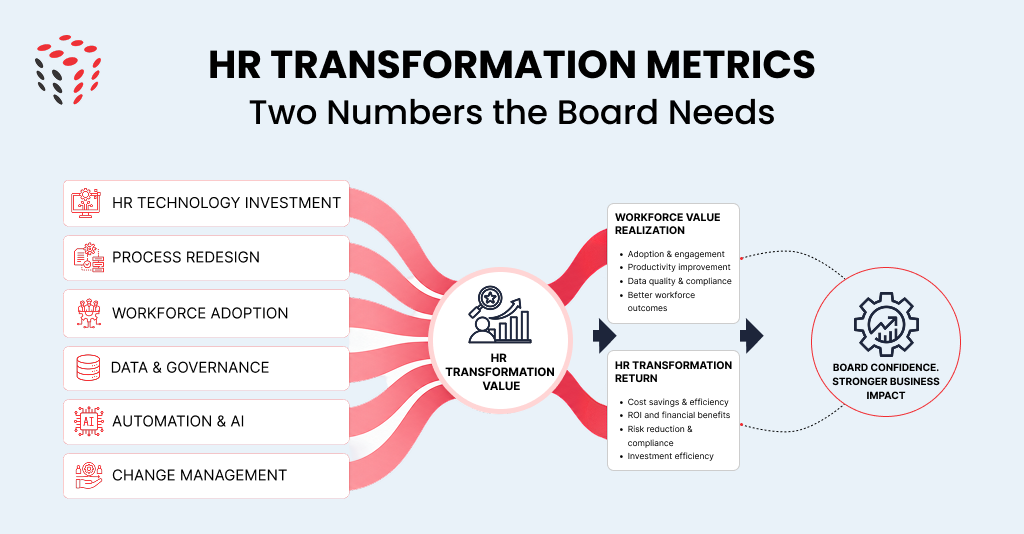
HR Transformation Investment → New Capabilities → Workforce and Operational Outcomes → Measurable Business Value
This does not mean HR should stop measuring operational performance. It means HR leaders should translate those measures into a smaller set of transformation outcomes that executives can use to evaluate value.
What Does the Board Actually Need to Know About HR Transformation?
The board needs to know whether the organization is achieving the workforce and business outcomes expected from HR transformation and whether the value created justifies the investment required to deliver and sustain those outcomes.
These questions become particularly important as organizations invest in HR platforms, process redesign, workforce analytics, automation, and AI-enabled capabilities.
Boards do not need detailed implementation dashboards to answer them.
They need visibility into two questions:
Are We Realizing the Workforce and Business Outcomes We Expected?
This question evaluates whether the transformation has produced measurable improvements against the objectives defined in the business case.
Organizations may have expected the transformation to:
- Reduce HR administration.
- Improve employee and manager self-service.
- Increase workforce data quality.
- Strengthen compliance and controls.
- Improve HR service delivery.
- Increase adoption of digital HR processes.
- Improve workforce planning and decision-making.
- Create stronger foundations for AI-enabled capabilities.
Leaders should compare current performance with the baseline and target established before the transformation began.
This creates the first number:
Workforce Value Realization
Does the Value Created Justify the Total Transformation Investment?
This question evaluates whether the measurable financial and operational value generated by the transformation supports the cost required to implement, operate, optimize, and sustain it.
The investment may include:
- Technology licensing and implementation costs.
- Integration and data migration.
- Process redesign.
- Change management and workforce adoption.
- Internal program resources.
- Ongoing platform support.
- Continuous optimization.
- Additional capabilities required to support future business priorities.
Organizations should compare these investments with measurable benefits such as cost reduction, productivity improvement, avoided costs, risk reduction, and other outcomes that Finance and business leaders agree to recognize.
This creates the second number:
HR Transformation Return
Together, these measures give leadership teams a more complete view of transformation performance.
One shows whether the organization achieved the intended outcomes.
The other shows whether those outcomes created sufficient value relative to the investment.
What Is Workforce Value Realization?
Workforce Value Realization is a measurement framework that shows how much of the workforce and operational value targeted by an HR transformation the organization has achieved and sustained over a defined period.
It is not a universally standardized HR metric.
Organizations should define the measure according to the outcomes, baselines, targets, and measurement methods established in their transformation business case.
The objective is to answer a simple executive question:
Are we realizing the value we expected from the transformation?
A practical approach begins by identifying the outcomes the organization committed to achieving.
The expected outcome of reducing annual HR administration is to reduce the baseline from 100,000 hours to 70,000 hours. The current result is 76,000 hours, indicating partial value realization.
Manager self-service adoption is expected to increase from 45% to 80%, with the current result at 74%, indicating performance near the target. Workforce data accuracy is expected to improve from 88% to 98%, with the current result at 96%, also near target.
Digital HR process adoption is targeted to increase from 60% to 90%, with the current result at 85%, indicating near-target performance. Overall, the results show that most transformation outcomes are approaching their targets, while reducing annual HR administration requires further improvement.
- Assign measurable targets to each transformation outcome.
- Agree on the relative importance of those outcomes.
- Identify an accountable business owner.
- Define how frequently leaders will review performance.
- Track whether improvements remain sustainable over time.
- Reassess measures as business priorities evolve.
This approach turns Workforce Value Realization into a management framework rather than another dashboard metric.
What Is HR Transformation Return?
HR Transformation Return measures the financial and operational value created by an HR transformation relative to the total investment required to implement, operate, optimize, and sustain it.
The purpose of this measure is not to assign a financial value to every HR outcome.
It helps leadership teams understand whether the transformation continues to support the economic assumptions and expected benefits defined in the business case.
A simple representation is:
HR Transformation Return = Measurable Value Created ÷ Total Transformation Investment
Organizations should treat this as a decision-making framework rather than a universal accounting formula.
Finance, HR, IT, and business leaders should agree on what counts as measurable value, how they will calculate investment costs, and how they will validate benefits.
What Should Organizations Include in Measurable Value?
Depending on the transformation objectives, measurable value may include:
- Reduction in HR operating costs.
- Productivity gains from reduced administrative effort.
- Avoided costs from retiring legacy applications or redundant processes.
- Reduced external service or manual processing costs.
- Financial value associated with stronger compliance and risk controls where the organization can validate the benefit.
- Reduced costs associated with process errors and rework.
- Measurable improvements in workforce productivity where leaders can establish credible attribution.
What Should Organizations Include in Transformation Investment?
Organizations should evaluate the full cost of creating and sustaining value, including:
- Software and technology costs.
- Implementation and integration.
- Data migration and remediation.
- Process redesign.
- Change management and training.
- Internal transformation resources.
- Ongoing support and maintenance.
- Continuous optimization.
- Future improvements required to maintain business value.
Looking only at implementation costs can create an incomplete view of transformation economics.
Likewise, claiming broad business outcomes without credible attribution can overstate the value HR has created.
A useful HR Transformation Return measure therefore depends on clear baselines, agreed assumptions, consistent measurement, and validation with Finance.
Why Should HR Track Both Numbers Together?
HR should track Workforce Value Realization and HR Transformation Return together because one measure shows whether the organization achieved the intended transformation outcomes, while the other evaluates whether those outcomes created sufficient value relative to the investment.
Either number can create an incomplete picture when leaders view it alone.
An organization may achieve most of its targeted workforce outcomes but spend significantly more than expected to create and sustain them.
Another organization may report short-term cost savings while employees continue using manual workarounds, workforce data remains unreliable, and adoption falls below expectations.
Tracking both measures helps leaders distinguish between these situations.
When workforce value realization is high but HR transformation return is low, the intended outcomes are being achieved, but leaders should improve the transformation’s economics and cost efficiency. When both workforce value realization and HR transformation return are high, the transformation is delivering its intended outcomes along with strong economic value.
When both workforce value realization and HR transformation return are low, the transformation requires intervention across strategy, processes, technology, governance, or adoption. When workforce value realization is low but HR transformation return is high, financial benefits may exist, but leaders should assess whether the transformation is delivering the strategic outcomes originally expected.
This combined view gives the board a more useful transformation narrative.
Instead of reporting dozens of disconnected HR metrics, leaders can answer two connected questions:
Are we realizing the outcomes we promised?
Are those outcomes creating enough value to justify and sustain the investment?
These two numbers do not replace operational HR metrics.
They create an executive layer that connects HR performance, technology investments, transformation outcomes, and business value.
How Can HR Measure Value Without Claiming Credit for Every Business Outcome?
HR transformation can contribute to productivity, retention, workforce agility, cost reduction, compliance, and business performance. However, many factors outside HR also influence these outcomes.
For example, employee retention may improve after an organization introduces better workforce experiences, manager capabilities, career development programs, and HR technology. Market conditions, compensation strategies, leadership changes, and business performance may also influence retention.
HR should not claim that the transformation created the entire improvement.
A stronger measurement approach establishes the relationship between the transformation initiative and the outcome.
Organizations should:
- Establish baseline performance before the transformation begins.
- Define the expected business outcome and measurement method.
- Identify other factors that may influence the result.
- Agree with Finance and business leaders on attribution assumptions.
- Assign accountable owners for each transformation benefit.
- Track leading indicators that show whether the organization is progressing toward the outcome.
- Validate lagging indicators that demonstrate whether the expected value materialized.
- Review whether the benefits remain sustainable over time.
What Is the Difference Between Direct, Influenced, and Enabled Value?
Organizations can strengthen measurement credibility by separating transformation benefits into three categories.
Direct Value refers to measurable financial or operational benefits created by the transformation with clear attribution. An example is reducing external processing costs after automating an HR process.
Influenced Value occurs when HR transformation contributes to an outcome alongside other business factors. For example, retention may improve through better employee experiences, manager capabilities, and workforce practices.
Enabled Value refers to capabilities created by the transformation that help the organization make better decisions or pursue future opportunities. An example is building trusted workforce data and governance required for AI-enabled HR capabilities.
This distinction helps HR communicate value without overstating its contribution.
Boards and Finance teams are more likely to trust a business case when HR clearly explains where the transformation creates direct value, where it contributes to broader outcomes, and where it builds capabilities that support future business priorities.
How Should Organizations Establish These Numbers Before Transformation Begins?
Measurement should not begin after go-live.
When organizations wait until implementation is complete to define success, they may struggle to reconstruct accurate baselines, validate benefits, or determine whether the transformation created the expected value.
Before seeking board approval for a new HR technology investment, leaders should define:
- The business problems the transformation must address.
- The measurable outcomes the organization expects to achieve.
- Current baseline performance.
- Target performance and expected timeframes.
- The capabilities required to achieve those outcomes.
- Total implementation and ongoing investment requirements.
- Direct, influenced, and enabled benefits.
- Assumptions used to calculate financial value.
- Accountable owners for realizing each benefit.
- How Finance and business leaders will validate results.
- How frequently leaders will review transformation performance.
What Should a Board-Ready HR Transformation Business Case Include?
The Strategic Need addresses why the organization needs to act now, while the Cost of Inaction considers what could happen if the organization delays the transformation. Expected Outcomes define the measurable improvements the transformation should create, and Baseline and Targets establish how leaders will determine whether performance has improved.
Investment Requirements focus on the cost of implementing and sustaining the transformation. Benefits and Attribution identify the value the organization can credibly expect and measure. Risks and Dependencies consider the factors that could prevent the organization from realizing value.
The Value Realization Plan defines who owns each outcome and how leaders will track progress. Finally, Transformation Return evaluates whether the expected value is sufficient to support the investment decision.
How Can Existing HR Technology Customers Determine Whether They Are Still Realizing Value?
Existing HR technology customers can determine whether they are still realizing value by evaluating how effectively their current platforms, processes, integrations, workforce data, governance, and adoption support changing business priorities.
Go-live does not guarantee continued value realization.
Over time, organizations introduce new processes, integrations, customizations, business requirements, and local variations. Employees may develop manual workarounds. Platform capabilities may remain underused. Workforce data issues can reduce confidence in reporting and analytics.
Organizations using SAP SuccessFactors or Workday should periodically evaluate whether their current HR technology environment continues to deliver the outcomes expected from the original investment.
A structured assessment should examine:
Business Alignment assesses whether the HR technology environment continues to support current business and workforce priorities. Process Effectiveness evaluates whether manual workarounds, unnecessary approvals, or process variations have reduced efficiency.
Platform Optimization considers whether the organization uses existing platform capabilities effectively. Integrations assess whether systems exchange reliable and timely data across the enterprise. Workforce Data focuses on whether leaders can trust the information used for reporting, analytics, automation, and AI.
Governance evaluates whether clear ownership and decision rights support continuous improvement. Adoption assesses whether employees and managers consistently use the intended processes and capabilities. Business Outcomes examine whether the organization is achieving and sustaining the outcomes expected from its HR technology investments.
Finally, AI Readiness considers whether the current environment can support future AI-enabled and agentic AI priorities.
How Should HR Leaders Present Transformation Value to the Board?
The board does not need every operational measure that HR teams use to manage transformation performance.
A board-level view should answer five questions:
- What outcomes did the organization commit to achieving?
- How much of the expected value has the organization realized?
- Does the measurable value justify the total transformation investment?
- Where do gaps, risks, or unrealized benefits require intervention?
- What decisions or investments will help the organization protect or increase future value?
A simple executive scorecard can provide this view.
The assessment covers several key areas to evaluate the current HR technology environment. Business Alignment assesses whether the current HR technology environment supports changing business and workforce priorities. Process Effectiveness examines whether inefficient processes, manual workarounds, or unnecessary variations have developed over time. Platform Optimization evaluates whether the organization is fully utilizing the capabilities available within its existing HR technology environment. Integrations focuses on whether systems can exchange reliable and timely information across the enterprise. Workforce Data assesses whether leaders can trust the data required for reporting, analytics, automation, and AI. Governance examines whether ownership, decision rights, access controls, and accountability are clearly defined. Adoption evaluates whether employees and managers consistently use the processes and capabilities available to them. Finally, AI Readiness assesses whether the existing environment can support prioritized AI use cases and future agentic AI adoption.
What Questions Should HR Leaders Answer Before Presenting Transformation Value to the Board?
Before presenting HR transformation performance to the board, leaders should confirm that the organization can explain how it measures outcomes, validates benefits, and connects transformation performance with future decisions.
HR leaders should ask:
- What workforce and business outcomes did we commit to achieving?
- Did we establish credible baselines before implementation?
- How much of the expected value have we realized and sustained?
- Which benefits can we attribute directly to the transformation?
- Which outcomes did HR influence or enable alongside other business factors?
- Has Finance validated the assumptions and measurable benefits?
- Does the value created justify the total cost of implementing and sustaining the transformation?
- Where are manual workarounds, low adoption, data issues, or governance gaps limiting value?
- Does our existing HR technology environment support future business and AI priorities?
- What decisions do we need the board to make next?
Clear answers help HR leaders turn measurement into an executive decision-making tool rather than another reporting exercise.
Conclusion
Boards do not need HR to stop measuring time-to-fill, employee turnover, adoption, service volumes, or other operational metrics. These measures remain essential for managing HR performance.
Boards need HR leaders to connect those metrics to a clearer transformation value story.
Workforce Value Realization helps leaders understand whether the organization is achieving and sustaining the workforce and operational outcomes expected from transformation.
HR Transformation Return helps leaders evaluate whether those outcomes create sufficient measurable value relative to the investment required to implement, operate, optimize, and sustain the transformation.
Together, these two measures provide an executive layer above operational HR metrics.
They help organizations establish stronger business cases before making new HR technology investments, evaluate whether existing platforms continue to create value, identify opportunities for optimization, and make more informed decisions about future AI-enabled capabilities.
The strongest HR measurement strategy does not attempt to prove that HR deserves credit for every business outcome.
It gives leaders credible evidence about what the transformation delivered, what value the organization realized, where gaps remain, and what the organization should do next.
FAQ
What Is an AI Readiness Assessment for HR?
An AI readiness assessment for HR evaluates whether an organization’s business priorities, HR processes, workforce data, technology environment, governance, and workforce adoption capabilities can support AI-enabled and agentic AI use cases.
How Are AI Agents Different from Traditional HR Automation?
Traditional HR automation typically follows predefined rules and workflows. AI agents can interpret requests, access information, coordinate activities across systems, recommend actions, and, within defined boundaries, perform tasks with varying levels of autonomy.
Does an Organization Need to Replace Its Existing HR Platform to Adopt AI Agents?
No. Organizations can often optimize and extend their existing SAP SuccessFactors or Workday environments through integrations, AI-enabled capabilities, complementary solutions, and agentic AI use cases based on business requirements and technology readiness.
What Should Organizations Assess Before Selecting AI Agent Use Cases?
Organizations should assess business value, process maturity, workforce data quality, technology and integration readiness, AI governance, risk, human oversight requirements, and workforce adoption before prioritizing AI agent use cases.
How Does an AI Roadmap Support Agentic AI Adoption?
An AI roadmap connects business priorities with readiness gaps, prioritized use cases, process and data improvements, technology requirements, governance, build and execution plans, workforce adoption, and measures of business value and risk. It helps organizations move from AI experimentation to structured enterprise adoption.




Share with your network
Get updates in your inbox