
Table of Contents
Resources > Manu’s Blog > The 7-Number Story That Ends the “HR Is a Cost Center” Debate
The 7-Number Story That Ends the “HR Is a Cost Center” Debate

Founder & CEO – Rolling Arrays
Originally Published on LinkedIn
A board-ready way to talk about talent — in the language the board actually speaks.
It has been eight months. Thank you for staying subscribed.
The silence was not writer’s block. It was research. The last several months were spent testing one idea with CHROs, CFOs and CEOs across Asia Pacific. The idea is this:
HR loses the cost-center argument because HR is having the wrong conversation. Not the wrong work. The wrong conversation.
This newsletter exists to fix that. So let us get back to it.
What your CEO actually cares about
Over a hundred CHROs have been asked the same question across these conversations:
“Two years after your HR tech go-live, can you draw a line from that investment to your business results?”
The answer is almost always no. Not because the work did not matter. Because the measurement did not exist.
CEOs care about three things. Top line. Bottom line. Growth of both, relative to competitors. That is what the board expects. That is what shareholders demand.
When the CHRO walks in to discuss compensation revamps, appraisal cycles, shared services, onboarding fixes, or a Workday-versus-SuccessFactors selection — the CEO checks out. Not because these do not matter. Because they are means, not ends.
The fix is not to work harder on the means. It is to start measuring the ends.
HR is not a department. It is a supply chain.
Here is the reframe.
Every business — product, services, healthcare, manufacturing, public sector — is ultimately a collection of employees making decisions. Increase the quality of those people in the seats that matter most, and revenue moves. Margins move. Strategy executes.
That makes HR a supply chain function. Talent flows through the organization the way raw materials flow through a factory. Quality enters. Value is added. Waste accumulates. Yield matters.
Manufacturing learned to measure this fifty years ago. HR has not.
That gap is the cost-center narrative. It is not a positioning problem. It is a measurement problem.
The 7 R’s: your talent supply chain
Seven stages exist where talent quality either rises or falls. Every HR program, every policy, every tech investment lives inside one of them.
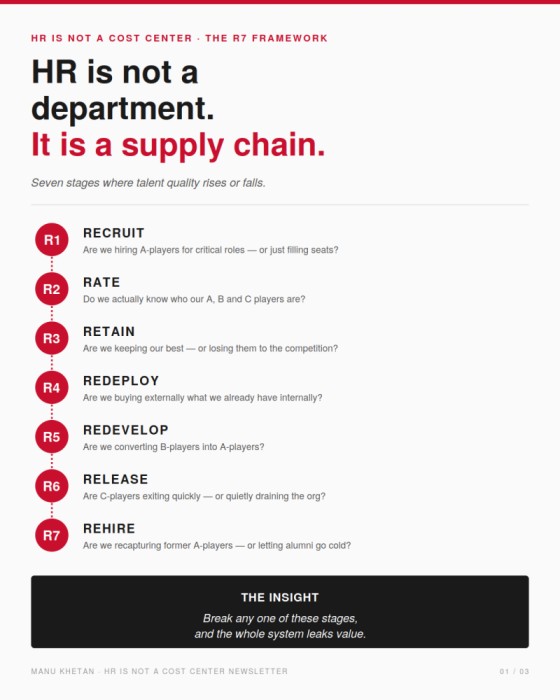
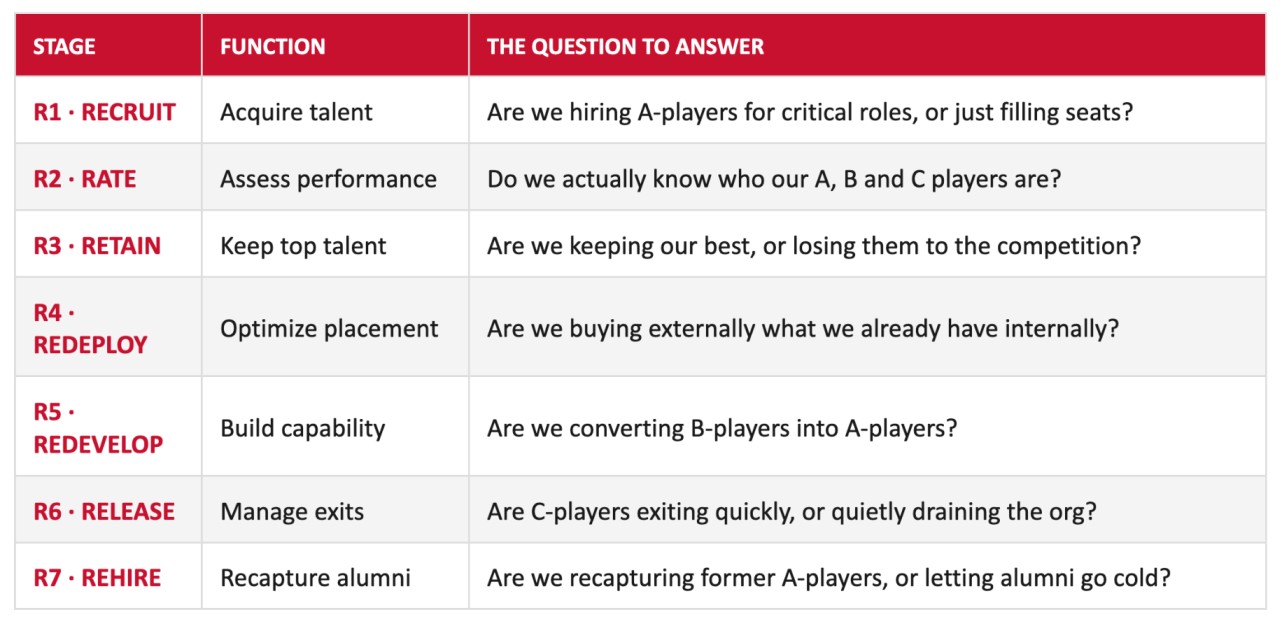
These are not HR functions. They are quality-control checkpoints in a supply chain. Break any one of them, and the whole system leaks value.
The two metrics that matter to the board
The board does not care about any of them.
The board cares about two numbers:
- The percentage of A-players in your critical roles.
- The tenure of those A-players in those roles.
That is it. Move these two numbers, and every other HR metric earns its place. Fail to move them, and the rest is theatre.
A typical organization has 15-20% critical roles, 60% standard and 20-25% support. Yet HR spreads its energy evenly across all three. The math says it should not. An A-player lost in a critical role costs roughly 2x more than an A-player lost in a support role. Retention dollars should follow the value, not the headcount.
What this looks like in dollars
Make it concrete.
Take a 4,000-employee company. 20% A-player concentration. 12% A-player attrition. Average A-player salary: $120,000. Conservative SHRM-aligned replacement cost: 2.5x salary.
The math:
96 A-players walking out the door every year. At $300,000 each. $28.8 million in annual hidden cost.
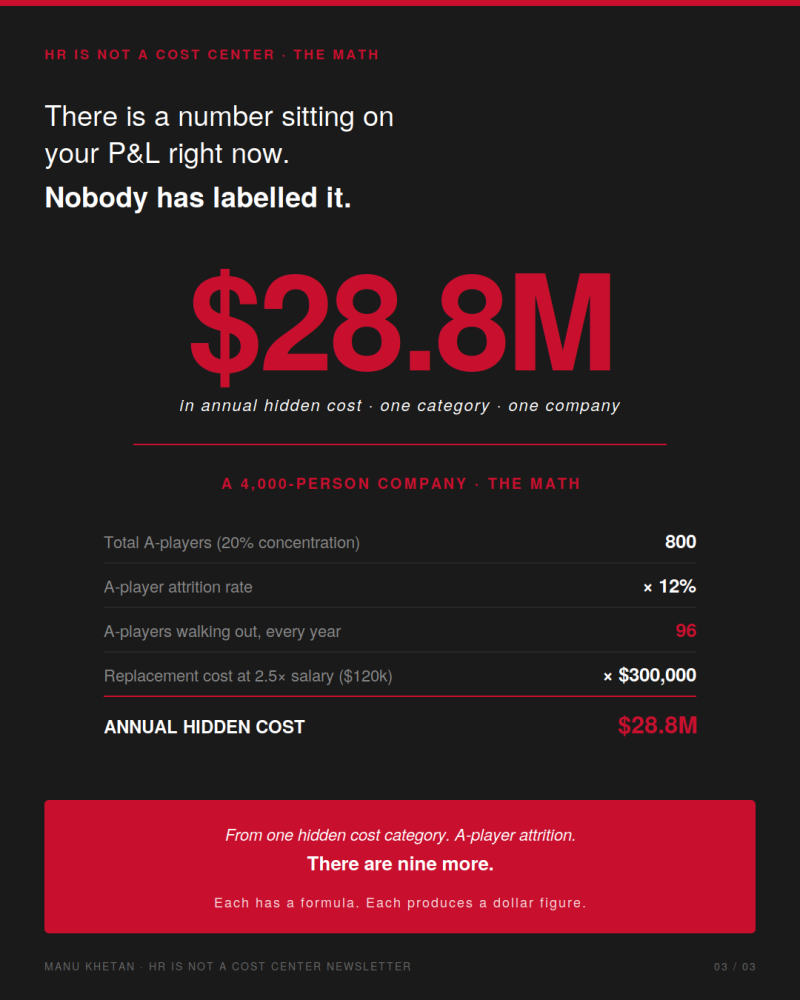
From one hidden cost category. A-player attrition. That is before counting poor quality of hire. Before talent misplacement. Before C-player tolerance. Before compliance exposure. Before the leadership hours lost to admin work.
There are ten of these hidden costs. They sit on your P&L right now. They are just not labelled.
The same math goes the other way. Ten value drivers. A-player retention. Internal mobility savings. B-to-A development conversion. Leadership capacity reclaimed. Each has a formula. Each produces a dollar figure.
This is the conversation the board recognizes. It is the same conversation it has with every other function that runs a supply chain.
The board narrative, on one slide
Stop walking in with HR activity. Walk in with this:
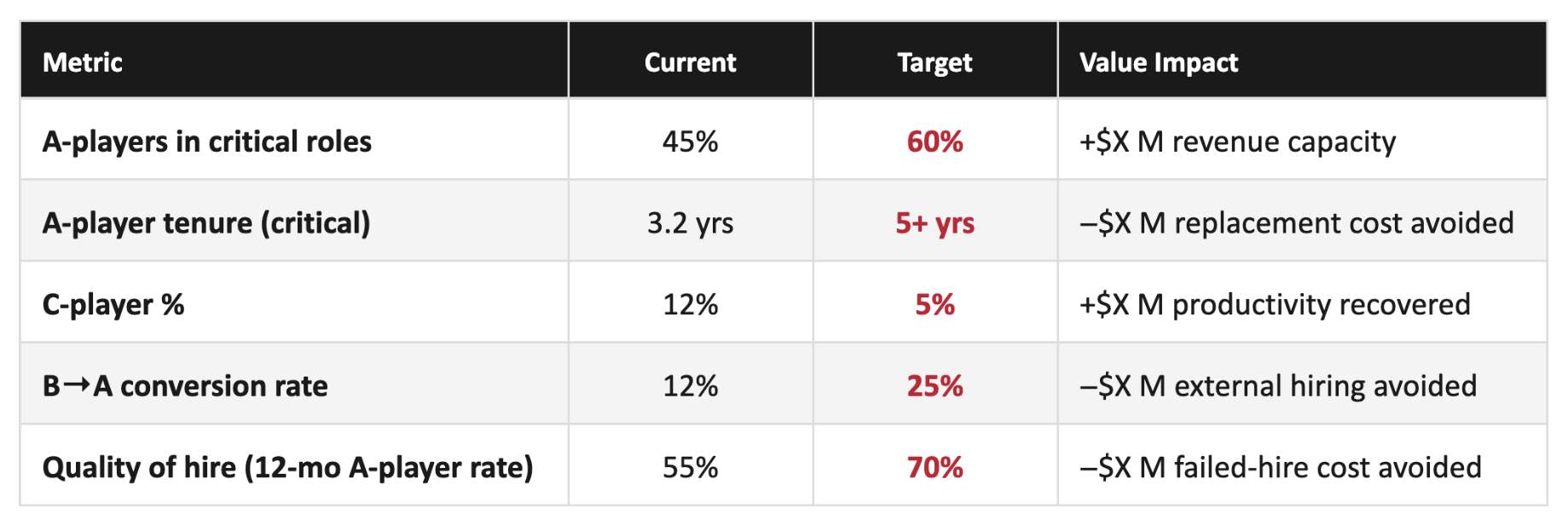
Every percentage-point gain in A-player concentration in critical roles = $X million in enterprise value.
Now the CFO leans in. Now the CEO has something to defend in the next quarterly call. Now the conversation stops being about HR’s cost and starts being about HR’s contribution.
The shift in language
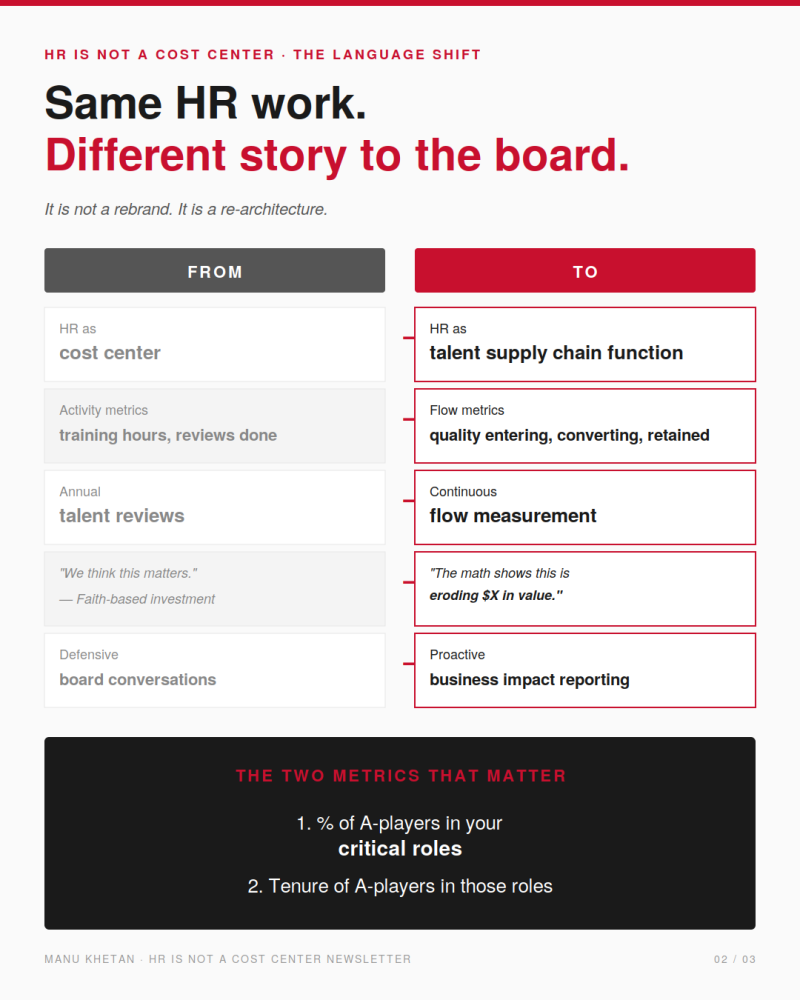
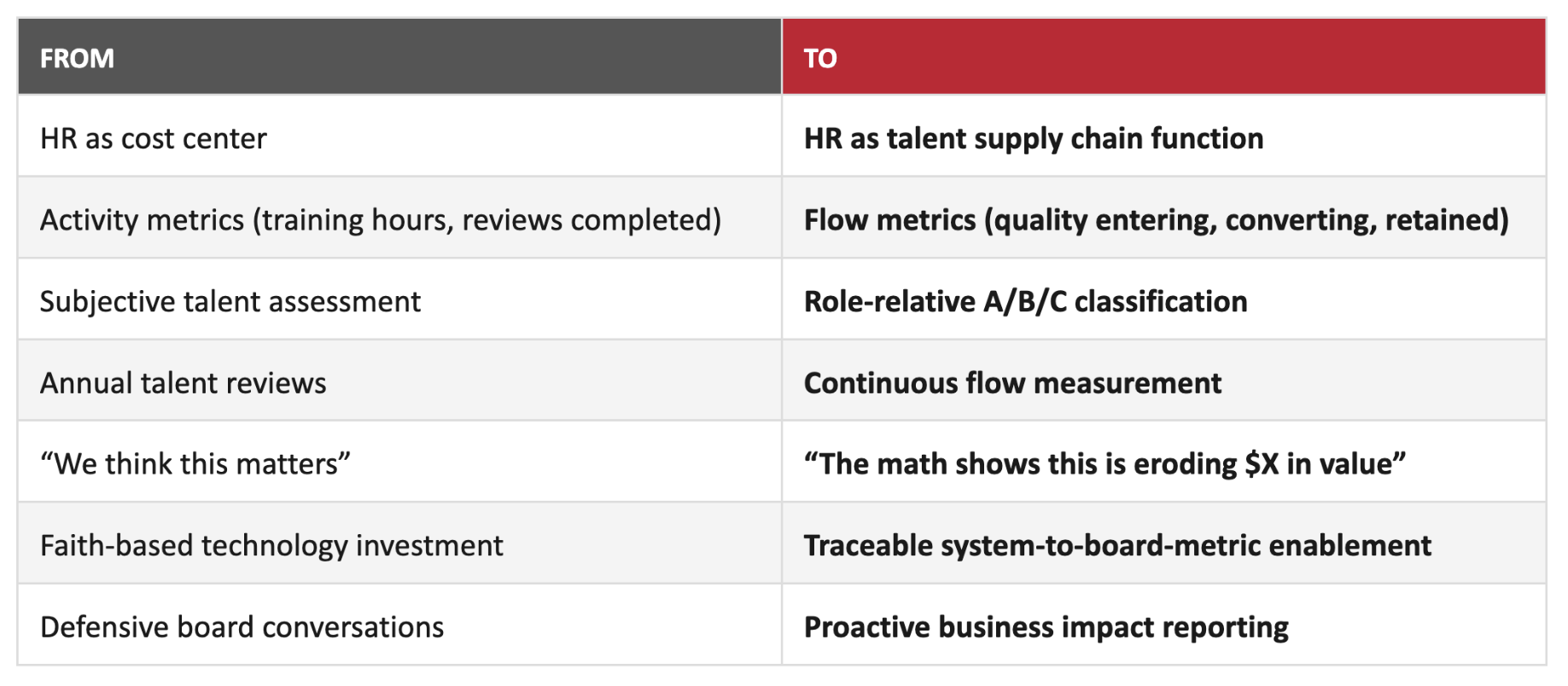
This is the shift. It is not a rebrand. It is a re-architecture.
Where to start on Monday
Pick three numbers. Do not try to measure everything.
- A-player % in your top 20 critical roles. If you do not know who is in those roles, the rest does not matter. Start there.
- A-player attrition cost (last 12 months). Use the formula above. Be conservative. The number will still be large enough to commission attention.
- The single biggest hidden cost from the list of ten. Whichever surfaces first becomes the priority.
A consulting engagement is not the starting point. A calculator and twenty minutes are.
One question
After eight months away, this is what I want to come back to.
If you walked into your next board meeting and put just those five numbers on one slide — would the conversation about HR change?
Hit reply and tell me which one of the five you would put first. I will share what I am hearing back in the next issue.
Welcome back.
— Manu
P.S. The seven stages, the ten hidden costs, the ten value drivers, the role-criticality multipliers — they sit inside the R7 Framework. The next few issues will go deeper into each. For the full pre-read on the architecture, comment “Pre-read” and it will be sent across.
About Manu Khetan
Manu, Founder and CEO of Rolling Arrays, a global HR technology leader, brings two decades of expertise to redefine HR practices. Passionate about pioneering HR automation and nurturing talent, Manu advocates for a customer-first and employee-first approach, prioritizing value creation. Beyond the boardroom, he is a dedicated family man, a skilled pianist, and an advocate for empowering the next generation of entrepreneurs. Join Manu on the transformative journey where HR emerges as a dynamic force for positive change in the business world.



Share with your network
Get updates in your inbox