Table of Contents
- Why Do HCM Implementations Underdeliver?
- Where Does HCM Value Get Lost?
- How Can Organisations Realize More Value?
- What Should Leaders Measure After Go Live?
- How Can Organisations Build a Value Realization Playbook?
- Establish the Baseline
- Define the Expected Value
- Identify Value Gaps
- Prioritize Improvements
- Measure and Optimize
- What Happens When Value Realization Becomes Continuous?
- Frequently Asked Questions
Resources > Blog > Performance Rating Inflation: How to Identify and Correct Rating Bias
Performance Rating Inflation: How to Identify and Correct Rating Bias
November 11, 2026
What Is Performance Rating Inflation and Why Does It Matter?
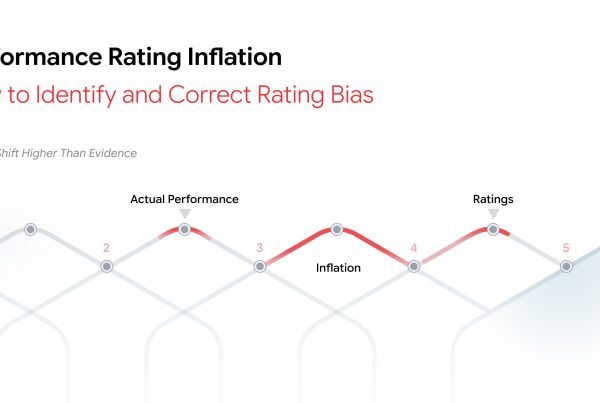
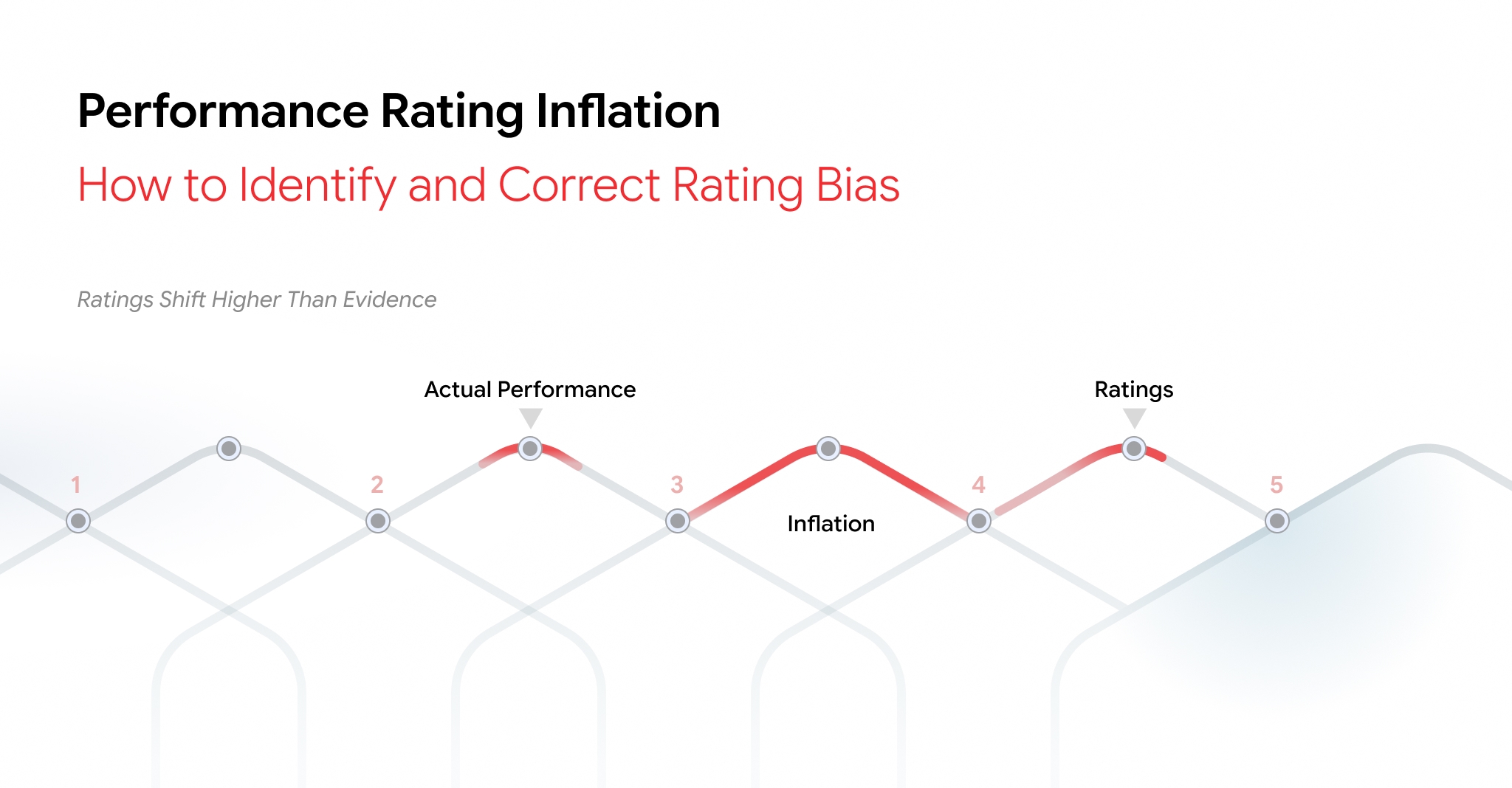
Inflated ratings create problems beyond the performance review process. They can make it harder to distinguish exceptional contribution from expected performance, weaken promotion decisions and direct rewards towards employees whose results may not justify them.
Rating inflation can also reduce trust in the performance management system. When employees see similar contributions receiving different ratings, they may question whether the process rewards performance or reflects individual manager preferences.
Organisations therefore need to examine not only the ratings employees receive, but also how managers arrive at those ratings.
What Are the Common Types of Bias in Performance Reviews?
What Is Leniency Bias in Performance Appraisal?
Leniency bias occurs when a manager consistently gives employees more favourable ratings than their performance evidence supports.
A manager may avoid low ratings to prevent conflict, maintain positive relationships or protect employees from perceived negative consequences. Over time, the team may appear to perform exceptionally well even when its results vary considerably.
How to identify it: Review rating distributions across managers and compare them with documented objectives, role expectations and performance evidence. Consistently high ratings without corresponding differences in contribution may warrant further examination.
How to correct it: Establish clear rating definitions, ask managers to support ratings with specific examples, and use calibration discussions to examine unusually generous assessments.
What Is Central Tendency Bias in Performance Appraisal?
Central tendency bias occurs when managers cluster ratings around the middle of the scale, avoiding both high and low ratings.
Managers may do this because they lack confidence in the rating criteria, want to avoid difficult discussions or believe middle ratings reduce the risk of disagreement.
This pattern makes it harder to recognise exceptional contribution or identify employees who need additional support.
How to identify it: Examine whether a manager assigns middle ratings to most employees despite meaningful differences in documented performance.
How to correct it: Clarify what each rating means, provide examples of different performance levels and help managers become more confident in making evidence based distinctions.
What Is the Rater Effect in Performance Appraisal?
The rater effect occurs when an assessment reflects a manager’s personal tendencies or perceptions rather than employee performance alone.
Some managers may consistently rate employees more favourably, while others apply stricter standards. Personal preferences, similarity bias, recency bias and the tendency to judge employees through a single prominent characteristic can also influence assessments.
How to identify it: Compare rating patterns across managers and examine whether similar performance receives different assessments. Review the evidence and rationale behind significant differences rather than assuming that every difference indicates bias.
How to correct it: Train managers to evaluate employees against defined criteria, document supporting evidence and participate in structured calibration discussions.
How Can Organisations Identify Performance Rating Bias?
Useful approaches include:
- Compare ratings across managers: Identify managers whose ratings consistently differ from those of peers assessing comparable roles and performance.
- Examine rating distributions: Look for unusual concentrations of high, low or middle ratings.
- Review ratings against evidence: Compare assessments with documented objectives, relevant outcomes and agreed expectations.
- Track changes over time: Determine whether rating patterns persist across review cycles or change after managers receive guidance.
- Investigate differences between groups: Examine whether assessment patterns vary across teams or employee groups, while accounting for role, opportunity and other relevant factors.
These indicators can highlight potential problems, but they do not prove bias on their own. A manager may lead a genuinely high performing team, and another may manage a team facing different operating conditions.
The purpose of analysis is to identify where further review is needed, not to label managers as biased solely because their ratings differ.
How Does Performance Review Calibration Help Correct Rating Bias?
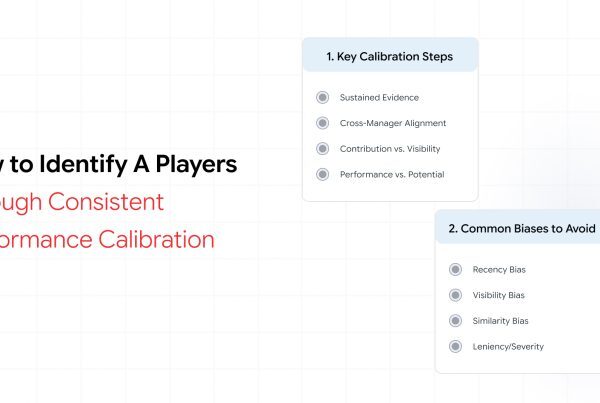
An effective calibration discussion should focus on four areas:
- Evidence: What specific results or behaviours support the rating?
- Standards: Has the manager applied the agreed rating criteria consistently?
- Context: Did the employee have comparable responsibilities, resources and opportunities to deliver results?
- Rationale: Can the manager explain why the rating accurately reflects the employee’s contribution?
Calibration should not become a negotiation in which managers compete to defend their teams or senior leaders impose their personal preferences.
Nor should organisations force ratings into predetermined proportions. The objective is to improve the accuracy of each assessment, not to create an artificial distribution.
When discussions reveal inconsistent standards, organisations should document the reasons for adjustments and use the findings to improve future assessments.
What Performance Management Best Practices Help Prevent Rating Inflation?
Define rating standards clearly. Managers should understand what distinguishes exceptional performance from strong performance, expected contribution and performance that needs improvement.
Use evidence throughout the review period. Regular feedback and documented examples reduce reliance on recent events or memory at the end of the year.
Train managers to assess performance. Training should cover rating criteria, common biases, constructive feedback and the use of evidence in appraisal discussions.
Separate performance from potential. An employee who performs exceptionally in a current role may not automatically be ready for a more senior position. Assessing these separately helps prevent ratings from becoming a proxy for promotion readiness.
Review outcomes after calibration. Track recurring differences, examine whether managers understand the standards and identify areas where additional guidance is necessary.
These practices make performance reviews more consistent while preserving the judgement required to assess different roles and working conditions.
How Can Organisations Measure Whether Rating Bias Is Improving?
Useful indicators include:
- Changes in rating patterns across comparable teams and managers.
- The proportion of ratings adjusted during calibration, alongside the reasons for those changes.
- The consistency between documented performance evidence and final ratings.
- Manager confidence in applying rating criteria.
- Employee perceptions of fairness and clarity in performance reviews.
- The quality of development, promotion and reward decisions informed by performance ratings.
A reduction in rating inflation is not automatically evidence of improvement. Ratings may fall because managers have become more accurate, or because they have become unnecessarily strict.
Organisations should therefore interpret rating patterns alongside supporting evidence, employee feedback and the outcomes of talent decisions.
How Can Rolling Arrays Help Organisations Strengthen Performance Decisions?
Rolling Arrays supports a business focused approach to HR transformation by helping organisations examine how HR processes, technology and workforce decisions work together. A stronger performance management process can give leaders a more consistent view of employee contribution, improve confidence in talent decisions and highlight where additional development is needed.
Technology can support this work by making performance information easier to review and analyse. However, accurate decisions still depend on clear standards, relevant evidence and accountable managers.
The goal is not to eliminate judgement from performance reviews. It is to make that judgement more consistent, transparent and defensible.
Work with Rolling Arrays to align HR processes, technology and workforce priorities.
FAQ
What is performance rating bias?
Performance rating bias occurs when an employee’s assessment is influenced by inconsistent standards, a manager’s tendencies or personal perceptions rather than relevant evidence of performance.
What are the main types of bias in performance reviews?
Common examples include leniency bias, central tendency bias, recency bias, similarity bias and the rater effect. Each can distort how managers assess employee contribution.
How can organisations identify rating inflation?
Organisations can examine rating distributions, compare assessments across managers, review documented performance evidence and investigate patterns that persist across review cycles.
What is the difference between leniency bias and central tendency bias?
Leniency bias involves consistently generous ratings. Central tendency bias involves clustering ratings around the middle of the scale, even when employee performance differs.
Can performance review calibration eliminate bias?
Calibration can help identify inconsistent standards and challenge unsupported ratings. However, it cannot eliminate all bias without reliable evidence, clear criteria, manager accountability and ongoing review.
Should organisations force managers to follow a fixed rating distribution?
No. Fixed distributions can create artificial rating outcomes that do not reflect actual employee performance. Calibration should improve the accuracy and consistency of assessments rather than require a predetermined proportion of employees to receive each rating.
Share with your network