
Table of Contents
- The 70 Percent Problem
- Why Technology Alone Cannot Transform an Organization
- Technology Implementation vs HR Transformation
- Three Reasons Organizations See Little Change After Go Live
- What Successful Organizations Do Differently
- From Technology Investment to Business Value
- Five Questions Leaders Should Ask After Go-Live
Resources > Blog >The “We Bought the Platform, Nothing Changed”: Why Technology Alone Cannot Deliver HR Transformation
“We Bought the Platform, Nothing Changed”: Why Technology Alone Cannot Deliver HR Transformation
July 10, 2026
Overview
Organizations continue investing in modern HR platforms to improve efficiency, enhance employee experiences, and support business growth. Yet many leaders find themselves asking the same question months after implementation: Why hasn’t anything really changed? Although the technology works as expected, business outcomes often fall short because transformation requires much more than software. This article explores why technology alone cannot deliver HR transformation, the common reasons organizations struggle to realize value after they go live, and the practical steps leaders can take to achieve sustainable business outcomes.
The 70 Percent Problem
Every year, organizations invest millions in HR technology with the expectation that a new platform will solve long standing operational challenges. They replace legacy systems, modernize workflows, and introduce new digital capabilities across the employee lifecycle.
Yet, many organizations see little improvement after implementation.
According to McKinsey, nearly 70% of digital transformation initiatives fail to achieve their intended business outcomes, not because the technology is ineffective, but because organizations underestimate the importance of strategy, governance, process redesign, and change management.
This is often referred to as the “technology without transformation” problem.
The platform works.
The implementation succeeds.
But the business continues operating much as it did before.
Instead of improving workforce productivity, organizations continue relying on manual workarounds, fragmented reporting, and inconsistent business processes. Leaders begin questioning the return on their technology investment, even though the system itself performs exactly as designed.
Technology can accelerate transformation, but it cannot create transformation on its own.
Technology Alone Does Not Create Transformation
Why Technology Alone Cannot Transform an Organization
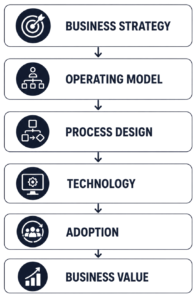
Technology plays an important role in HR transformation, but it represents only one part of a much broader business initiative. Sustainable transformation requires organizations to rethink how HR supports the business, how employees work, and how leaders make workforce decisions.
Technology can enable these changes, but it cannot define them.
- Automate repetitive HR activities.
- Improve access to workforce information.
- Standardize digital workflows.
- Generate real time reporting.
- Support AI enabled decision making.
Technology cannot:
- Define business strategy.
- Improve ineffective business processes.
- Build leadership alignment.
- Drive employee adoption.
- Create organizational accountability.
Organizations that recognize this distinction are far more likely to achieve meaningful business outcomes because they treat technology as an enabler rather than the transformation itself.
Technology Implementation vs HR Transformation
Technology implementation focuses on deploying new platforms, automating existing processes, delivering digital tools, and ensuring system delivery and project completion. HR transformation goes beyond technology by improving business performance, redesigning business processes, focusing on business outcomes, measuring organizational impact, and building long-term organizational capability.
The most successful organizations invest as much effort in redesigning the way they operate as they do in implementing technology.
Three Reasons Organizations See Little Change After Go-Live
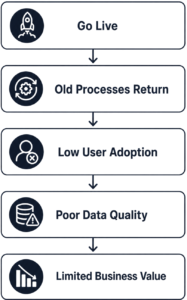
When organizations struggle to realize value after implementation, the causes usually extend beyond the technology itself.
Existing Processes Remain Unchanged
Many organizations configure new platforms around existing ways of working instead of redesigning inefficient processes. As a result, they automate complexity rather than eliminate it.
Employees Return to Familiar Ways of Working
Employees often continue using spreadsheets, email approvals, and manual reporting because they have not fully adopted the new platform. Without continuous communication and change management, adoption gradually declines after go-live.
Success Is Measured by Implementation Instead of Business Outcomes
Many transformation programmes celebrate successful deployment but stop measuring progress once the system goes live. Business leaders should continue monitoring workforce productivity, employee adoption, compliance, and operational efficiency to ensure the transformation delivers lasting value.
Technology Alone Does Not Create Transformation
What Successful Organizations Do Differently
Organizations that achieve lasting HR transformation treat implementation as the beginning of a continuous business improvement journey, not the final milestone. They align technology with business strategy and continually refine processes, governance, and workforce adoption.
Successful organizations typically focus on the following priorities:
- Define measurable business outcomes before implementation begins
- Redesign HR processes instead of automating existing inefficiencies
- Establish clear governance to guide decisions throughout the transformation
- Invest in continuous employee adoption through communication, training, and leadership engagement
- Measure business performance long after the system goes live
- Build an AI ready HR foundation with standardized processes and trusted workforce data
Together, these priorities are what ultimately determine HR technology ROI.
According to Deloitte Insights, technology investments deliver the greatest value when paired with redesigned processes, updated governance, and behavioral change, and organizations that align initiatives to clear business outcomes are significantly more likely to realize measurable enterprise value. (Source: Deloitte Digital — “Digital transformation: beyond technology”)
From Technology Investment to Business Value
The difference between implementation success and transformation success often comes down to one question: what happens after go-live?
Organizations that focus on technology measure project completion, prioritize platform features, configure existing processes, deliver one-time training, and view implementation as the end goal. In contrast, organizations that focus on transformation measure business outcomes, prioritize workforce improvements, redesign business processes, support continuous adoption, and treat transformation as an ongoing journey.
Organizations that adopt the second approach consistently generate greater long-term value from their HR technology investments.
Five Questions Leaders Should Ask After Go-Live
Instead of asking whether the implementation finished successfully, leadership teams should evaluate whether the transformation continues creating business value. Ask these questions regularly:
-
- Has workforce productivity improved?
- Are employees and managers consistently using the platform?
- Have manual HR activities decreased?
- Do leaders trust workforce data for decision making?
- Is the organization building an AI ready HR function through standardized processes and connected data?
These questions help organizations shift their focus from project delivery to continuous business improvement.
- Higher workforce productivity
- Faster HR service delivery
- Better employee experiences
- Improved workforce data quality
- Stronger compliance and governance
- Greater readiness for AI driven decision making
These measures provide a more meaningful view of transformation success than implementation milestones alone.
Conclusion
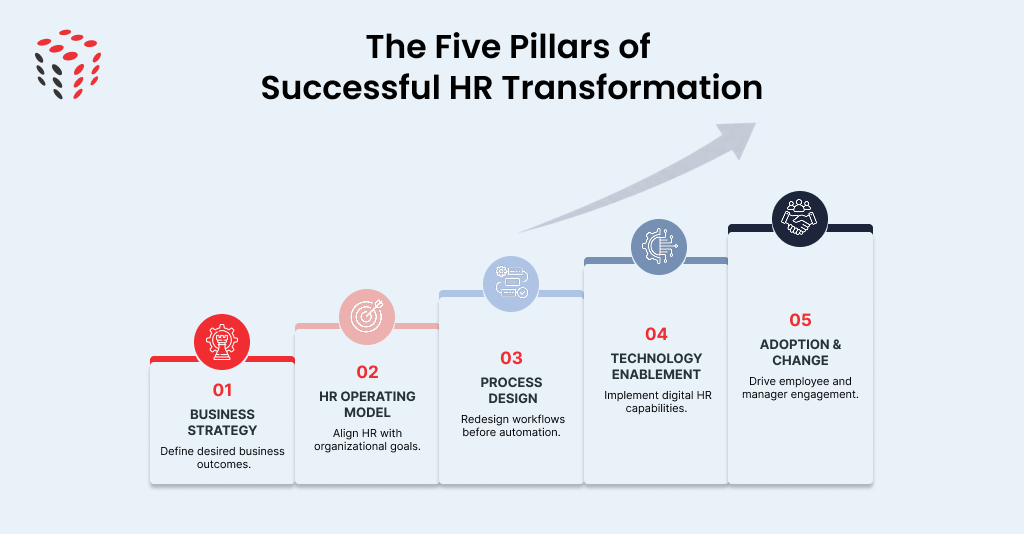
A successful HR transformation does not begin or end with technology. While a modern HR platform enables digital capabilities, organizations achieve lasting value only when they redesign processes, strengthen governance, support workforce adoption, build a resilient HR operating model, and continuously measure business outcomes.
The most successful organizations do not ask whether the platform works. They ask whether the transformation has improved the way people work, how leaders make decisions, and how the business creates value. That shift in perspective separates successful HR transformations from technology implementations that deliver only short-term results.
FAQ
Why do many HR transformation initiatives fail after implementation?
Many initiatives focus on implementing technology without redesigning business processes, strengthening governance, or driving employee adoption. As a result, organizations struggle to realize the expected business value.
What is the difference between HR technology implementation and HR transformation?
HR technology implementation focuses on deploying a new platform. HR transformation focuses on improving business performance through better processes, governance, workforce experiences, and decision making
Why is employee adoption important in HR transformation?
Employee adoption determines whether new processes become part of everyday operations. Without consistent adoption, organizations often return to manual workarounds and fail to achieve long-term business outcomes.
How does HR transformation support AI readiness?
HR transformation establishes standardized processes, connected workforce data, and governance. These capabilities create the foundation required for AI ready automation, predictive analytics, and intelligent workforce planning.





Share with your network
Get updates in your inbox