
Resources > Blog >The HR Transformation Roadmap: What Organizations Should Expect in the First 36 Months
The HR Transformation Roadmap: What Organizations Should Expect in the First 36 Months
Julye 7, 2026
Overview
HR transformation is not a project that ends when a new platform goes live. It is a long term business initiative that evolves as organizations improve processes, strengthen governance, increase workforce adoption, and adapt to changing business needs. While every organization follows a different path, successful transformations typically progress through three distinct phases over the first 36 months. Understanding what to expect during each stage helps leadership teams set realistic expectations, measure meaningful outcomes, and maximize the long term value of their HR transformation investment.
HR Transformation Is a Journey, Not a Project
Organizations often define success by implementation milestones such as completing configuration, migrating data, or launching a new HR platform. These milestones are important, but they represent only one phase of the transformation journey.
Successful organizations continue improving their HR function long after implementation. They optimize processes, strengthen governance, increase employee adoption, and use workforce data to support better business decisions.
Gartner’s own research on HR transformation describes this same pattern: transformation must keep compounding long after go-live, supported by governance that enables regular strategy resets rather than treating implementation as a finish line.
The first 36 months therefore represent a continuous journey of improvement rather than a single technology project.
The HR Transformation Journey

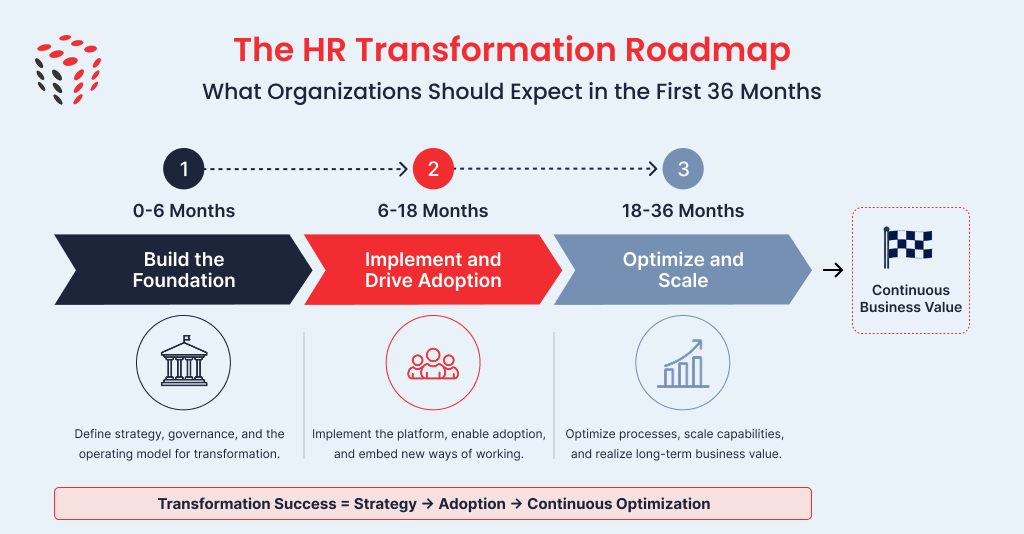
Phase One (Months 0–6): Build the Foundation
The first six months determine the direction of the entire transformation. Decisions made during this phase influence governance, implementation complexity, employee adoption, and long term business outcomes.
Instead of focusing immediately on technology, organizations should first establish a strong strategic foundation.
- Defining clear business objectives
- Designing the HR operating model
- Establishing governance and decision ownership
- Standardizing HR processes
- Evaluating technology requirements
- Preparing a change management strategy
Organizations that complete these activities before implementation reduce project risks and improve long term adoption.
Phase One Priorities
The focus areas and their primary objectives are as follows: Business Strategy focuses on defining transformation goals, while the HR Operating Model aims to design future ways of working. Governance focuses on establishing accountability, and Process Design aims to simplify and standardize workflows. Technology Selection focuses on aligning technology with business needs, while Change Management aims to prepare leaders and employees.
Why Strong Foundations Matter
Organizations sometimes accelerate technology selection because they want to deliver results quickly. While this approach may shorten procurement timelines, it often increases implementation complexity later.
Without clearly defined governance, standardized processes, and measurable business objectives, implementation teams spend more time resolving conflicting requirements than delivering business value.
As organizations increasingly adopt AI ready HR strategies, strong foundations become even more important. AI depends on connected workforce data, standardized processes, and consistent governance. Organizations that establish these capabilities early are better positioned to scale intelligent automation and workforce analytics in later phases of the transformation.
Questions Leaders Should Answer During the First Six Months
- What business outcomes should the transformation deliver?
- How should HR support future business growth?
- Which HR processes require standardization?
- How will governance support long term decision making?
- How will the organization prepare employees for change?
- How will this transformation support future AI initiatives?
Answering these questions early creates a stronger foundation for every decision that follows.
Phase Two (Months 6–18): Implement and Drive Adoption
The second phase focuses on turning the transformation strategy into day to day operations. Organizations configure the platform, migrate data, train employees, and launch new HR processes. Although technology implementation takes place during this period, user adoption becomes the biggest success factor.
A successful go live does not guarantee a successful transformation. Organizations create long term value only when employees, managers, and HR teams consistently adopt new ways of working.
- Configuring the platform to support standardized processes
- Migrating accurate and complete workforce data
- Delivering role based training programmes
- Maintaining regular communication with employees
- Monitoring platform usage and adoption
- Resolving adoption challenges quickly
Industry research on change management consistently finds that organizations investing in structured change management are more likely to achieve their transformation objectives than those focused primarily on technology implementation.
From Go Live to Business Value

Phase Three (Months 18–36): Optimize and Scale
By the third phase, organizations should shift their focus from implementation to continuous improvement. Instead of asking whether the platform works, leadership teams should evaluate how effectively it supports business strategy and workforce performance.
Optimization should become an ongoing business discipline rather than an occasional system upgrade.
- Improving workforce analytics and reporting
- Identifying opportunities for process optimization
- Expanding intelligent automation
- Strengthening governance
- Enhancing employee experiences
- Building AI ready HR capabilities
Organizations that continuously optimize their HR function create greater business value while remaining agile as business priorities evolve.
Transformation Priorities Across the First 36 Months
The transformation timeline is divided into three phases. Months 0–6 focus on strategy and planning, with success measured by established governance and clearly defined business objectives. Months 6–18 focus on implementation and adoption, with success measured through platform usage and employee adoption. Months 18–36 focus on optimization and innovation, with success measured by business outcomes and continuous improvement.
This phased approach helps organizations maintain momentum while ensuring that each stage builds on the previous one.
- Greater consistency across HR processes and business units.
- Faster decision-making through clearly defined governance.
- Improved employee and manager experiences.
- Higher confidence in workforce data.
- Better readiness for AI driven workforce planning and automation.
- Reduced implementation and operational risks.
Measuring Success Beyond Go Live
Organizations should avoid measuring success solely by project completion or implementation timelines. A successful HR transformation delivers measurable business improvements long after the platform becomes operational.
- Higher workforce productivity
- Faster HR service delivery
- Better employee experiences
- Improved workforce data quality
- Stronger compliance and governance
- Greater readiness for AI driven decision making
These measures provide a more meaningful view of transformation success than implementation milestones alone.
Conclusion
HR transformation is not a twelve month project. It is a long term business journey that evolves as organizations strengthen governance, improve workforce adoption, optimize processes, and embrace new technologies.
Organizations that understand this HR transformation roadmap make better decisions at every stage of the transformation. They build strong foundations during the first six months, focus on adoption during implementation, and continue improving long after go live. This approach helps them maximize the value of their HR technology investment while creating a future ready HR function.
FAQ
What is an HR transformation roadmap?
An HR transformation roadmap outlines the stages organizations follow to plan, implement, adopt, and continuously improve their HR transformation initiatives.
How long does an HR transformation typically take?
While implementation timelines vary, organizations typically spend the first 36 months establishing foundations, driving adoption, and optimizing business outcomes.
Why is employee adoption important after go live?
Employee adoption ensures that new HR processes become part of everyday operations. Without adoption, organizations often struggle to achieve the expected return on their technology investment.
What happens after HR implementation is complete?
Successful organizations continue optimizing processes, strengthening governance, improving workforce analytics, and expanding AI enabled capabilities to maximize long term business value.




Share with your network
Get updates in your inbox