Table of Contents
- Why Shouldn’t Technology Be the Starting Point?
- What Is an HR Operating Model and Why Does It Matter?
- Why Should Organizations Define the Operating Model Before Selecting a Platform?
- How Can Organizations Build the Right HR Operating Model?
- What Happens When Organizations Select Technology Too Early?
- What Questions Should Leaders Answer Before Evaluating HR Technology?
- How Does an HR Operating Model Create Long Term Business Value?
- What Is the Right Sequence for HR Transformation?
- Why Do AI First Organizations Build an AI Ready Operating Model?
- How Can Organizations Build an Operating Model That Scales With the Business?
- Is Your Organization Ready to Select an HR Platform?
Resources > Blog >Transformation before platform: why the operating model decision must precede the vendor decision
Transformation before platform: why the operating model decision must precede the vendor decision
June 29, 2026
Overview
Many HR transformation initiatives begin by evaluating technology platforms, comparing product features, and selecting implementation partners. While these activities are important, they often overlook a more fundamental question: How should the HR function operate to support the business? Organizations that define their HR operating model before selecting technology create a stronger foundation for process standardization, governance, workforce adoption, and long-term business value. This article explores why operating model decisions should precede platform selection and how this approach helps organizations build future ready, AI enabled HR functions.
Why Shouldn’t Technology Be the Starting Point?
Technology often becomes the first discussion in an HR transformation programme. Organizations compare vendor capabilities, request demonstrations, and evaluate implementation timelines. Although these activities are necessary, they should support the transformation strategy rather than define it.
Successful HR transformations begin with business strategy. Executive leaders first determine how HR should operate, how services should be delivered, and how workforce decisions should support organizational objectives. Technology then enables that operating model instead of shaping it.
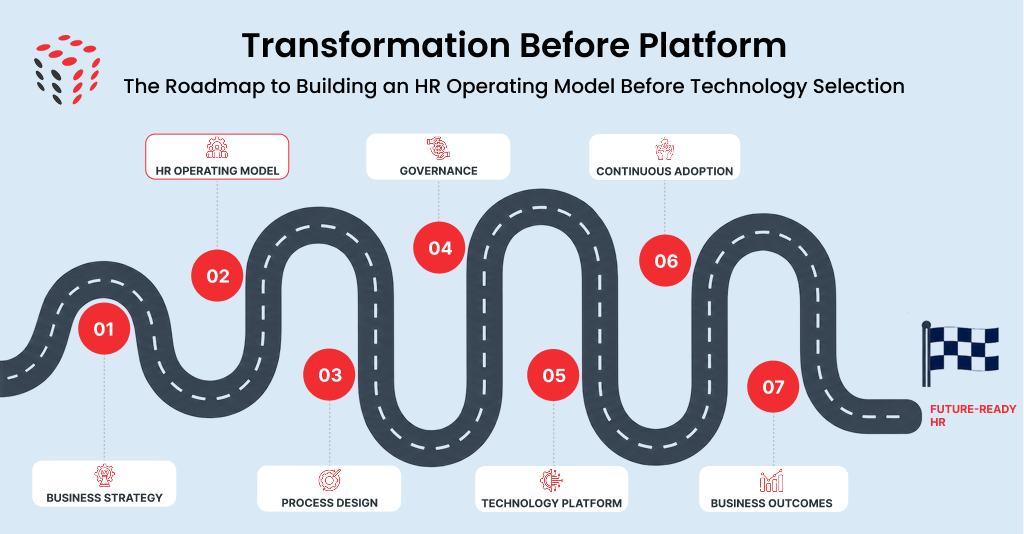
The Right Sequence for Successful HR Transformation
Organizations that define their HR operating model before selecting technology create a stronger foundation for governance, adoption, and long-term business value.
According to Gartner, organizations that align technology investments with business strategy are significantly more likely to realize greater value from digital transformation initiatives. This reinforces an important principle: technology creates value only when it supports clearly defined business outcomes.
As organizations increasingly adopt AI first business strategies, this sequence becomes even more important. AI depends on standardized processes, connected workforce data, and clear governance. Without these foundations, organizations struggle to scale intelligent automation and generate meaningful workforce insights.
What Is an HR Operating Model and Why Does It Matter?
An HR operating model defines how the HR function delivers value to the business. It establishes governance, service delivery, decision-making responsibilities, and workforce processes before technology implementation begins. Organizations that clearly define their operating model make better technology decisions and achieve more sustainable transformation outcomes.
Rather than focusing on technology, the operating model answers fundamental business questions such as:
- How will HR services be delivered?
- Which activities should be centralized or decentralized?
- Who owns workforce data and governance?
- How will managers and employees interact with HR?
- Which processes should remain consistent across business units?
Answering these questions before selecting technology helps organizations avoid designing processes around software limitations.
HR Operating Model vs Platform Selection
The HR Operating Model defines business processes, establishes governance, clarifies roles and responsibilities, creates standardization, and aligns HR with business strategy. In contrast, HR Platform Selection enables business processes, supports governance through technology, provides digital capabilities, automates standardized processes, and supports the execution of the strategy.
Organizations that reverse this sequence often customize technology to fit existing ways of working instead of improving them.
Why Should Organizations Define the Operating Model Before Selecting a Platform?
Organizations should define the operating model first because technology can automate processes but cannot determine how HR should operate. A well-designed operating model creates the foundation for governance, standardized processes, workforce adoption, and long-term business value.
An effective HR operating model creates clarity before implementation begins. It establishes governance, simplifies decision-making, and helps organizations standardize processes across functions and geographies. As a result, platform configuration becomes simpler, implementation risks decrease, and user adoption improves.
According to Deloitte’s Global Human Capital Trends, organizations increasingly prioritize redesigning work and operating models alongside technology investments because sustainable transformation depends on organizational design as much as digital capability.
When organizations define the operating model first, they also create a stronger foundation for AI-enabled HR. Standardized processes, trusted workforce data, and consistent governance allow organizations to leverage predictive analytics, intelligent automation, and AI driven workforce planning more effectively.
How Can Organizations Build the Right HR Operating Model?
Organizations often know that they need to redesign their HR operating model before selecting a technology platform, but they are less certain about where to begin.
A practical approach is to focus on three strategic priorities:
Align
Align the HR operating model with business objectives, workforce strategy, governance, and future operating requirements. This creates a clear foundation for process design and technology decisions.
Automate
Automate standardized and well-governed HR processes instead of digitizing existing inefficiencies. Technology should enable the operating model, not define it.
Adopt
Support long-term success by helping employees, managers, and leaders embrace new ways of working. Continuous adoption ensures that transformation delivers measurable business value beyond implementation.
This Align. Automate. Adopt. approach helps organizations create an operating model that supports sustainable transformation, accelerates AI readiness, and maximizes the value of future technology investments.
What Happens When Organizations Select Technology Too Early?
Organizations that prioritize technology before operating model design often encounter avoidable implementation challenges. These include unnecessary customization, inconsistent governance, lower employee adoption, and limited business value.
- Technology drives the process instead of the business strategy.
- Departments request unnecessary customization to preserve existing ways of working.
- Governance becomes inconsistent across business units.
- Employee adoption slows because processes remain overly complex.
- AI capabilities deliver limited value due to fragmented workforce data and inconsistent business rules.
Most of these challenges become visible after implementation, even though they originate during the earliest planning stages.
Organizations that answer these questions early establish a stronger foundation for technology selection and long-term transformation success.
What Questions Should Leaders Answer Before Evaluating HR Technology?
Before comparing vendors or requesting product demonstrations, leadership teams should align on the strategic questions that shape a successful HR transformation.
- What business outcomes should HR transformation deliver?
- How should HR services operate across the organization?
- Which processes require global consistency?
- What governance model will support future growth?
- How will the operating model prepare the organization for AI enabled workforce management?
Organizations that answer these questions early establish a stronger foundation for technology selection and long-term transformation success.
How an HR Operating Model Creates Long-Term Business Value
An HR operating model creates long-term business value by aligning HR services, governance, and workforce processes with organizational strategy. It provides the structure needed to improve operational efficiency, support AI-enabled capabilities, and sustain transformation beyond implementation.
Organizations that invest in a well defined operating model create long-term advantages across the enterprise.
- Greater consistency across HR processes and business units.
- Faster decision-making through clearly defined governance.
- Improved employee and manager experiences.
- Higher confidence in workforce data.
- Better readiness for AI driven workforce planning and automation.
- Reduced implementation and operational risks.
When these capabilities are established before technology selection, organizations can configure platforms to support business objectives rather than redesigning the business around software limitations.
What Is the Right Sequence for HR Transformation?
Many transformation programmes focus heavily on platform evaluation before defining how HR should operate. A more effective approach begins with business strategy and gradually builds the foundation required for successful technology adoption.
The following framework illustrates the recommended sequence.
The transformation process consists of six stages. Business Strategy focuses on defining organizational priorities, resulting in clear transformation objectives. HR Operating Model focuses on designing service delivery and governance, leading to a standardized operating model. Process Design aims to simplify and optimize HR processes, resulting in consistent employee experiences. Technology Platform focuses on configuring technology around business needs, enabling faster implementation. Change Management prepares employees and managers, leading to higher user adoption. Finally, Continuous Improvement focuses on measuring and optimizing outcomes to create sustainable business value.
Organizations that follow this sequence reduce implementation complexity while creating a stronger foundation for future innovation.
Why Do AI First Organizations Build an AI Ready Operating Model?
Organizations across industries are investing in AI to improve decision-making, automate repetitive activities, and enhance employee experiences. However, AI delivers meaningful business value only when organizations establish the right operational foundation.
- Standardized HR processes.
- Connected workforce data.
- Strong governance.
- Clear ownership of business decisions.
- Consistent data quality across the employee lifecycle.
Without these capabilities, AI initiatives often produce fragmented insights and inconsistent outcomes.
An HR operating model helps organizations establish these foundations before introducing AI enabled capabilities. This approach allows leaders to move beyond isolated automation initiatives and build an intelligent HR function that supports workforce planning, talent management, and organizational performance.
How Can Organizations Build an Operating Model That Scales With the Business?
As organizations grow, workforce expectations, compliance requirements, and business priorities continue to evolve. The HR operating model should evolve alongside them.
Successful organizations regularly review their operating model to ensure it continues supporting business objectives.
- Governance remains effective.
- HR processes continue supporting business priorities.
- Workforce data enables informed decision-making.
- Employees consistently adopt digital HR processes.
- Technology continues supporting organizational growth.
Continuous evaluation helps organizations maintain alignment between business strategy, HR operations, and technology investments.
Is Your Organization Ready to Select an HR Platform?
Before evaluating technology vendors, organizations should ensure they have established the right business foundation. Consider the following questions:
- Have you clearly defined your business objectives?
- Have you designed your HR operating model?
- Is your governance structure clearly established?
- Have you standardized your core HR processes?
- Have you defined ownership for workforce data?
- Have you assessed your organization’s AI readiness?
- Is your change management strategy in place?
If the answer to most of these questions is yes, your organization is in a much stronger position to evaluate HR platforms and maximize long-term business value.
Conclusion
Technology plays an important role in HR transformation, but it should never become the starting point. Organizations create lasting value when they first define how HR should operate, establish governance, standardize processes, and align transformation with business strategy.
An effective HR operating model creates the foundation for successful technology implementation, stronger workforce experiences, and better business outcomes. It also prepares organizations to adopt AI driven capabilities with confidence by ensuring that processes, governance, and workforce data support intelligent decision-making.
Organizations that place the operating model before the platform position themselves to achieve sustainable transformation rather than short term implementation success.
About Rolling Arrays
For more than 16 years, Rolling Arrays has helped organizations across Asia design and implement HR transformation strategies that align people, processes, and technology with business objectives. Our expertise in HR consulting, operating model design, HR technology implementation, and change management enables enterprises to build future-ready HR functions that deliver measurable business value long after implementation.
FAQ
Why is an HR operating model important before selecting an HR platform?
An HR operating model defines how the HR function will deliver services, govern processes, and support business objectives. Establishing the operating model first helps organizations configure technology around business needs rather than existing operational limitations.
What happens if organizations choose technology before defining the operating model?
Organizations often introduce unnecessary customization, inconsistent processes, and governance challenges. These issues reduce user adoption, increase implementation complexity, and limit long-term business value.
How does an HR operating model support AI readiness?
A well designed operating model establishes standardized processes, trusted workforce data, and strong governance. These capabilities create the foundation required for AI enabled workforce planning, intelligent automation, and better business decisions.
What should organizations define before selecting an HR platform?
Organizations should establish business objectives, governance structures, service delivery models, process ownership, workforce data standards, and change management strategies before evaluating technology platforms.


Share with your network
Get updates in your inbox