Table of Contents
- Why Do HR Technology Stacks Become Overlapping?
- What Is HR Technology Rationalization?
- How Can Organisations Identify Technology Overlap?
- Should Organisations Consolidate Every HR System Into One Platform?
- How Should Organisations Decide Which HR Systems to Keep?
- What Are the Hidden Costs of an Overlapping HR Tech Stack?
- How Does HR System Integration Affect Rationalization?
- What Is the Right Approach to HR Systems Consolidation?
- How Can HR Decide Whether to Consolidate or Retain a System?
- How Does Rationalization Support HR Transformation?
- What Role Can AI Play in HR Technology Rationalization?
- How Should Leaders Measure the Success of Rationalization?
- From More HR Technology to Better HR Technology
- Key Takeaways
- Frequently Asked Questions
Resources > Blog > HR Technology Rationalization: How to Reduce an Overlapping HR Tech Stack
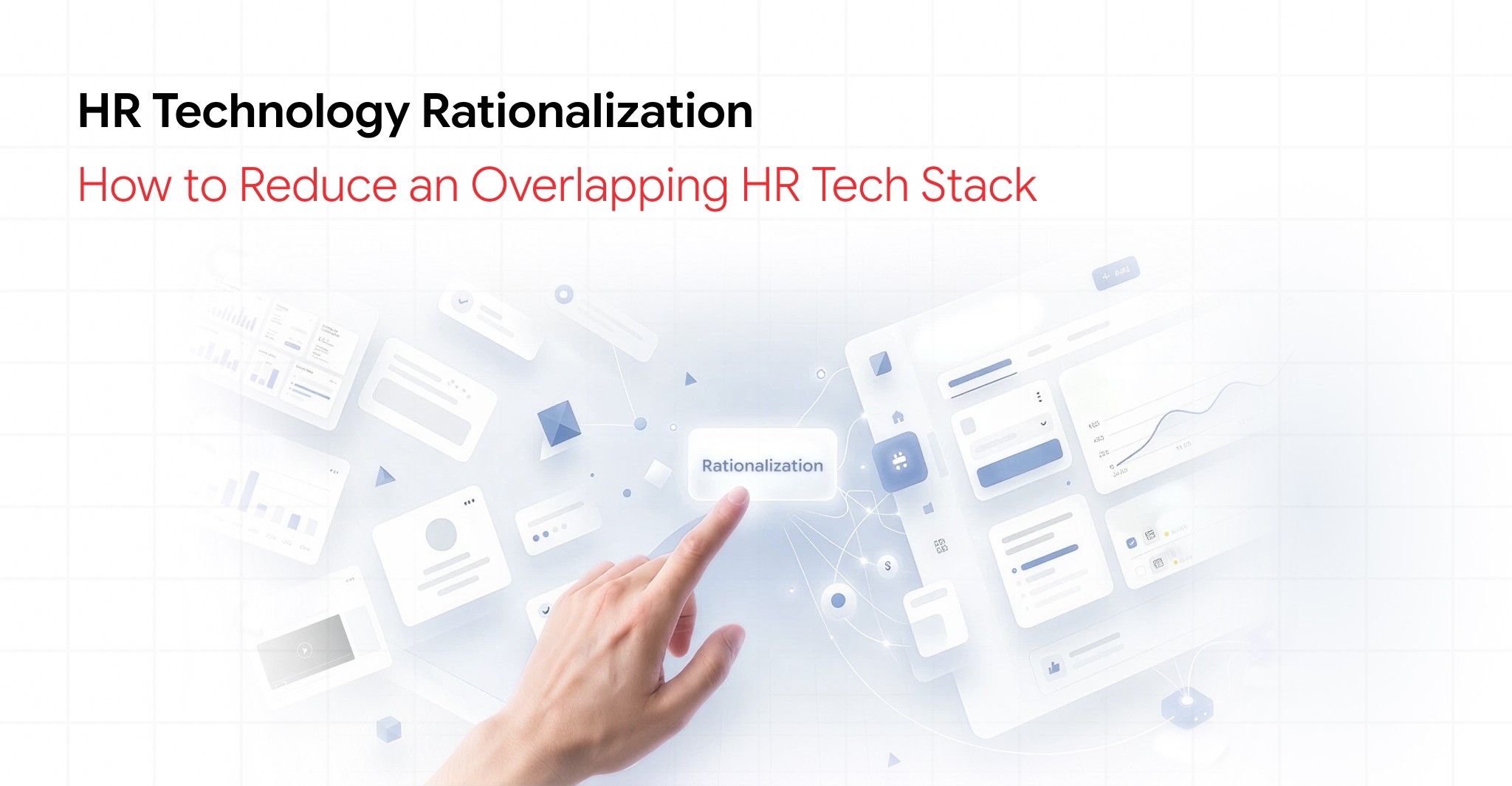
HR Technology Rationalization: How to Reduce an Overlapping HR Tech Stack
October 15, 2026
Over time, organisations often accumulate platforms for recruiting, onboarding, performance, learning, employee experience, workforce planning, analytics, payroll, engagement, and other specialised requirements. Each system may have been introduced to solve a legitimate business problem. The challenge emerges when the technology landscape becomes fragmented.
Employees may use multiple systems to complete related activities. HR teams may maintain the same data across several platforms. IT teams may manage complex integrations. Leaders may struggle to determine which system contains the most reliable information.
This is where HR technology rationalization becomes important.
The objective is not simply to remove applications. It is to determine which technologies the organisation genuinely needs, which capabilities overlap, which systems should integrate, and which can be retired or consolidated.
Why Do HR Technology Stacks Become Overlapping?
A new system may be introduced to address an immediate business requirement. Another department may independently adopt a specialised platform. A regional business unit may implement a local solution. An acquisition may bring another HR system into the organisation.
Over time, these decisions can create overlapping capabilities.
For example, an organisation might have separate platforms for employee surveys, performance management, learning, analytics, and employee experience even though several of these capabilities are available within its core HCM platform.
The issue is not that every additional application is unnecessary.
The issue is whether the incremental value justifies the additional complexity.
What Is HR Technology Rationalization?
It examines:
- What systems are currently in use
- What business capabilities each system supports
- Where functionality overlaps
- Which systems hold critical data
- How systems integrate
- What each application costs
- How widely each system is adopted
- Which capabilities are strategically important
- Which systems could be consolidated, replaced, integrated, or retired
The objective is to create a technology landscape that is simpler, more intentional, and aligned with the future HR operating model.
How Can Organisations Identify Technology Overlap?
Instead of asking:
“How many HR applications do we have?”
Ask:
“How many different systems support the same HR capability?”
For example, an organisation may discover that employee data, skills, reporting, learning, performance, and workforce analytics appear across multiple platforms.
The next step is to understand why the overlap exists.
Some duplication may be intentional. A specialised platform may provide capabilities that the core HCM system does not offer.
Other duplication may exist because different business units adopted different tools without an enterprise architecture.
This distinction is critical before making consolidation decisions.
Should Organisations Consolidate Every HR System Into One Platform?
A single platform can simplify the technology landscape, but one platform should not automatically become the objective.
Some specialised solutions may provide capabilities that are strategically important and difficult to replicate elsewhere.
The better question is:
Does each application have a clear role in the future HR technology architecture?
A system may be:
- Retained as a strategic platform
- Consolidated into another system
- Integrated with the core HCM
- Replaced with a more capable solution
- Retired because its capability is no longer required
This creates a more practical approach to HR systems consolidation.
How Should Organisations Decide Which HR Systems to Keep?
Business Value
Does the system support an important business or HR outcome?
Capability Fit
Does it provide capabilities that the organisation genuinely needs?
Adoption
Are employees, managers, and HR teams actually using the system effectively?
Data Importance
Does the platform contain critical information or act as a system of record?
Integration Complexity
How difficult and expensive is it to maintain its connections with other systems?
Cost
What are the licensing, implementation, integration, support, and maintenance costs?
Strategic Fit
Does the system support the organisation’s future HR operating model?
Future Readiness
Can the platform evolve as workforce, technology, and business requirements change?
This creates a more balanced basis for technology rationalization than simply counting applications.
What Are the Hidden Costs of an Overlapping HR Tech Stack?
The larger cost can come from the complexity surrounding it.
Multiple HR systems can create:
- Duplicate data maintenance
- Integration development and support
- Additional security administration
- Multiple user experiences
- Data reconciliation
- Reporting complexity
- Vendor management overhead
- Training requirements
- Upgrade dependencies
- Higher change management effort
For example, if employee information must move between five different applications, every integration creates another dependency that needs to be maintained.
Technology rationalization therefore needs to consider total technology complexity, not just software licence costs.
How Does HR System Integration Affect Rationalization?
If two systems perform substantially similar functions, creating another integration between them may simply preserve the underlying complexity.
Organisations should therefore distinguish between:
Integration that connects complementary capabilities
and
Integration that keeps redundant capabilities alive.
The first can strengthen the HR technology ecosystem.
The second may indicate an opportunity for consolidation.
What Is the Right Approach to HR Systems Consolidation?
1. Map the Current Technology Landscape
Identify every HR application, its users, business owner, capabilities, cost, data, and integrations.
2. Map Capabilities
Group applications according to the HR capabilities they provide and identify areas of functional overlap.
3. Assess Business Value
Determine which systems provide measurable business or HR value and which have limited adoption or strategic relevance.
4. Define the Future Architecture
Establish which platforms should act as core systems, specialised solutions, integration layers, or data sources.
5. Develop the Rationalization Roadmap
Prioritise consolidation, replacement, integration, or retirement decisions based on value, complexity, risk, and feasibility.
6. Manage the Transition
Plan data migration, integration changes, user adoption, vendor exits, and implementation activities.
This turns rationalization into a transformation programme rather than an application clean-up exercise.
How Can HR Decide Whether to Consolidate or Retain a System?
A system with high business value and unique capabilities may justify remaining in the landscape.
A system with low adoption, significant overlap, high integration complexity, and limited strategic value may represent a stronger consolidation opportunity.
The decision can therefore be viewed through four questions:
Keep: Does it provide unique and valuable capability?
Consolidate: Can another platform deliver the same capability effectively?
Integrate: Does it provide complementary functionality that should remain connected?
Retire: Is the capability no longer required or already available elsewhere?
This approach avoids treating consolidation as an automatic objective.
How Does Rationalization Support HR Transformation?
If HR is redesigning service delivery, centralising processes, introducing new employee experiences, or increasing automation, the technology landscape should support those changes.
This creates a logical sequence:
Business Strategy → HR Operating Model → Process Design → Technology Architecture → Application Portfolio
Without this alignment, organisations can end up simplifying the technology landscape while preserving outdated processes.
What Role Can AI Play in HR Technology Rationalization?
Organisations can assess whether AI can:
- Automate repetitive HR activities
- Improve employee self service
- Support HR decision making
- Connect information across systems
- Reduce manual reporting
- Assist with workforce analytics
- Support managers through conversational interfaces
However, AI should not simply become another layer added to an already complex technology stack.
The question should be:
Can AI simplify the way work is performed and reduce unnecessary technology complexity?
How Should Leaders Measure the Success of Rationalization?
Organisations can track:
- Number of HR applications
- Number of overlapping capabilities
- Technology spend
- Integration count and complexity
- Data duplication
- Application adoption
- User experience
- HR process efficiency
- System support effort
- Number of systems retired or consolidated
The objective is not to achieve the smallest possible number of applications.
The objective is to create a technology environment where each platform has a clear purpose and contributes to the organisation’s HR strategy.
From More HR Technology to Better HR Technology
It may be about understanding what the organisation already owns and asking whether those investments continue to support the business.
A rationalised HR technology landscape can reduce unnecessary complexity, clarify ownership, simplify data flows, and create a stronger foundation for future transformation.
The most effective technology strategy is therefore not always additive.
Sometimes, the greatest value comes from knowing what to consolidate, what to retain, and what to stop using.
Key Takeaways
- HR technology complexity often develops through individual decisions made over time.
- More applications do not automatically create more HR value.
- Rationalization should assess capabilities, business value, adoption, cost, integrations, and future fit.
- Not every specialised system needs to be eliminated.
- HR systems consolidation should follow the future HR operating model.
- Integration should connect complementary capabilities rather than preserve unnecessary duplication.
- AI should be considered as part of future process and technology design, not simply added as another application.
- The objective is a purposeful HR technology ecosystem where every platform has a clear role.
FAQ
How do I consolidate multiple HR systems into one platform?
Start by mapping the current HR technology landscape, identifying overlapping capabilities, assessing business value and adoption, defining the future architecture, and determining which systems should be consolidated, integrated, replaced, or retired.
How do you consolidate HR systems?
HR systems can be consolidated by assessing applications against business value, functionality, data, integration complexity, cost, adoption, and future strategic fit before creating a phased rationalization roadmap.
What is HR technology rationalization?
HR technology rationalization is the structured process of evaluating and optimising an organisation’s HR application portfolio to reduce unnecessary overlap and align technology with business and HR priorities.
Why is HR system integration important?
Integration enables complementary HR platforms to share data and support connected processes. However, integration should not be used automatically when consolidation can remove unnecessary duplication.
Should every HR system be consolidated?
No. Some specialised systems may provide unique capabilities or strategic value. The decision should be based on business need, capability overlap, cost, complexity, and future technology strategy.
How can HR technology rationalization reduce costs?
Rationalization can reduce licence duplication, integration maintenance, support requirements, data reconciliation, vendor management, and other costs associated with maintaining overlapping HR applications.