Table of Contents
- Why Is HRIS Vendor Selection More Difficult Than Comparing Features?
- What Should an HRIS Selection Framework Evaluate?
- How Should Organisations Weight HRIS Selection Criteria?
- Should Every HRIS Requirement Have the Same Weight?
- How Should Organisations Build an HRIS Selection Checklist?
- How Should Vendor Demonstrations Be Evaluated?
- How Does a Weighted Scorecard Improve HRIS Evaluation?
- How Should Organisations Validate Vendor Claims?
- What Role Does Total Cost Play in HRIS Selection?
- How Should Organisations Evaluate Future Readiness?
- What Are the Most Common HRIS Selection Mistakes?
- How Can Organisations Make the Final HRIS Decision?
- From Vendor Comparison to a Defensible HR Technology Decision
- Key Takeaways
- Frequently Asked Questions
Resources > Blog > How to Evaluate HR Technology Vendors: A Weighted HRIS Selection Framework
How to Evaluate HR Technology Vendors: A Weighted HRIS Selection Framework
October 14, 2026
A structured HRIS selection process starts with the organisation’s requirements and priorities before evaluating vendor capabilities.
The central question is not:
Which HR technology vendor has the most features?
It is:
Which solution best fits our business requirements, operating model, technology environment, and future direction?
A weighted evaluation framework helps organisations answer that question consistently and creates a defensible basis for the final technology decision.
Why Is HRIS Vendor Selection More Difficult Than Comparing Features?
The challenge is determining which capabilities actually matter to the organisation.
For example, an organisation may consider global payroll integration, employee experience, analytics, talent management, skills, or AI important. However, the relative importance of each capability will differ depending on the organisation’s strategy, operating model, workforce structure, existing technology landscape, and transformation objectives.
A feature comparison treats these requirements as equal.
A weighted evaluation recognises that not every requirement carries the same business importance.
What Should an HRIS Selection Framework Evaluate?
The assessment can include:
- Business and HR transformation objectives
- Functional requirements
- Non functional requirements
- User experience
- Technology architecture
- Integration capabilities
- Data requirements
- Security and compliance
- Scalability
- Implementation complexity
- Vendor capabilities
- Total cost considerations
- Product roadmap and future readiness
This provides a broader view of whether a platform can support the organisation beyond the initial implementation.
How Should Organisations Weight HRIS Selection Criteria?
For example, an organisation operating across multiple countries may consider global regulatory support and integration architecture critical requirements. A particular employee experience feature may be important but carry a lower weighting.
A weighted model could therefore assign greater importance to requirements that directly influence business outcomes or implementation feasibility.
The principle is straightforward:
Business priority → Requirement importance → Weight → Vendor score
This prevents the vendor’s strongest capabilities from automatically becoming the organisation’s priorities.
Should Every HRIS Requirement Have the Same Weight?
Treating every requirement equally can distort the evaluation.
Consider an organisation that requires a complex integration with its existing payroll environment. If that requirement receives the same weighting as a minor user interface preference, the final score may not accurately represent implementation risk.
A weighted HRIS evaluation allows leadership to distinguish between:
Must Have → High Priority → Important → Nice to Have
This creates a clearer connection between business requirements and technology selection.
How Should Organisations Build an HRIS Selection Checklist?
Organisations should first document:
- Business objectives
- Current HR processes
- Current technology landscape
- Key pain points
- Future operating model
- Functional requirements
- Non functional requirements
- Integration requirements
- Data and reporting requirements
- Implementation considerations
- Commercial requirements
- Future scalability requirements
This creates a common evaluation baseline for every vendor.
It also reduces the risk of allowing demonstrations to shape the requirements after the process has already started.
How Should Vendor Demonstrations Be Evaluated?
For example, instead of asking a vendor to demonstrate performance management generally, the organisation could provide a scenario involving:
- Goal setting
- Manager review
- Employee self assessment
- Calibration
- Approval
- Reporting
- Integration with existing employee data
Each vendor then demonstrates how its platform addresses the same scenario.
This creates a more comparable evaluation and provides evidence for the scoring process.
How Does a Weighted Scorecard Improve HRIS Evaluation?
Each vendor can be assessed against the same requirements, with scores supported by evidence from demonstrations, documentation, reference discussions, technical assessments, and commercial proposals.
A simple model is:
Requirement Weight × Vendor Capability Score = Weighted Score
The final result should not be treated as an automatic answer.
Instead, it provides leadership with a transparent view of:
- Where each vendor performs strongly
- Where capability gaps exist
- Which requirements carry the greatest risk
- Which assumptions require validation
- Where implementation complexity may arise
The scorecard therefore supports the decision rather than replacing decision making.
How Should Organisations Validate Vendor Claims?
High priority capabilities should be validated through multiple sources where appropriate.
Organisations can use:
- Product demonstrations
- Scenario based demonstrations
- Technical documentation
- Security assessments
- Integration discussions
- Customer references
- Proof of concept exercises
- Commercial proposals
- Implementation partner discussions
The higher the business impact of a requirement, the stronger the evidence should be before the organisation accepts the vendor’s claim.
What Role Does Total Cost Play in HRIS Selection?
The evaluation should consider the broader investment, including:
- Implementation
- Integration
- Data migration
- Configuration
- Testing
- Training
- Change management
- Support
- Additional modules
- Future expansion
A platform with a lower initial licence cost may not necessarily represent the lower overall investment if it requires significantly greater integration or implementation effort.
This is why cost should be evaluated alongside business fit, technology capability, implementation complexity, and future scalability.
How Should Organisations Evaluate Future Readiness?
Organisations should therefore assess whether the shortlisted platform can support anticipated changes in workforce strategy, operating models, technology, data, and AI.
Questions can include:
- Can the platform scale with workforce growth?
- Can it support new countries or business units?
- Can it integrate with the evolving technology landscape?
- Can it support emerging workforce and skills requirements?
- How does the vendor approach AI and automation?
- What is the product roadmap?
- How easily can the organisation adapt the platform as requirements change?
Future readiness should be assessed against the organisation’s actual roadmap rather than generic technology trends.
What Are the Most Common HRIS Selection Mistakes?
- Starting with vendors instead of business requirements
- Treating every requirement as equally important
- Relying on generic demonstrations
- Overweighting user interface features
- Accepting vendor claims without validation
- Ignoring integration complexity
- Focusing only on licence costs
- Underestimating data migration
- Failing to involve business stakeholders
- Selecting a platform without considering the future operating model
A structured process helps reduce these risks.
How Can Organisations Make the Final HRIS Decision?
Leadership should consider:
Business Fit + Functional Capability + Technology Fit + Implementation Feasibility + Cost + Future Readiness
The highest numerical score should not automatically determine the outcome.
If a vendor scores highly overall but has a material gap against a critical requirement, leadership should understand that risk before proceeding.
The purpose of the HRIS selection framework is therefore to make the decision transparent, evidence based, and aligned with organisational priorities.
From Vendor Comparison to a Defensible HR Technology Decision
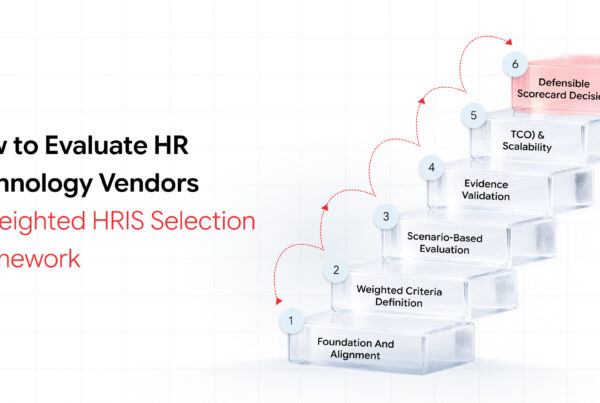
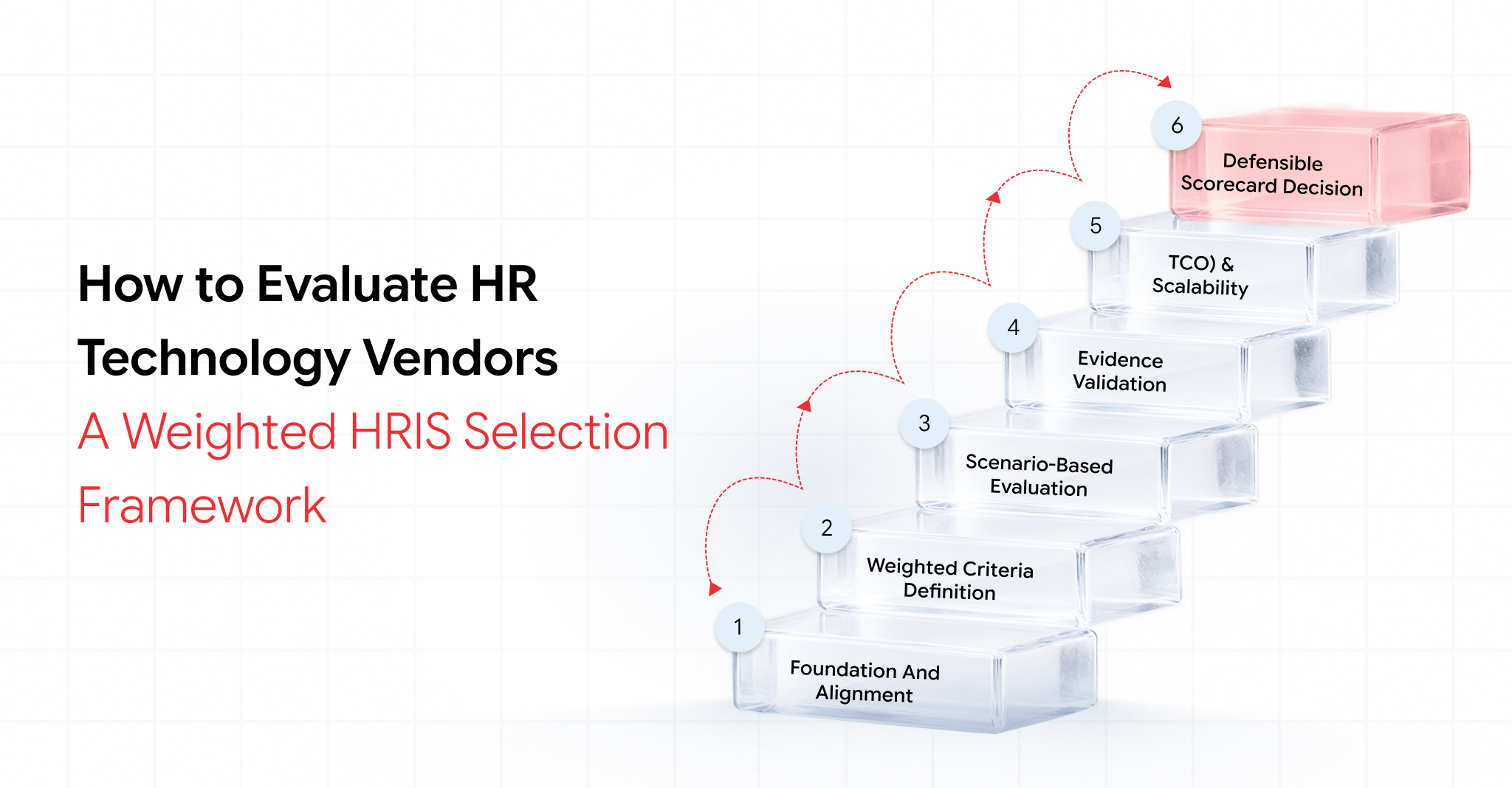
A structured HRIS selection framework allows organisations to define their requirements, weight them according to business priorities, evaluate vendors against common scenarios, validate evidence, and assess the broader implications of implementation.
The result is a decision based not on which vendor presents the strongest demonstration, but on which technology best supports the organisation’s requirements today and its transformation objectives tomorrow.
Key Takeaways
- Start with business and HR transformation objectives before evaluating vendors.
- Define functional and non functional HRIS selection criteria.
- Weight requirements according to business importance.
- Use scenario based demonstrations instead of generic product tours.
- Validate important vendor claims with evidence.
- Consider implementation, integration, data migration, and total cost.
- Assess scalability and future readiness alongside current functionality.
- Use a structured scorecard to support a transparent and defensible decision.
FAQ
What is HRIS selection?
HRIS selection is the structured process of identifying, evaluating, comparing, and selecting an HR technology platform that meets an organisation’s business, functional, technical, and future requirements.
How do you select an HRIS?
Start by defining business objectives and requirements, establish weighted selection criteria, shortlist suitable vendors, conduct scenario based demonstrations, validate vendor capabilities, assess implementation and cost, and make an evidence based decision.
What are the key HRIS selection criteria?
Key criteria can include functional fit, technology architecture, integrations, data, security, scalability, user experience, implementation complexity, cost, vendor capability, and future readiness.
What is an HRIS selection checklist?
An HRIS selection checklist is a structured set of requirements and evaluation areas used to compare HR technology vendors consistently throughout the selection process.
Why should HRIS selection criteria be weighted?
Weighting ensures that strategically important requirements have greater influence on the evaluation than lower priority features.
How should HRIS vendors be compared?
HRIS vendors should be compared against the same business requirements and scenarios using a structured scorecard supported by evidence from demonstrations, documentation, technical validation, references, and commercial proposals.
Share with your network