Table of Contents
- What Is the Talent Supply Chain?
- Why Should Organisations Think of Talent as a Supply Chain?
- What Are the Seven Stages of the Talent Supply Chain?
- Where Does the Talent Supply Chain Lose Yield?
- How Do You Measure Talent Supply Chain Yield?
- How Does Workforce Planning Connect to Talent Supply Chain Strategy?
- How Can Organisations Improve Talent Supply Chain Yield?
- What Role Does Technology Play in Talent Supply Chain Management?
- What Should Leaders Measure?
- From Talent Management to Talent Supply Chain Management
- Key Takeaways
- Frequently Asked Questions
Resources > Blog > What Is the Talent Supply Chain and How Do You Measure Its Yield?
What Is the Talent Supply Chain and How Do You Measure Its Yield?
October 07, 2026
The result is a fragmented view of how talent moves from workforce demand to business value.
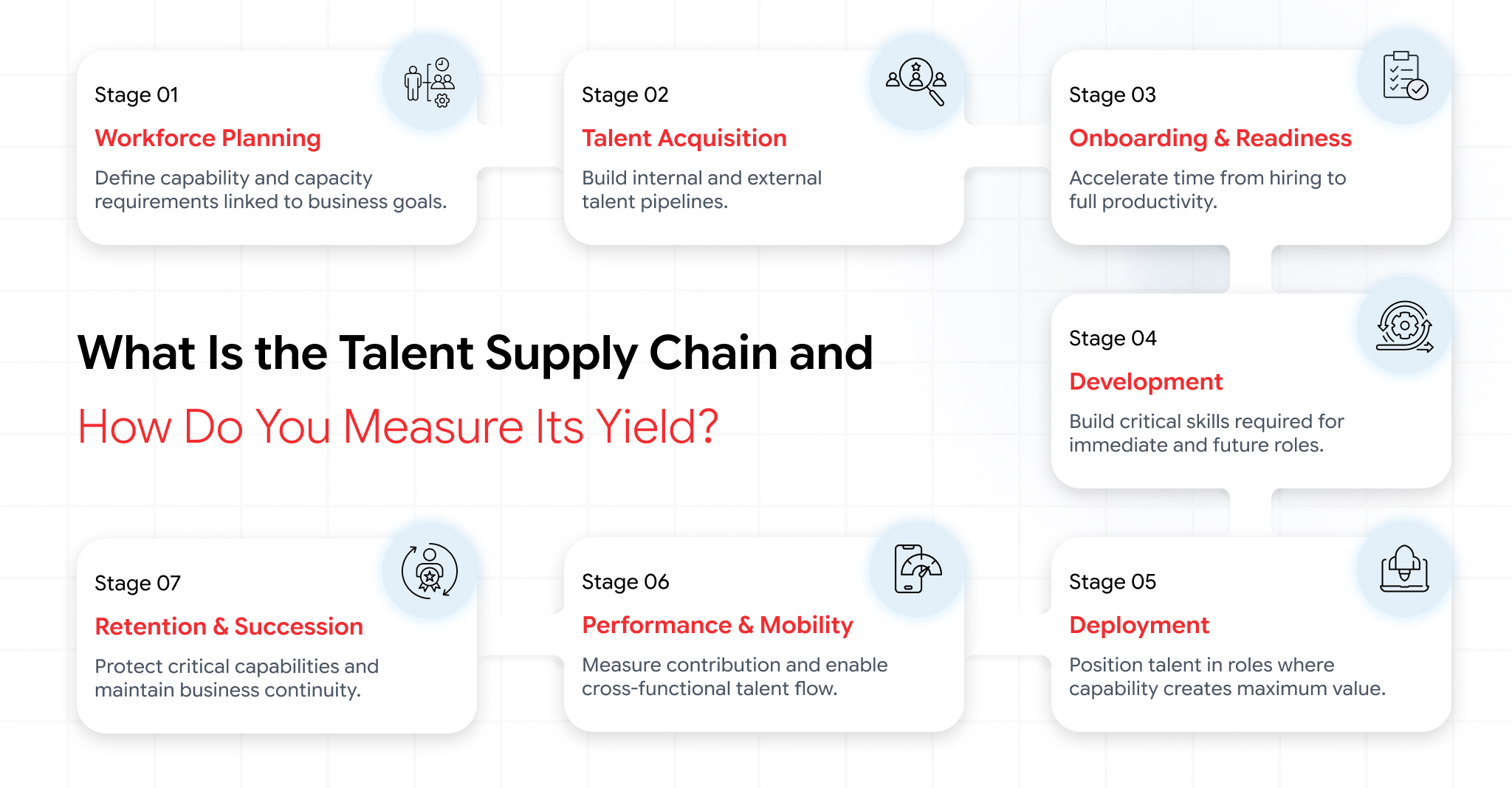
A talent supply chain provides a different way to look at this system. It connects workforce planning, talent acquisition, development, deployment, performance, mobility, and retention as an interconnected flow.
The objective is not simply to move more people through the talent lifecycle. It is to ensure that the right capabilities reach the roles where they can create the greatest business value.
What Is the Talent Supply Chain?
A simplified talent supply chain can be viewed as:
Workforce Demand → Talent Acquisition → Development → Deployment → Performance → Mobility → Retention
Each stage affects the next.
For example, hiring additional employees does not automatically solve a capability shortage if those employees cannot reach productive performance quickly. Similarly, developing talent creates limited value if employees with critical capabilities cannot be deployed into the roles where the business needs them.
This is why talent supply chain management requires an end to end view.
Why Should Organisations Think of Talent as a Supply Chain?
A supply chain perspective focuses on flow, capacity, bottlenecks, demand, and yield.
Consider an organisation that expects rapid growth in a new business area. Workforce planning may identify a requirement for 500 employees with specialised capabilities.
Recruitment may successfully fill 450 positions.
But if only 300 employees reach the required productivity level within the expected timeframe, the organisation has not fully solved its talent requirement.
The issue is therefore not simply how many people were hired.
It is how effectively talent moved from demand to productive capability.
What Causes Talent Supply Chain Yield to Increase or Decrease?
Yield can improve when organisations:
- Increase the quality of talent entering the organisation
- Improve identification of high value talent
- Retain critical capabilities
- Move talent into roles where they can create greater value
- Develop capabilities aligned with future business needs
- Reduce productivity loss from persistent performance gaps
- Reconnect with high value former employees where appropriate
The key question is not simply how much talent an organisation has. It is how effectively the organisation converts its available talent into business value.
Where Does the Talent Supply Chain Lose Yield?
Common leakage points include:
- Hiring people without the capabilities required for the role
- Long periods before new hires reach productivity
- Skills that remain unused after development investments
- Critical roles remaining vacant
- High performers leaving strategically important positions
- Limited internal mobility
- Workforce plans that do not reflect changing business demand
For example, an organisation may invest significantly in developing digital capabilities but fail to redeploy those employees into roles where those capabilities are required.
The capability exists, but the organisation does not capture its full value.
How Do You Measure Talent Supply Chain Yield?
Instead, leadership should connect measures across the talent lifecycle.
A useful framework is:
Talent Demand → Talent Supply → Readiness → Deployment → Performance → Retention
Relevant measures may include:
- Critical role vacancy rate
- Time to fill
- Time to productivity
- Quality of hire
- Internal mobility rate
- Critical skill coverage
- Performance attainment
- Critical talent retention
- Succession coverage
The objective is to identify where talent is being lost, delayed, underutilised, or deployed away from business priorities.
How Does Workforce Planning Connect to Talent Supply Chain Strategy?
It asks:
What capabilities will the organisation need?
Talent supply chain strategy then asks:
Where will those capabilities come from, and how effectively can we move them into productive roles?
The answer may involve recruitment, reskilling, internal mobility, contingent talent, automation, or redesigning work.
This creates a more integrated approach to workforce planning rather than treating hiring as the default response to every talent gap.
How Can Organisations Improve Talent Supply Chain Yield?
A practical approach is to:
1. Map demand
Identify critical roles and capabilities linked to business priorities.
2. Map supply
Understand existing workforce capacity, skills, mobility, and external talent availability.
3. Identify leakage
Find where hiring, development, deployment, or retention fails to meet requirements.
4. Prioritise critical roles
Focus investment where talent shortages can materially affect business performance.
5. Connect HR data
Link recruiting, learning, performance, workforce planning, and retention data.
6. Measure outcomes
Track whether talent investments actually improve readiness, productivity, performance, and retention.
What Role Does Technology Play in Talent Supply Chain Management?
An integrated HR technology environment can help organisations connect:
Workforce Planning + Recruiting + Skills + Learning + Performance + Talent Mobility
AI can further support skills inference, workforce forecasting, talent matching, career recommendations, and identification of emerging capability gaps.
However, technology does not create the talent supply chain strategy by itself.
Organisations first need to determine which talent decisions matter, which capabilities are critical, and which outcomes they want to measure.
What Should Leaders Measure?
A technology company may focus on critical skills coverage and time to productivity.
A manufacturing organisation may prioritise workforce capacity, critical role coverage, and succession.
A professional services organisation may focus on deployment, utilisation, internal mobility, and retention.
This is why talent supply chain measurement should begin with business demand, rather than starting with whichever HR metrics are easiest to collect.
From Talent Management to Talent Supply Chain Management
How do we attract, develop, engage, and retain our people?
A talent supply chain perspective adds another question:
How effectively does our talent system convert workforce investment into the capabilities the business needs?
That shift creates a more connected talent management strategy.
It links workforce planning to talent acquisition, development to deployment, and retention to business continuity.
The result is a talent model designed not simply to manage employees, but to ensure that critical capabilities reach the right roles at the right time.
Key Takeaways
- The talent supply chain connects workforce demand with talent acquisition, development, deployment, performance, mobility, and retention.
- Talent supply chain management requires an end to end view rather than isolated HR programmes.
- Yield should measure how effectively talent investment translates into productive capability and business outcomes.
- Workforce planning provides the demand signal for the talent supply chain.
- Critical roles and capabilities should receive greater attention than undifferentiated workforce metrics.
- HR technology and AI can connect data and improve talent decisions, but strategy should come before technology.
- The ultimate objective is to ensure that the organisation has the capabilities it needs where and when they matter most.
FAQ
What is a talent supply chain?
A talent supply chain is an end to end approach to managing how organisations forecast talent demand, source capabilities, develop people, deploy them into roles, and retain critical talent.
What is talent supply chain management?
Talent supply chain management connects workforce planning, recruitment, development, deployment, mobility, performance, and retention to ensure talent requirements are met efficiently.
How do you measure talent supply chain yield?
Yield can be assessed by connecting measures such as critical role coverage, quality of hire, time to productivity, internal mobility, performance, skills coverage, and critical talent retention.
How does workforce planning support the talent supply chain?
Workforce planning identifies future workforce and capability requirements. The talent supply chain determines how those requirements can be met through hiring, development, mobility, reskilling, or other workforce strategies.
What is the difference between talent management and talent supply chain management?
Talent management focuses on managing people and their development across the employee lifecycle. Talent supply chain management adds an end to end focus on how effectively talent capabilities flow from business demand to productive deployment.
Why is talent supply chain strategy important?
It helps organisations connect talent decisions with business requirements, identify capability gaps, reduce talent leakage, and focus workforce investment on areas that matter most to business performance.
Share with your network