Table of Contents
- What Makes a Role Critical to the Business?
- How Do Critical Roles Create Disproportionate Business Value?
- How Should Organisations Identify Critical Roles?
- Should Critical Roles Be Defined by Job Title?
- Where Should HR Invest in Critical Roles?
- How Does Workforce Planning Support Critical Role Strategy?
- How Should HR Measure the Value of Critical Role Investment?
- What Happens When Organisations Treat Every Role the Same?
- How Can HR Technology Support Critical Role Management?
- How Should Organisations Balance Business Value and Employee Development?
- From Critical Roles to Strategic Workforce Investment
- Key Takeaways
- Frequently Asked Questions
Resources > Blog > How Critical Roles Drive Business Value and Where HR Should Invest
How Critical Roles Drive Business Value and Where HR Should Invest
October 12, 2026
For HR leaders, this creates an important workforce planning question:
Where should the organisation focus its limited talent investment?
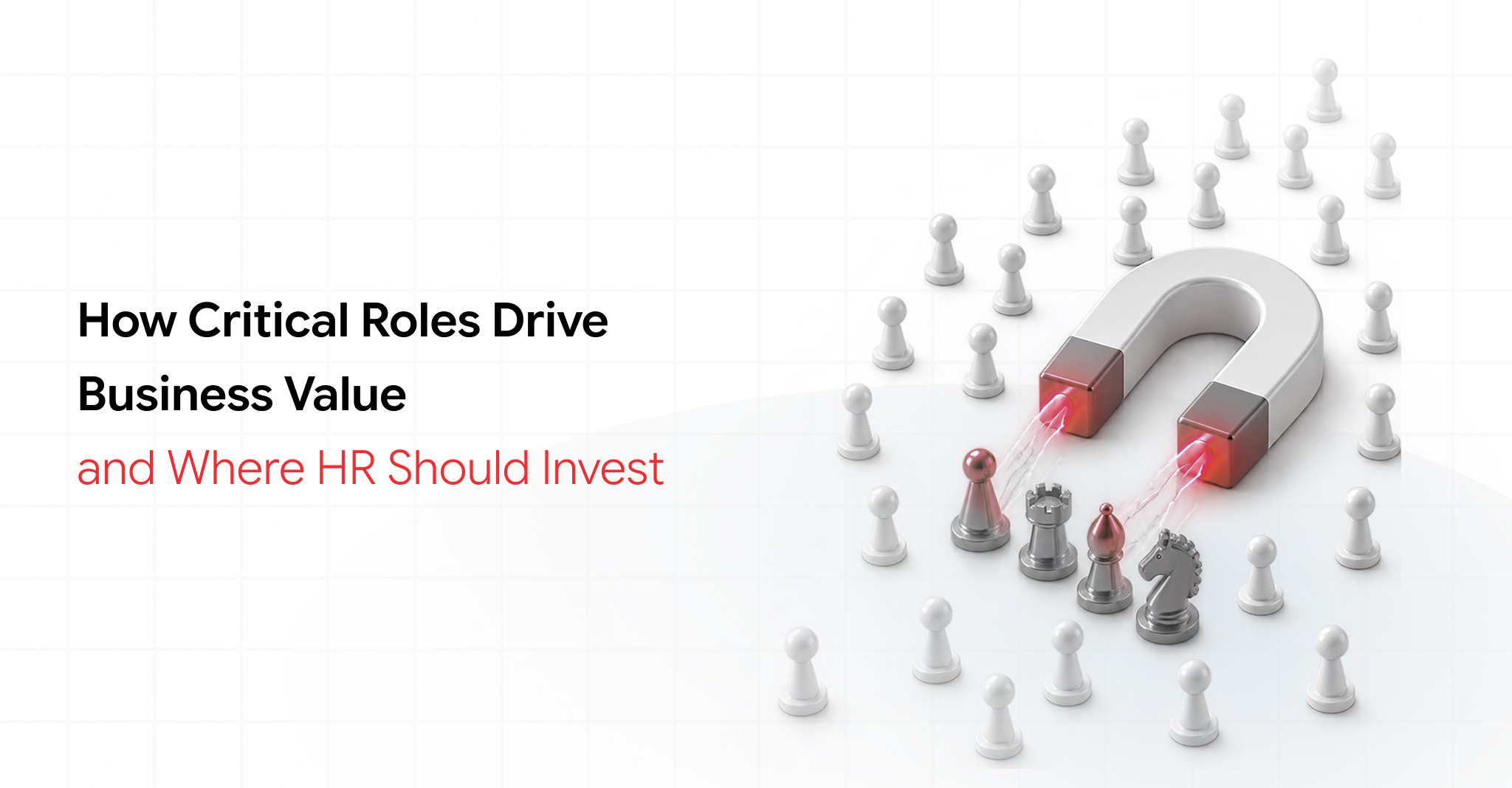
A critical role strategy helps answer that question by connecting workforce decisions to business priorities. Instead of distributing development, succession, recruitment, and retention investments uniformly, organisations can identify roles where capability gaps could have a disproportionate effect on business performance.
The objective is not to suggest that some employees matter more than others. It is to understand where specific capabilities are most critical to achieving strategic outcomes.
What Makes a Role Critical to the Business?
Criticality can come from several factors:
- Direct revenue contribution
- Customer or market impact
- Operational dependency
- Scarcity of required capabilities
- Regulatory or compliance responsibility
- Difficulty of replacement
- Length of the learning curve
- Strategic importance of the function
For example, a specialist engineer responsible for a proprietary production process may not have a large team, but losing that capability could create significant operational disruption.
The criticality comes from the business dependency on the capability, not the number of people reporting to the role.
How Do Critical Roles Create Disproportionate Business Value?
A single role may influence multiple downstream activities. A senior sales role may affect a strategic customer relationship. A specialist technology role may support a platform used across the organisation. A supply chain role may influence production continuity across multiple facilities.
This creates a multiplier effect.
When organisations identify these dependencies, they can better understand where capability gaps could create business risk.
For example:
Critical Role → Critical Capability → Business Dependency → Potential Business Impact
This provides a stronger foundation for workforce investment than simply counting employees or vacancies.
How Should Organisations Identify Critical Roles?
Organisations should consider:
- Business impact: What happens if this role cannot perform?
- Revenue impact: Does the role directly influence revenue generation?
- Customer impact: Could a capability gap affect important customers?
- Capability scarcity: How difficult is the required capability to find?
- Replacement difficulty: How long would it take to replace the capability?
- Succession readiness: Is there a ready internal successor?
- Strategic relevance: Is the role directly linked to a major business priority?
This creates a more evidence based critical roles strategy and helps HR connect workforce decisions with business priorities.
Should Critical Roles Be Defined by Job Title?
The same job title can have different levels of criticality across organisations.
A software engineer in one organisation may work on a non critical internal application. In another, a similar role may maintain a platform that supports a major revenue stream.
Therefore, organisations should assess role context, capability dependency, and business impact rather than relying only on job titles or organisational hierarchy.
Where Should HR Invest in Critical Roles?
Potential investments include:
- Succession planning
- Targeted development
- Reskilling and upskilling
- Internal mobility
- Strategic recruitment
- Knowledge transfer
- Retention programmes
- Leadership development
- Workforce redesign
For example, if a critical role has no ready successor and requires two years of experience to reach full productivity, developing an internal pipeline may be more useful than waiting until the role becomes vacant.
The investment decision should therefore consider future workforce risk, not only today’s vacancy numbers.
How Does Workforce Planning Support Critical Role Strategy?
It helps organisations ask:
Which capabilities will the business need?
Where are those capabilities today?
Which critical roles depend on them?
Where could future shortages emerge?
For example, a business entering a new market may identify several capabilities that do not currently exist at sufficient scale. Workforce planning can determine whether those capabilities should be acquired externally, developed internally, accessed through partners, or supported through technology.
This turns workforce planning from a headcount exercise into a capability planning process.
How Should HR Measure the Value of Critical Role Investment?
Organisations can track:
- Critical role vacancy rates
- Critical skill coverage
- Succession readiness
- Time to productivity
- Internal fill rates
- Retention of critical talent
- Performance outcomes
- Capability development
- Time required to replace critical roles
These measures can be connected to business indicators where appropriate.
For example, if a critical role supports a major customer segment, HR can examine whether improved succession coverage and retention reduce operational disruption or improve service continuity.
The exact business metric will depend on the role.
What Happens When Organisations Treat Every Role the Same?
This can create situations where:
- Critical roles have weak succession coverage
- Scarce skills remain concentrated among a few employees
- Development investments do not address strategic capability gaps
- Recruitment focuses on volume rather than capability
- Workforce risks remain invisible until a critical employee leaves
A differentiated approach does not mean reducing investment in other employees.
It means ensuring that strategically important capability risks receive appropriate attention.
How Can HR Technology Support Critical Role Management?
Skills + Performance + Succession + Learning + Mobility + Workforce Planning
This creates greater visibility into where critical capabilities exist and where gaps may emerge.
AI can also support skills inference, talent matching, succession analysis, workforce scenario planning, and identification of potential internal candidates.
However, technology cannot determine business criticality on its own.
Business leaders and HR need to establish which roles and capabilities matter most before technology can help manage them effectively.
How Should Organisations Balance Business Value and Employee Development?
The broader objective is to understand which capabilities the organisation needs and how those capabilities can be developed across the workforce.
An employee in a non critical role today may develop into a critical capability holder tomorrow.
Therefore, workforce investment should include:
Critical Role Protection + Capability Development + Internal Mobility + Future Workforce Planning
This creates a more sustainable talent management strategy.
From Critical Roles to Strategic Workforce Investment
It is creating a connection between business strategy and workforce decisions.
When organisations know which roles and capabilities are essential, they can make more deliberate decisions about recruitment, development, succession, retention, mobility, and technology.
The question changes from:
“Where should HR spend its talent budget?”
to:
“Which workforce capabilities are most important to delivering our business strategy, and what investment will protect or build them?”
That shift can help HR demonstrate the business value of workforce investment more clearly.
Key Takeaways
- Critical roles are defined by business dependency, not simply seniority or job title.
- Critical role strategy connects workforce decisions with business priorities.
- Workforce planning can identify current and future capability requirements.
- HR investment can be prioritised around critical roles, scarce skills, succession gaps, and future capability needs.
- Critical role metrics should connect workforce outcomes with relevant business outcomes.
- HCM technology can provide visibility across skills, performance, succession, learning, and workforce planning.
- A critical role strategy should support broader workforce capability development rather than create a narrow focus on a small group of employees.
FAQ
What are critical roles in business management?
Critical roles are positions where a capability gap, vacancy, or performance issue could materially affect important business, operational, customer, revenue, or compliance outcomes.
How do you identify critical positions in an organisation?
Organisations can assess roles using factors such as business impact, capability scarcity, customer dependency, replacement difficulty, succession coverage, regulatory exposure, and strategic relevance.
Why is a critical roles strategy important?
A critical roles strategy helps organisations identify where workforce capability is most closely connected to business priorities and where targeted talent investment may be required.
How does workforce planning support critical roles?
Workforce planning identifies the capabilities and capacity the organisation will need and helps determine how those requirements can be met through recruitment, development, mobility, reskilling, or other workforce strategies.
How can HR measure the business value of workforce investment?
HR can connect measures such as critical role coverage, succession readiness, retention, time to productivity, and capability development with relevant business outcomes where a clear relationship exists.
Does every critical role require a separate talent strategy?
Not necessarily. Organisations can use common frameworks for identifying and managing critical roles while tailoring interventions according to the capability, business dependency, and risk associated with each role.
Share with your network