Table of Contents
- Why Does HR Technology Support Matter After Go Live?
- What Are the Three HRIS Support Models?
- How Should Organisations Choose the Right Support Model?
- What Should an HRIS Post Go Live Support Model Include?
- How Should Organisations Approach Workday Post Implementation Support?
- How Does HR Technology Support Contribute to HR Transformation?
- How Can Organisations Measure Support Effectiveness?
- Frequently Asked Questions
Resources > Blog > HR Technology Support After Go Live: In House, Partner or Hybrid?
HR Technology Support After Go Live: In House, Partner or Hybrid?
November 18, 2026
Why Does HR Technology Support Matter After Go Live?
Without clear support ownership, these issues can move between HR, IT, implementation partners and software vendors without timely resolution.
Effective HR technology post implementation support establishes clear accountability for system performance, incident resolution, configuration changes, user assistance and continuous improvement.
Organisations should assess support as an ongoing operating capability, not simply an extension of the implementation project.
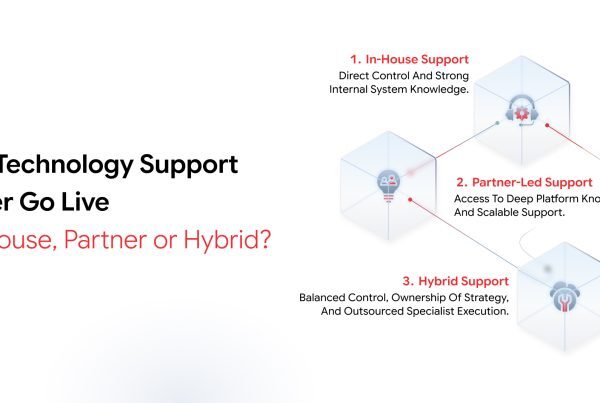
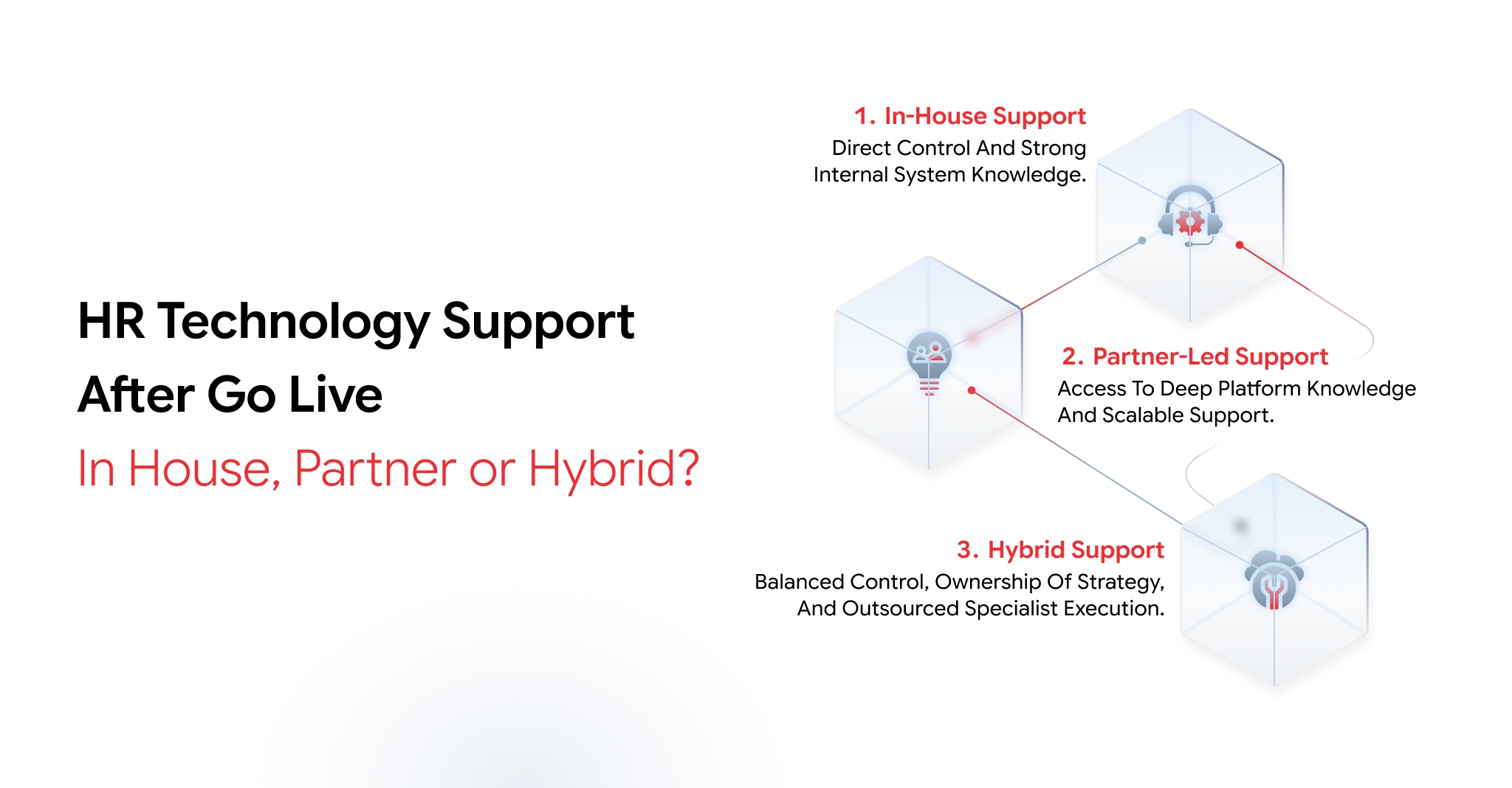
What Are the Three HRIS Support Models?
1. In House HR Technology Support
An in house model assigns ongoing support responsibilities to internal HRIS, HR operations and IT teams.
When does it work best?
This approach suits organisations with established HR technology teams, complex internal processes and a strong need to retain system knowledge internally.
Key advantages:
- Direct control over priorities, access and service standards.
- Strong understanding of internal processes and business requirements.
- Closer coordination with HR, Finance, IT and other business teams.
Potential challenges:
Internal teams must maintain sufficient expertise across configuration, integrations, security, reporting and vendor updates. Recruitment, training and employee turnover can also affect support capacity.
An in house model works best when the organisation can sustain the required skills and coverage without creating excessive dependency on a few individuals.
2. Partner Led HR Technology Support
A partner led model uses an external specialist to manage agreed support activities, from issue resolution and configuration assistance to system maintenance and enhancement delivery.
For example, organisations using SAP SuccessFactors may engage SAP SuccessFactors support services for specialist assistance with system configuration, integrations, recurring incidents and platform changes.
Similarly, organisations using Workday may use external specialists for ongoing configuration, business process support, reporting and release related activities.
When does it work best?
Partner led support suits organisations that lack sufficient internal expertise, need flexible specialist capacity or want to avoid building a large permanent support team.
Key advantages:
- Access to specialist knowledge across relevant HR technology platforms.
- Flexible capacity for incidents, enhancements and complex technical issues.
- Reduced dependence on internal recruitment for every specialist requirement.
Potential challenges:
External support can become expensive if scope and service expectations remain unclear. Organisations may also lose internal knowledge if the partner becomes the sole source of system expertise.
The contract should define responsibilities, response targets, escalation routes, documentation standards and knowledge transfer requirements.
SAP SuccessFactors post-implementation support and maintenance guide →
3. Hybrid HR Technology Support
A hybrid model combines internal ownership with external specialist support.
Internal teams typically retain business accountability, prioritisation, governance and knowledge of organisational processes. The external partner provides agreed technical expertise, additional capacity and support for complex incidents or enhancements.
When does it work best?
A hybrid model often suits organisations that need direct control over HR technology decisions but cannot justify maintaining every specialist skill internally.
For example, an internal HRIS team may manage user requests, prioritise enhancements and coordinate with business stakeholders. A support partner may handle complex configuration, integration failures, technical troubleshooting and release impact assessments.
The key is to define which team owns each activity. Without clear boundaries, a hybrid model can create duplicated effort, unclear accountability and unnecessary handoffs.
How Should Organisations Choose the Right Support Model?
Consider these five factors:
Internal expertise: Does the organisation have sufficient skills to manage configuration, integrations, reporting and troubleshooting?
System complexity: How many HR platforms, countries, integrations and business processes require support?
Service expectations: How quickly must teams resolve payroll affecting incidents, employee access problems and other operational issues?
Cost and scalability: Can the organisation maintain the required support capacity as its workforce, systems and requirements evolve?
Knowledge and governance: Who owns system documentation, change approvals, security controls and long term improvement priorities?
Organisations should evaluate these factors against actual support demand rather than choosing a model based only on the lowest quoted cost.
What Should an HRIS Post Go Live Support Model Include?
- Incident management: Classify issues by severity, assign ownership and establish escalation paths.
- Configuration and enhancement management: Review changes against business requirements, security controls and testing standards.
- Integration monitoring: Track data exchanges between HR systems, payroll, identity management and other connected applications.
- Release management: Assess vendor updates, test relevant scenarios and communicate changes to affected users.
- Knowledge management: Maintain system documentation, troubleshooting guidance and decision records.
- Service reporting: Monitor issue volumes, resolution times, recurring incidents and outstanding enhancements.
- Continuous improvement: Identify recurring problems and prioritise improvements that reduce manual effort and improve service quality.
These responsibilities should appear in the support agreement and operating procedures, even when multiple teams share delivery.
How Should Organisations Approach Workday Post Implementation Support?
Organisations should determine which activities internal teams can manage confidently and which require specialist support. They should also define how support teams assess new requirements, test changes and maintain documentation.
Organisations using Workday should define clear ownership for incident resolution, configuration changes, release management and continuous improvement after go live. Effective support starts with a well planned implementation and a clear transition from project delivery to ongoing operations. For guidance on preparing for a successful launch, read our Workday implementation step by step guide.
The same principle applies to SAP SuccessFactors and other enterprise HR platforms: the support structure should reflect the organisation’s requirements, platform configuration and internal capabilities rather than follow a one size fits all approach.
How Does HR Technology Support Contribute to HR Transformation?
However, support teams need a clear mechanism to distinguish urgent operational issues from improvement opportunities. Otherwise, recurring incidents can consume the capacity needed for strategic work.
This is where HR transformation services can complement operational support. A broader review can assess whether the current HR operating model, technology configuration and business processes continue to meet organisational objectives.
Rolling Arrays helps organisations evaluate HR technology, identify improvement opportunities and align technology decisions with business priorities. This creates a path from day to day system support towards structured improvement and long term value realisation.
How Can Organisations Measure Support Effectiveness?
Useful indicators include:
- Average incident resolution time.
- Number of recurring incidents.
- Percentage of incidents resolved within agreed service targets.
- Volume of unresolved requests and ageing tickets.
- Integration failures and data correction effort.
- Enhancement delivery time and change related incidents.
- Internal user satisfaction with support services.
- Support cost relative to service demand.
These measures become more useful when reviewed together. Faster resolution alone does not indicate success if the same issue repeatedly returns or creates additional work for HR operations.
FAQ
Is in house or outsourced HRIS support better?
Neither model is universally better. In house support provides direct control and internal knowledge, while outsourced support offers specialist expertise and flexible capacity. The right choice depends on system complexity, available skills, service requirements and cost.
What is a hybrid HR technology support model?
A hybrid model combines internal ownership with external specialist support. Internal teams generally manage priorities and business accountability, while partners provide agreed technical expertise and additional capacity.
What do SAP SuccessFactors support services include?
Depending on the agreement, services may include incident resolution, configuration assistance, integration troubleshooting, reporting support, release preparation and system enhancements.
What should organisations include in a post go live support agreement?
The agreement should define scope, responsibilities, severity levels, response and resolution targets, escalation routes, change control, documentation, reporting and knowledge transfer.
When should an organisation change its HRIS support model?
Consider a change when recurring incidents increase, internal expertise becomes insufficient, support costs rise without better outcomes, accountability remains unclear or the current model cannot support new business requirements.
How does HR technology support improve long term value?
Effective support maintains system reliability, reduces recurring problems and creates capacity for improvements. When teams connect support priorities with business outcomes, HR technology can continue to support operational efficiency and transformation objectives.
Share with your network