Table of Contents
- Why Does Change Management Become an Easy Target When HR Transformation Budgets Tighten?
- Why Can Go-Live Success Hide Future Adoption Problems?
- What Happens in Year Two When Organizations Underinvest in Change Management?
- What Does Weak Adoption Actually Cost the Organization?
- Which Change Management Activities Create the Most Value After Go-Live?
- How Should Organizations Budget for Change Management Beyond Go-Live?
- How Can Organizations Build a Business Case for Sustained Change Investment?
- What Adoption Metrics Should Leaders Track in Year Two?
- Who Should Own Adoption After the Transformation Team Leaves?
- How Can Existing HR Technology Customers Identify Adoption and Value Gaps?
- What Should Leaders Protect When Transformation Budgets Come Under Pressure?
- What Questions Should Leaders Ask Before Reducing the Change Management Budget?
Resources > Blog > What Does Cutting Change Management Cost an HR Transformation in Year Two?
What Does Cutting Change Management Cost an HR Transformation in Year Two?
August 3, 2026
Overview
Change management often receives strong attention during HR transformation planning but faces pressure when budgets tighten or implementation timelines change. Organizations may reduce communication, manager enablement, training reinforcement, local change support, or post-go-live adoption activities because leaders view them as costs they can defer. The consequences rarely appear immediately. Project teams may still complete implementation, launch the platform, and meet go-live milestones. The impact becomes clearer later as employees return to familiar processes, managers create workarounds, adoption varies across business units, and HR teams struggle to realize expected outcomes. This article explores what organizations risk when they reduce change management investment and why year-two adoption provides a stronger measure of transformation sustainability than go-live participation.
Why Does Change Management Become an Easy Target When HR Transformation Budgets Tighten?
Organizations often reduce change management investment because leaders can see technology, implementation, and integration costs more easily than the long-term value of sustained workforce adoption.
A transformation budget usually contains visible technical requirements. Organizations need software, implementation resources, integrations, data migration, testing, security, and project management to reach go-live.
Change management can appear more flexible.
Leaders may reduce:
- Change impact assessments
- Local change resources
- Manager enablement
- Employee communication
- Role-based training
- Change champion networks
- Post-go-live reinforcement
- Adoption measurement
- Continuous learning and support
The project can often continue after these reductions.
The system still goes live. Employees receive access. Project teams complete training activities. Leadership communicates the launch.
This creates a misleading sense that the organization reduced costs without affecting transformation success.
The real impact develops over time.
Employees may understand how to complete basic transactions but not why the organization changed the process. Managers may not reinforce new ways of working. Country and business teams may return to familiar local practices. HR teams may lack the resources to identify adoption problems and intervene early.
Organizations save money in the implementation budget but create a larger value-realization risk after go-live.
The stronger question is therefore not:
How much can we reduce the change management budget?
It is:
What transformation outcomes become harder to achieve if we reduce the organization’s ability to adopt and sustain new ways of working?
Why Can Go-Live Success Hide Future Adoption Problems?
Organizations commonly track:
- Training completion
- Communication reach
- System access
- Help desk volumes
- Initial transaction completion
- Go-live readiness
- Implementation milestones
These measures provide useful information during deployment.
However, they do not show whether the organization will sustain adoption after project resources leave and leadership attention shifts to other priorities.
A business unit may report high training completion while employees continue using spreadsheets.
Managers may log into the new system while delegating transactions to HR teams.
Employees may complete processes digitally but continue using email and offline communication to manage exceptions.
HR teams may process transactions successfully while maintaining manual controls around the platform.
These behaviors may not prevent go-live.
They can significantly reduce long-term transformation value.
What Is the Difference Between Go-Live Readiness and Sustainable Adoption?
Go-Live Readiness includes ensuring that employees have completed the required training, users can access the system, communications have reached the target audiences, transactions can be completed, support channels are available, project teams are monitoring implementation issues, and leaders are focused on launch success.
Sustainable Adoption means that employees consistently use the intended processes, users understand how technology supports their work, employees understand why ways of working have changed, users avoid unnecessary manual workarounds, managers and local leaders reinforce expected behaviors, business owners monitor adoption and value realization, and leaders continue reinforcing transformation outcomes.
Go-live readiness answers:
Can the organization launch the new HR environment?
Sustainable adoption answers:
Will people continue using new processes and capabilities after the transformation program loses its initial momentum?
Organizations need both.
What Happens in Year Two When Organizations Underinvest in Change Management?
The first year after implementation often receives additional support.
Project teams remain involved. Implementation partners resolve issues. Leaders monitor stabilization. Employees receive additional training. Governance forums continue meeting regularly.
By year two, the environment changes.
Project resources are reduced. Transformation teams move to other priorities. Executive attention shifts. New employees join the organization. Managers change roles. Business requirements evolve. Teams discover exceptions that the original implementation did not address.
Without sustained change capabilities, small adoption gaps can become operating practices.
Common consequences include:
- Employees return to spreadsheets, email, and offline processes.
- Managers rely on HR teams to complete activities intended for manager self-service.
- Different business units adopt different versions of the same process.
- New employees receive inconsistent training on HR technology and processes.
- Local teams introduce workarounds without governance review.
- HR teams spend more time correcting errors and supporting users.
- Workforce data becomes less consistent as processes diverge.
- Leaders struggle to realize the productivity and efficiency benefits expected in the business case.
The organization may still have a functioning HR platform.
The problem is that the operating environment around the platform gradually reduces its value.
What Does Weak Adoption Actually Cost the Organization?
Weak adoption creates costs through lost productivity, manual rework, additional support, process inconsistency, unreliable data, delayed benefits, and lower returns from HR technology investments.
Organizations often struggle to quantify these costs because they appear across different budgets and business functions.
The Hidden Cost of Weak HR Transformation Adoption
When employees maintain manual workarounds, it can lead to duplicate effort and longer processing times, resulting in lost productivity and higher operating costs. When managers avoid self-service processes, HR teams continue to handle administrative work, leading to unrealized efficiency benefits. If business units follow inconsistent processes, exceptions and complexity increase, resulting in higher support and governance costs.
When employees enter incomplete or inconsistent data, confidence in workforce information is reduced, which can lead to weaker reporting, analytics, and AI readiness. Limited enablement for new employees can cause adoption to decline as the workforce changes, increasing training and support requirements. If leaders stop reinforcing transformation behaviors, employees may return to familiar practices, resulting in delayed or unrealized business outcomes. Finally, when organizations do not measure adoption, problems can remain invisible until performance declines, potentially leading to higher remediation costs later.
The total cost can exceed the amount saved by reducing change management activities.
For example, if managers continue sending HR requests through email instead of using manager self-service, the organization retains administrative effort that the transformation expected to remove.
If employees maintain spreadsheets because they do not trust the new process, HR teams may need to reconcile multiple sources of workforce information.
If business units introduce local workarounds, technology and support teams may spend additional time managing process variation.
These costs accumulate over time.
Organizations should therefore evaluate change management investment against the value at risk if employees and managers fail to adopt the transformation as intended.
Which Change Management Activities Create the Most Value After Go-Live?
Organizations do not need to maintain the same level of change activity indefinitely.
They need to shift from implementation-focused change management to an operating model for sustained adoption.
Manager Reinforcement
Managers influence whether employees continue using new processes and technologies.
Organizations should equip managers to:
- Explain why the organization introduced new ways of working.
- Reinforce expected employee behaviors.
- Identify adoption challenges within their teams.
- Direct employees to appropriate support.
- Provide feedback when processes create unnecessary friction.
Role-Based Learning
One-time training cannot support a workforce that continuously changes.
Organizations should provide learning based on employee roles, process responsibilities, and evolving technology capabilities.
This becomes particularly important when new employees join, managers change roles, or the organization introduces additional functionality.
Adoption Measurement
Organizations should monitor how employees and managers use HR processes and technology after implementation.
Useful measures may include:
- Completion of intended digital processes
- Use of manual workarounds
- Manager self-service adoption
- Process abandonment
- Repeated support requests
- Adoption differences across business units or countries
- Employee feedback on process friction
- Business outcomes connected to adoption
Adoption data helps leaders identify where the organization needs additional communication, training, process improvement, configuration changes, or leadership intervention.
Local Change Networks
Regional, country, and business-unit change champions can identify adoption challenges that central transformation teams may not see.
They can provide feedback, reinforce expected behaviors, support local employees, and help organizations distinguish between genuine business requirements and resistance to new ways of working.
Continuous Improvement
Organizations should treat employee feedback and adoption data as inputs for improving processes and technology.
If users consistently avoid a process, the organization should investigate why.
The problem may require better communication or training.
It may also reveal unnecessary process complexity, configuration gaps, integration issues, or user experience challenges.
Sustained adoption depends on the organization’s ability to improve the environment around employees rather than repeatedly asking users to accept unnecessary friction.
How Should Organizations Budget for Change Management Beyond Go-Live?
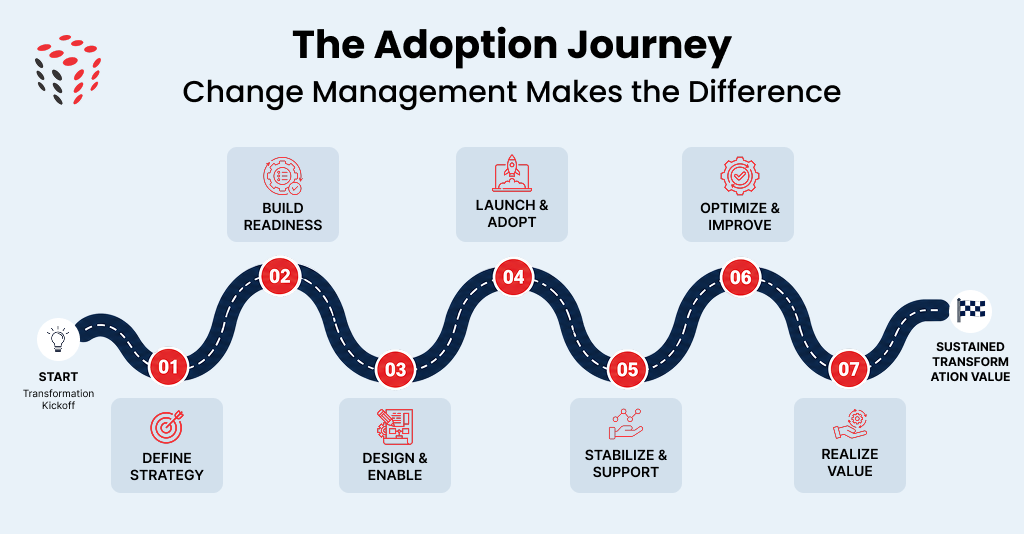
Organizations should budget for change management as a capability that continues beyond implementation, with investment shifting from launch activities toward adoption measurement, manager enablement, ongoing learning, local reinforcement, and continuous improvement.
During implementation, organizations typically spend more on communication, training development, change impact assessments, stakeholder engagement, and launch preparation.
After go-live, the nature of the investment should change.
Before implementation, the change management priority is to prepare the organization through stakeholder alignment, change impact assessment, leadership engagement, and workforce readiness. During implementation, the focus shifts to building understanding and capability through communication, role-based training, manager enablement, and local change networks.
During go-live and stabilization, the priority is to support new ways of working through user support, feedback, issue resolution, and adoption monitoring. In Year One, the focus is on strengthening adoption through targeted interventions, manager reinforcement, process improvement, and adoption measurement.
In Year Two and beyond, the priority is to sustain value realization through continuous learning, governance, optimization, onboarding new employees, and ongoing monitoring of business outcomes.
The objective is not to maintain a large transformation team indefinitely.
Organizations should establish clear ownership for sustained adoption within the HR operating model.
Process owners can monitor whether employees follow intended processes. HR technology teams can identify usage patterns and recurring issues. HR leaders can review whether adoption supports the outcomes established in the transformation business case.
This approach helps organizations prevent adoption from becoming an implementation activity that ends when project funding closes.
How Can Organizations Build a Business Case for Sustained Change Investment?
Change management budgets become vulnerable when leaders describe them only through activities.
For example:
- Number of communications sent
- Number of employees trained.
- Number of change champions appointed.
- Number of workshops conducted.
These measures explain what the change team did.
They do not demonstrate the business value that sustained adoption protects.
A stronger business case connects investment to outcomes.
Manager enablement drives greater use of manager self-service, reducing HR administration and enabling faster service delivery. Role-based learning helps reduce process errors and support requests, resulting in lower rework and support costs.
Adoption analytics enables earlier identification of adoption gaps, reducing remediation costs and accelerating value realization. Local change networks help identify country- or business-unit-specific issues faster, leading to greater process consistency and fewer unmanaged workarounds.
Employee feedback helps identify process and technology friction, supporting better adoption and continuous improvement. Continuous reinforcement ensures sustained use of intended processes, protecting the benefits of the transformation over time.
For example:
- How many hours does HR spend completing activities intended for employee or manager self-service?
- How much time do employees spend maintaining duplicate spreadsheets or offline trackers?
- How many support requests result from recurring adoption problems?
- What is the cost of correcting process errors and inconsistent data?
- Which benefits in the original transformation business case depend on sustained employee and manager adoption?
- How much expected value remains unrealized because adoption has fallen below target?
These questions help leaders evaluate change management as an investment in value realization rather than an optional project expense.
What Adoption Metrics Should Leaders Track in Year Two?
Leaders should track measures that show whether employees and managers continue using intended processes, whether workarounds are increasing, whether adoption supports business outcomes, and where the organization needs intervention.
No single adoption metric provides a complete picture.
System logins, training completion, and transaction volumes can provide useful signals, but organizations should connect usage data with process performance, employee behavior, and business outcomes.
A practical year-two adoption scorecard may include:
Manager enablement drives greater use of manager self-service, reducing HR administration and enabling faster service delivery. Role-based learning helps reduce process errors and support requests, resulting in lower rework and support costs.
Adoption analytics enables earlier identification of adoption gaps, reducing remediation costs and accelerating value realization. Local change networks help identify country- or business-unit-specific issues faster, leading to greater process consistency and fewer unmanaged workarounds.
Employee feedback helps identify process and technology friction, supporting better adoption and continuous improvement. Continuous reinforcement ensures sustained use of intended processes, protecting the benefits of the transformation over time.
Who Should Own Adoption After the Transformation Team Leaves?
One of the reasons adoption declines after go-live is that ownership becomes unclear.
During implementation, a dedicated program team coordinates communication, training, stakeholder engagement, issue management, and readiness activities.
After implementation, those responsibilities may disperse across the organization.
Without clear ownership:
- HR technology teams focus primarily on system performance.
- Process owners assume users will continue following new processes.
- Managers expect HR to resolve adoption issues
- Change teams move to new projects
- Local teams create their own solutions to operational problems
- Leadership receives limited visibility into declining adoption
Organizations should define sustained adoption responsibilities as part of the post-go-live operating model.
Process Owners
Process owners should monitor whether employees and managers follow intended processes, identify unnecessary variations, and initiate improvements when adoption declines.
HR Technology Teams
HR technology teams should monitor platform usage, recurring issues, integrations, configuration gaps, and opportunities to improve the user experience.
Managers and Business Leaders
Managers should reinforce expected behaviors, identify barriers within their teams, and help employees adopt new ways of working.
HR Leadership
HR leaders should review adoption alongside transformation outcomes and ensure that the organization continues investing in capabilities required to sustain value.
Regional and Local Teams
Regional and local teams should identify market-specific adoption challenges, support employees, and escalate genuine requirements that may need process or technology changes.
Clear ownership helps organizations move from project-based change management to sustained adoption governance.
How Can Existing HR Technology Customers Identify Adoption and Value Gaps?
For SAP SuccessFactors and Workday customers, adoption challenges may develop gradually.
The platform may remain technically stable while:
- Manual workarounds increase
- Business units introduce process variations
- Employees underuse available capabilities
- Manager self-service remains below expectations
- Workforce data quality declines
- Integrations create additional manual effort
- Governance becomes less structured
- Transformation benefits remain unrealized
- The organization lacks the foundations required for future AI priorities
A structured HR technology health check can evaluate the relationship between platform capabilities, processes, integrations, data, governance, adoption, and business outcomes.
The objective is not to blame the technology or the workforce.
It is to identify where the organization can optimize the existing environment, strengthen adoption, and improve value realization before making additional technology investments.
What Should Leaders Protect When Transformation Budgets Come Under Pressure?
Not every change activity requires the same level of investment.
Organizations should prioritize:
- Manager enablement: Managers influence whether new behaviors become part of everyday work.
- Role-based learning: Employees need support as roles, processes, and technology capabilities evolve.
- Adoption measurement: Leaders need evidence about where adoption is declining and why.
- Local reinforcement: Regional and business-unit teams help identify adoption gaps that central teams may miss.
- Feedback mechanisms: Employees need a structured way to report process and technology friction.
- Continuous improvement: Organizations need the capability to respond when adoption data reveals process, configuration, integration, or user experience issues.
- Clear ownership: Business and process owners must remain accountable for sustaining transformation outcomes.
When leaders reduce change investment, they should evaluate the transformation value placed at risk rather than focusing only on the immediate budget reduction.
What Questions Should HR Leaders Answer Before Presenting Transformation Value to the Board?
Leadership teams should ask:
- Which expected benefits depend on employees and managers changing how they work?
- What evidence shows that new processes have become sustainable operating practices?
- Where do employees still rely on manual workarounds?
- Are managers reinforcing the intended ways of working?
- How will new employees and managers learn the transformed processes?
- Who owns adoption after the implementation team leaves?
- How will leaders identify declining adoption before it affects business outcomes?
- What is the cost of recurring support, rework, and process inconsistency?
- What transformation value could remain unrealized if adoption falls below expectations?
- Will reducing change investment create higher remediation costs in year two?
These questions help leaders distinguish between reducing unnecessary project activity and removing the capabilities required to sustain transformation value.
Conclusion
Cutting change management investment can reduce the immediate cost of an HR transformation without affecting the go-live date.
That is why the decision can appear attractive.
The consequences often emerge later.
Employees return to familiar ways of working. Managers bypass self-service processes. Manual workarounds increase. Business units introduce process variations. Workforce data becomes less reliable. HR teams spend more time supporting users and correcting issues.
By year two, the organization may have a functioning HR platform but still struggle to realize the outcomes that justified the transformation investment.
Organizations should therefore evaluate change management based on the value it helps protect.
Manager enablement, continuous learning, adoption measurement, local reinforcement, employee feedback, clear ownership, and continuous improvement help organizations sustain new ways of working after implementation teams leave.
The objective is not to maintain transformation-era spending forever.
It is to build sustained adoption into the HR operating model and continue investing in the capabilities required to protect long-term business value.
FAQ
Why Is Change Management Important After HR Technology Go-Live?
Change management remains important after go-live because employees, managers, business requirements, and technology capabilities continue to change. Sustained reinforcement, learning, adoption measurement, and continuous improvement help organizations maintain new ways of working and protect transformation value.
What Happens When Organizations Cut Change Management Budgets?
Organizations may experience declining adoption, growing manual workarounds, increased support requirements, inconsistent processes, weaker workforce data, and unrealized transformation benefits. These consequences may become more visible after implementation support and executive attention decline.
How Should Organizations Measure HR Technology Adoption?
Organizations should measure intended process usage, manager and employee self-service, manual workarounds, process consistency, recurring support needs, workforce data quality, employee feedback, and business outcomes connected to adoption.
Who Owns HR Transformation Adoption After Go-Live?
Business and process owners should own sustained adoption, supported by HR technology teams, managers, HR leadership, change specialists, and regional or local teams.
How Can an HRTech Health Check Identify Adoption Gaps?
An HRTech Health Check can evaluate how effectively employees and managers use existing HR processes and technology capabilities. It can identify manual workarounds, process inconsistencies, underused capabilities, governance gaps, workforce data issues, and unrealized business outcomes that may require optimization.


Share with your network
Get updates in your inbox