
Table of Contents
- Why Does an HRIS Fail to Deliver the Expected Value?
- What Are the Three Paths Out of a Disappointing HRIS?
- How Do You Know Which Path Is Right?
- What Does Each Option Cost?
- How Long Does Each Path Take?
- What Should Leaders Compare Before Choosing a Path?
- Why Should Organizations Calculate the Cost of Staying With the Current HRIS?
- What Are the Risks of Repairing an HRIS?
- When Does Reimplementation Make More Sense Than Repair?
- When Should Organizations Seriously Consider Replacing Their HRIS?
- What Happens If an Organization Chooses the Wrong Path?
- How Should Leaders Build the Business Case for the Three Options?
- How Can an HRIS Health Check Help Leaders Choose Between the Three Paths?
- How Should Organizations Sequence the Decision?
- What Should Leaders Ask Before Making an HRIS Decision?
Resources > Blog > Only a Third of Employees Use the HRIS You Paid For
Only a Third of Employees Use the HRIS You Paid For: The Post Go Live Adoption Playbook
September 9, 2026
Overview
An HRIS can deliver significant capabilities, but those capabilities create value only when employees and managers use them effectively. Low adoption often reflects more than employee resistance. Process complexity, unclear communication, poor user experience, limited training, and unused functionality can all reduce engagement. A structured post go live adoption approach helps organisations identify these barriers, improve usage, and turn technology investment into measurable business value.
Why Does HRIS Adoption Fall After Go Live?
Common adoption barriers include:
- Unclear processes
- Limited user awareness
- Insufficient training
- Poor user experience
- Complex workflows
- Lack of manager engagement
- Low confidence in workforce data
- Unused system capabilities
The result is a familiar situation: the organisation owns a modern HRIS, but employees continue working around it.
How Can Organisations Diagnose Adoption Problems?
Review:
- Login and usage patterns
- Process completion rates
- Help desk tickets
- Frequently used and unused capabilities
- Employee and manager feedback
- Manual workarounds
- Process completion times
This helps distinguish an awareness problem from an ability, process, or technology problem.
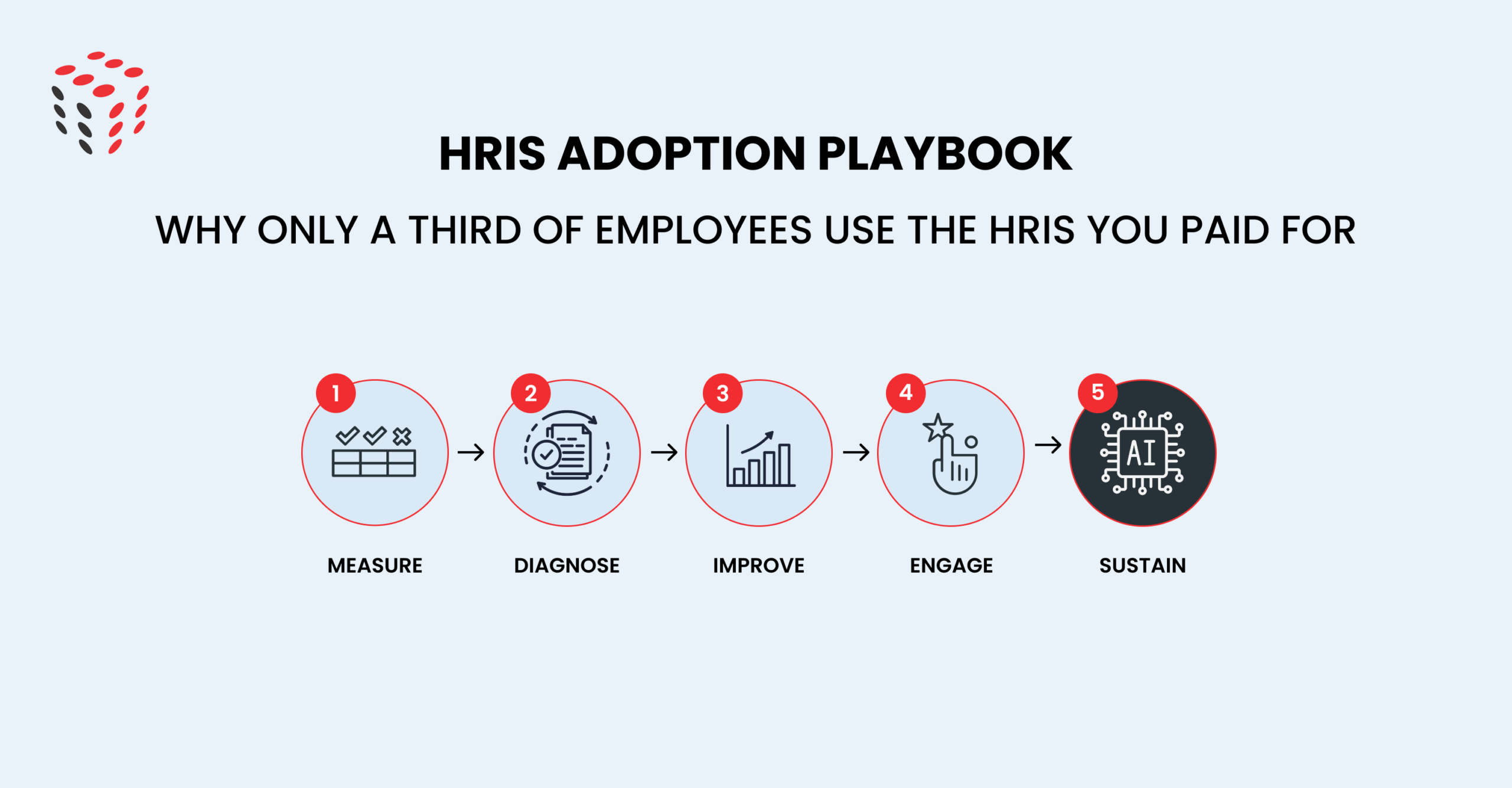
What Should a Post Go Live Adoption Playbook Include?
Measure
Establish adoption baselines and identify the biggest gaps.
Diagnose
Understand whether gaps come from awareness, ability, process design, technology, or governance.
Improve
Simplify processes, improve guidance, optimize configuration, and address user barriers.
Engage
Use targeted communication, training, manager support, and feedback loops.
Sustain
Monitor adoption continuously and introduce improvements as business needs change.
How Can Organisations Turn Adoption Into Business Value?
Leaders should connect usage with outcomes such as:
- Reduced administrative effort
- Faster HR processes
- Better workforce data quality
- Greater employee self service
- Improved manager productivity
- Increased use of automation
- Better workforce decision making
The objective is not simply to increase HRIS usage. It is to ensure employees use the right capabilities in the right way to create measurable business value.
How Can Organisations Improve HRIS Adoption?
Simplify the Experience
Review processes that require too many steps, approvals, or manual inputs. Simplifying the journey can make the intended process easier than the existing workaround.
Target the Right Users
Not every user needs the same support. Identify groups with low adoption and provide targeted guidance based on their roles and activities.
Strengthen Manager Adoption
Managers influence whether employees use HR technology consistently. Give managers clear expectations, practical guidance, and visibility into the benefits of using the system.
Improve Communication
Explain what is changing, why it matters, and how the system will make everyday work easier. Communication should continue after go live rather than ending at launch.
Use Feedback and Usage Data
Combine user feedback with actual usage data to identify where adoption remains weak. This creates a continuous feedback loop for improvement.
What Should Organisations Measure After Go Live?
- User adoption
- Process completion
- Self service usage
- Manager usage
- Help desk activity
- Manual workarounds
- Training effectiveness
- Use of automation
- Process performance
These measures help HR teams identify whether adoption is improving and where further intervention is required.
FAQ
Why do employees stop using an HRIS after go live?
Employees may return to familiar workarounds when processes feel complicated, communication is unclear, training is insufficient, or the system does not provide an obvious improvement to their daily work.
How can HR increase HRIS adoption?
Organisations can improve adoption by simplifying processes, targeting support to low adoption groups, strengthening manager engagement, improving communication, and continuously reviewing usage data.
Should HRIS adoption be measured through login rates?
Login rates provide useful information, but they do not show whether employees are using the system effectively. Organisations should also measure process completion, self service usage, manual workarounds, and business outcomes.
When should HRIS adoption activities begin?
Adoption planning should begin before go live and continue after implementation. Post go live monitoring helps organisations identify new barriers and continuously improve the employee experience.
What is the ultimate goal of HRIS adoption?
The goal is not simply to increase system usage. The goal is to ensure employees and managers use the right HRIS capabilities effectively, reducing manual effort and creating measurable business value.





Share with your network
Get updates in your inbox